
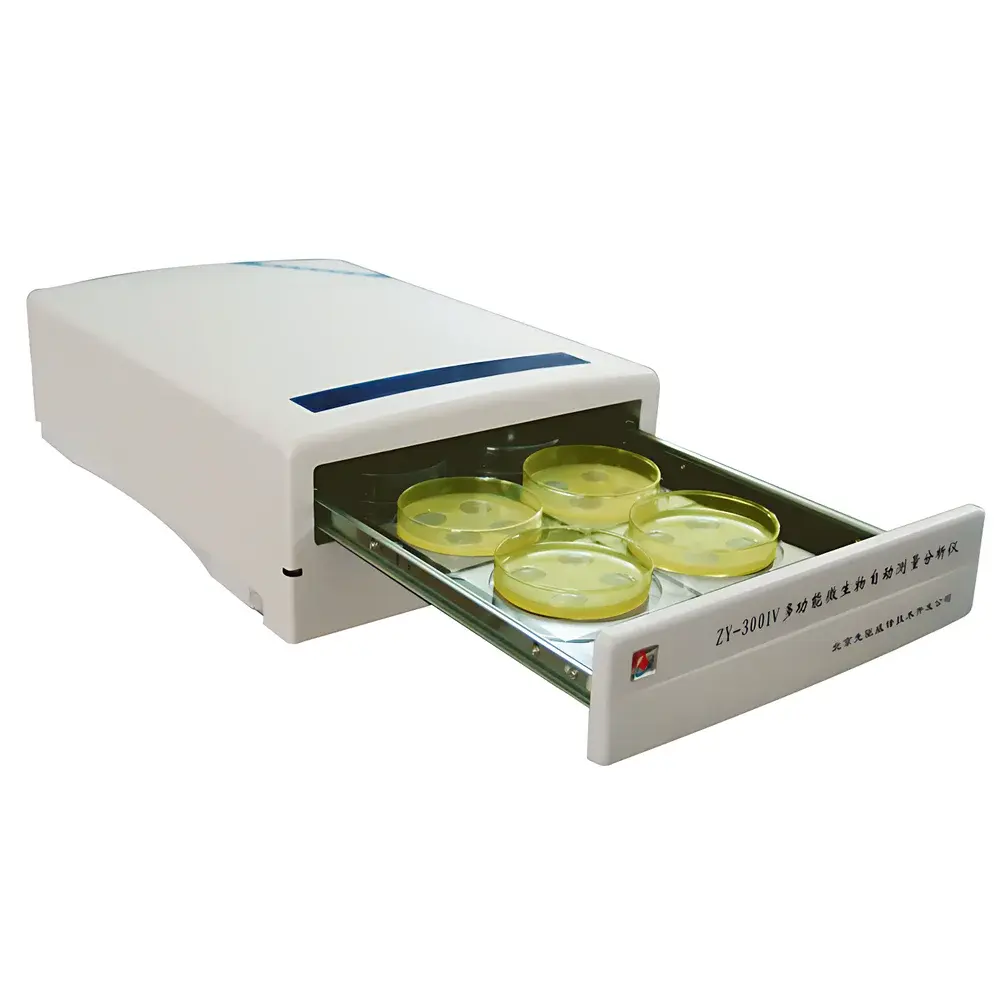
ZY-300Ⅳ Zone of Inhibition Automatic Analyzer by Forerunner
| Brand | Forerunner |
|---|---|
| Model | ZY-300Ⅳ |
| Origin | Beijing, China |
| Measurement Resolution | 0.0105 mm |
| Repeatability Error | ≤±0.01 mm |
| Inter-instrument Variation | ≤±0.2% |
| Potency Reproducibility | ≤±0.1% |
| Max Measurement Time (6 Petri Dishes or A4-sized Plate) | ≤8 s |
| Light Source | CCFL Linear Cold Cathode Fluorescent Lamp |
| Image Acquisition Interface | USB 2.0 (Hot-pluggable) |
| Calibration Option | NIM-traceable Calibration Template |
Overview
The ZY-300Ⅳ Zone of Inhibition Automatic Analyzer is an ISO/IEC 17025-aligned digital imaging system engineered for precise, objective, and high-throughput quantification of antibiotic potency via the agar diffusion assay—commonly known as the cup-plate method. It operates on the principle of high-fidelity digital image acquisition followed by algorithmic edge detection and geometric diameter calculation of inhibition zones formed around antibiotic-impregnated discs or cylinders on standardized agar plates inoculated with reference microorganisms. Designed in strict compliance with pharmacopoeial requirements—including USP , EP 2.6.6, and ChP (Chinese Pharmacopoeia) Volume IV Section 9201—the instrument eliminates subjective manual caliper measurements and inter-operator variability. Its optical architecture integrates a uniform, low-heat CCFL linear light source (cold cathode fluorescent lamp), ensuring stable illumination without filament degradation, minimal thermal distortion of agar media, and consistent spectral output across repeated acquisitions. The system delivers absolute diameter values—not relative or normalized outputs—enabling direct input into potency calculation algorithms per three-dose or two-dose parallel-line analysis models.
Key Features
- Automated zone recognition based on adaptive thresholding and morphological contour refinement, eliminating user-dependent manual outlining.
- Simultaneous analysis of up to six standard 90-mm Petri dishes or one full A4-format (210 × 297 mm) assay plate, supporting both conventional and high-density screening configurations.
- Sub-pixel resolution measurement capability with 0.0105 mm spatial resolution, validated against NIM (National Institute of Metrology, China)-certified traceable calibration templates.
- USB 2.0 high-speed interface with industrial-grade connectors, enabling robust data transfer, hot-plug compatibility, and seamless integration into regulated laboratory networks.
- Dedicated firmware optimized for low-noise image capture under controlled ambient lighting conditions; no external darkroom required.
- Non-contact, non-destructive measurement—preserves biological integrity of plates for downstream validation or reanalysis.
Sample Compatibility & Compliance
The ZY-300Ⅳ supports all pharmacopoeia-specified indicator strains used in antibiotic bioassays, including Staphylococcus aureus ATCC 6538, Bacillus subtilis ATCC 6633, Micrococcus luteus ATCC 9341, Bacillus cereus ATCC 11778, Escherichia coli ATCC 25922, Saccharomyces cerevisiae, Candida albicans, and Bacillus pumilus. Each strain exhibits reproducible growth kinetics and zone formation characteristics under standardized incubation (e.g., 16–18 h at 30–35 °C). Instrument performance meets acceptance criteria defined in ISO 20776-1 for antimicrobial susceptibility testing systems and aligns with GLP documentation requirements for assay validation—including system suitability, intermediate precision, and measurement uncertainty reporting. All calibration and verification records are exportable in CSV format for audit trail retention.
Software & Data Management
The embedded analysis software provides a locked-down, audit-ready environment compliant with FDA 21 CFR Part 11 principles. User roles (Administrator, Analyst, Reviewer) enforce separation of duties; all measurement events—including image capture timestamp, operator ID, plate ID, and raw pixel coordinates—are immutably logged. Data export supports both proprietary binary archives and open-format TIFF + CSV pairs for third-party statistical processing (e.g., SAS, R, or JMP). Built-in potency calculation modules implement parallel-line assay mathematics per ICH Q5E guidelines, generating confidence intervals, slope ratio tests, and validity flags for each run. Software updates are digitally signed and require dual-authorization to install, preserving configuration integrity across GMP-regulated environments.
Applications
- Routine quality control of antibiotic raw materials and finished dosage forms (e.g., injectables, ointments, powders) in pharmaceutical manufacturing.
- Stability-indicating potency monitoring during accelerated and long-term stability studies per ICH Q1.
- Method verification and transfer between QC laboratories during regulatory submissions (ANDA, NDA, MA).
- Educational use in university pharmacology and microbiology labs for teaching quantitative bioassay design and statistical validation.
- Supporting antimicrobial stewardship programs through rapid, standardized evaluation of novel compound candidates in early-stage discovery pipelines.
FAQ
Does the ZY-300Ⅳ comply with USP and EP requirements for antibiotic potency assays?
Yes—the instrument’s measurement accuracy, repeatability, and analytical workflow are validated against USP and EP 2.6.6 specifications for cup-plate bioassays.
Can it be integrated into a LIMS or ELN environment?
Yes—CSV and TIFF exports support automated ingestion via scheduled file watchers or REST API middleware; full LIMS integration requires optional driver package (contact Forerunner Support for protocol documentation).
Is NIM calibration traceability available outside China?
NIM-certified templates are supplied with each unit; international users may request equivalent NIST-traceable calibration artifacts through authorized regional distributors.
What maintenance is required for the CCFL light source?
The CCFL module has a rated lifetime exceeding 20,000 hours with no consumables or alignment adjustments needed during normal operation.
How is measurement uncertainty estimated for potency reports?
Uncertainty budgets incorporate contributions from pixel resolution, stage positioning repeatability, agar thickness variation, and biological replicate variance—calculated per GUM (JCGM 100:2008) and reported in final assay summaries.







