
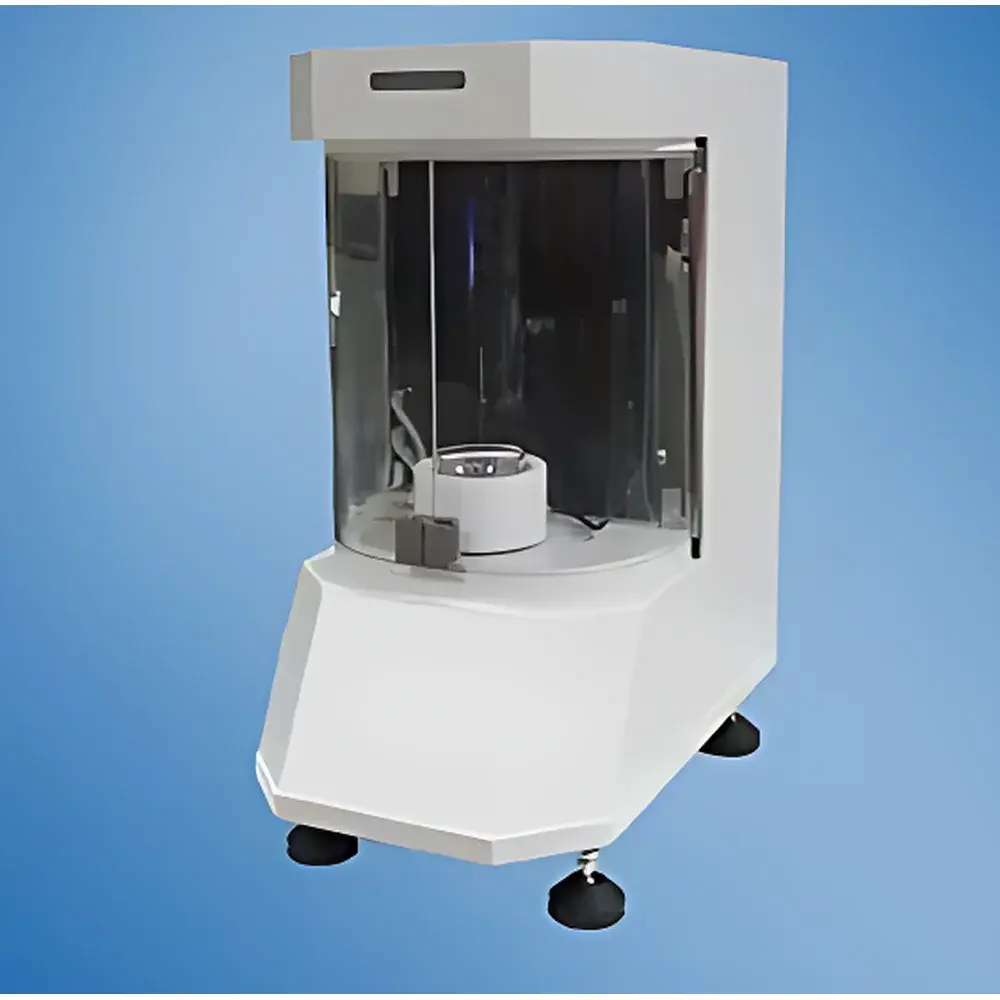
ZYKX JK99BM Fully Automated Surface Tensiometer
| Brand | ZYKX |
|---|---|
| Origin | Beijing, China |
| Model | JK99BM |
| Measurement Range | 0–500 mN/m |
| Sensitivity | 0.01 mN/m |
| Accuracy | ±0.01 mN/m |
| Resolution | 0.01 mN/m |
| Methods | Du Noüy Ring & Wilhelmy Plate |
| Sample Volume (Ring) | 40–50 mL |
| Sample Volume (Plate) | 20–30 mL |
| Sampling Time (Ring) | 150–200 s |
| Sampling Time (Plate) | 1–5 s |
| Power Supply | AC 220 V ±5%, <150 W |
| Temperature Sensing Accuracy | ±0.1 °C |
| Relative Humidity Range | 30–85% RH |
| Interface | RS-232 Serial Port |
| Compliance | GB/T 22237–2008, GB/T 5549–2010, GB/T 6541–1986 |
Overview
The ZYKX JK99BM Fully Automated Surface Tensiometer is a precision instrument engineered for the quantitative determination of surface tension (γSV) and liquid–liquid interfacial tension (γSL) using two internationally standardized physical methods: the Du Noüy ring method and the Wilhelmy plate method. Based on the principle of force balance at the solid–liquid interface—where the vertical pull force exerted by the liquid meniscus on a calibrated platinum probe is measured via a high-stability electromagnetic force compensation sensor—the JK99BM delivers traceable, reproducible results under controlled environmental conditions. Its dual-method capability enables method cross-validation, supports method transfer across laboratories, and ensures compatibility with regulatory testing workflows in coatings, petrochemicals, pharmaceuticals, and academic research. Unlike manual or semi-automated systems, the JK99BM integrates real-time force acquisition, automatic zero calibration, and temperature-synchronized data logging—eliminating operator-induced variability while maintaining full compliance with national standard methodologies.
Key Features
- High-precision Japanese-origin electromagnetic force sensor with long-term stability and repeatability better than ±0.01 mN/m
- Simultaneous support for both Du Noüy ring and Wilhelmy plate methods—each with dedicated sample volume optimization (40–50 mL for ring; 20–30 mL for plate) and distinct dynamic response profiles
- Automated platform control with programmable lift/drop sequences, enabling stepwise measurement protocols for teaching labs or kinetic studies
- Dual zeroing capability: hardware-based mechanical zero and software-initiated electronic zero—optionally configurable for periodic auto-zero intervals
- Integrated temperature sensing (±0.1 °C accuracy) and standardized thermal coupling interface for external circulation thermostats (e.g., Julabo, Huber, or Lauda units)
- Robust mechanical architecture with vibration-damped leveling base, low-noise motor drive, and anti-drift optical alignment system
- Onboard correction algorithms for buoyancy, wetting angle, and ring geometry—fully embedded in firmware to eliminate post-processing errors
Sample Compatibility & Compliance
The JK99BM accommodates a broad range of Newtonian and moderately non-Newtonian liquids—including solvents, surfactant solutions, crude oils, polymer melts, inks, paints, and emulsions—with reliable performance up to ~500 mPa·s viscosity. Its platinum ring and plate probes meet ASTM D971 and ISO 6295 specifications for geometric tolerance and surface purity. The instrument conforms to three key Chinese national standards: GB/T 22237–2008 (surfactant surface tension), GB/T 5549–2010 (interfacial tension by ring method), and GB/T 6541–1986 (petroleum products). While not pre-certified to ISO/IEC 17025 or FDA 21 CFR Part 11 out-of-the-box, its deterministic measurement protocol, audit-ready data export (CSV, TXT), and full traceability of calibration weights (supplied) support laboratory validation under GLP/GMP frameworks when paired with documented SOPs.
Software & Data Management
The Windows-based application provides real-time plotting of force vs. time curves, automatic peak detection for ring detachment, and continuous tension tracking during plate immersion/detachment. All raw sensor outputs are timestamped and stored with metadata (operator ID, ambient T/RH, method selected, probe ID). Export formats include ASCII-compatible CSV for LIMS integration and PDF reports with embedded calibration logs. The software supports multi-curve overlay, statistical summary (mean, SD, CV%), and user-defined pass/fail thresholds aligned with internal QC limits. No cloud dependency or subscription licensing is required—full local installation and offline operation ensure data sovereignty and uninterrupted use in regulated environments.
Applications
- Quality control of surfactant formulations in detergents and personal care products
- Kinetic analysis of adsorption dynamics at air–liquid and oil–water interfaces
- Stability assessment of emulsions and microemulsions in food and pharmaceutical development
- Surface energy evaluation of coating resins and ink vehicles
- Evaluation of crude oil–brine interfacial behavior for enhanced oil recovery (EOR) screening
- Teaching core concepts of capillarity, wetting, and intermolecular forces in physical chemistry labs
FAQ
Does the JK99BM require a dedicated computer to operate?
Yes—operation requires a Windows PC with an available RS-232 serial port (or USB-to-serial adapter). The instrument does not feature standalone display or onboard storage.
Can the JK99BM measure interfacial tension between two immiscible liquids?
Yes—both the platinum ring and platinum plate methods are validated for liquid–liquid interfacial tension measurements, provided density contrast and interfacial stability permit clear detachment or wetting events.
Is temperature control built into the instrument?
No—temperature regulation is achieved externally via optional circulation thermostats connected through the integrated thermal coupling port. The unit includes an embedded Pt100 sensor for accurate bath temperature monitoring.
What calibration standards are included?
A certified set of stainless-steel calibration weights (for sensor verification) and two pre-cleaned, certified platinum probes (one ring, one plate) are supplied. Additional probes are available as optional accessories.
How is data integrity ensured during long-term experiments?
The system logs all raw force values at ≥10 Hz sampling rate, timestamps each entry with system clock, and stores files with immutable creation metadata—supporting retrospective audit and 21 CFR Part 11-compliant documentation when used with validated IT infrastructure.



