
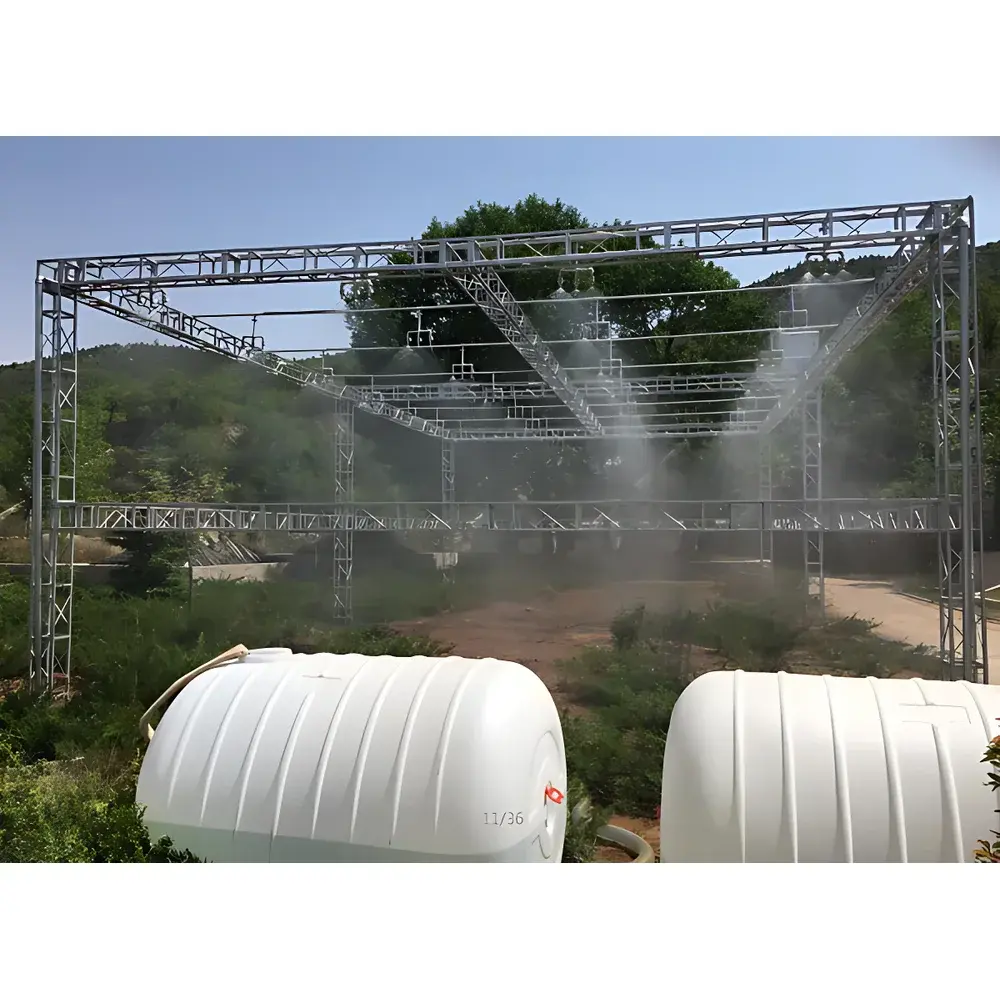
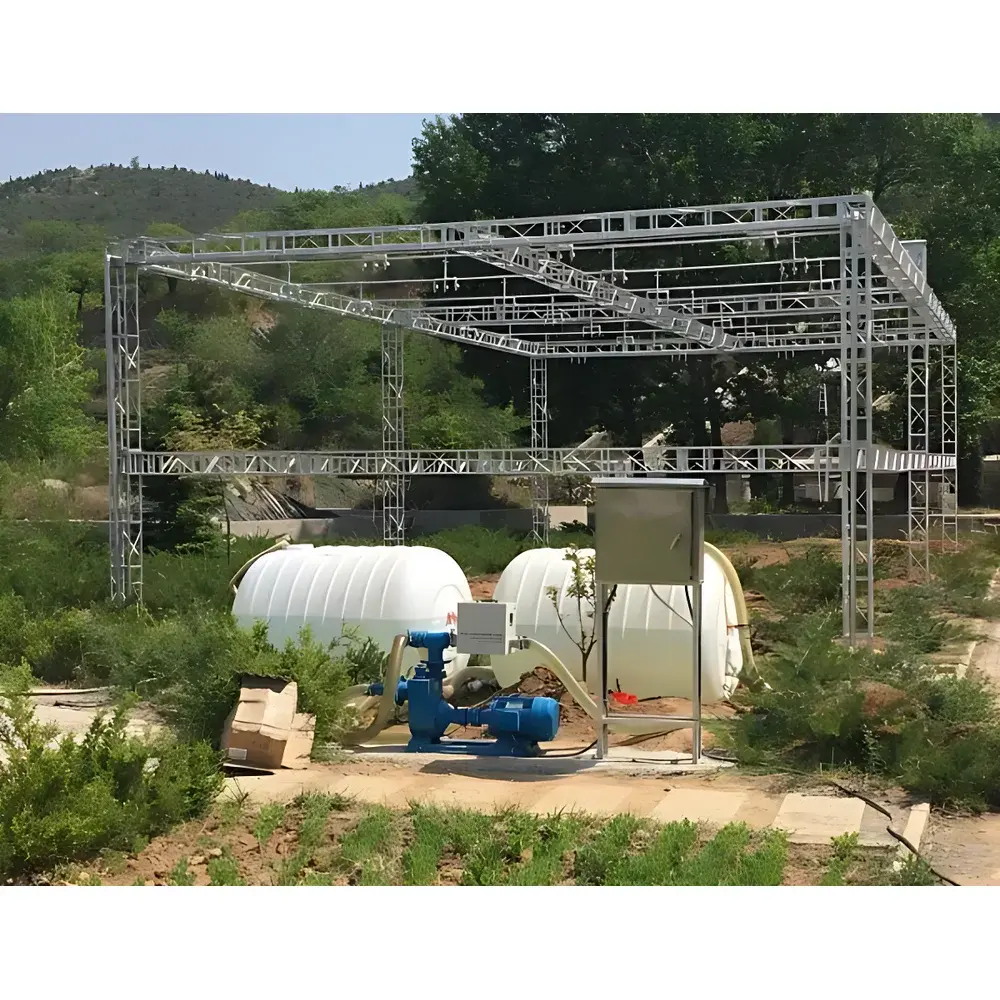
ZYKX-JY12 Artificial Rainfall Simulation System
| Brand | ZYKX |
|---|---|
| Origin | Beijing, China |
| Model | ZYKX-JY12 |
| Rainfall Intensity Range | 20–200 mm/h |
| Rainfall Area | 12 m² (3 m × 4 m, customizable) |
| Rainfall Height | 4 m (customizable) |
| Uniformity Coefficient | >0.90 |
| Droplet Diameter Range | 0.4–8 mm |
| Intensity Adjustment Resolution | 6 mm/h |
| Response Time for Intensity Change | <30 s |
| Rain Gauge Orifice Diameter | Φ200 ± 0.6 mm |
| Rain Gauge Resolution | 0.1 mm |
| Controller Power Supply | AC 220 V, 50 Hz |
| Operating Temperature | 0–60 °C |
| Operating Humidity | ≤95% RH |
| Data Logger Storage Capacity | Unlimited (user-configurable) |
| Sampling Interval | ≥3 s (adjustable) |
| Communication Interface | RS232 |
| Design Service Life | >15 years |
| Self-Priming Pump | Head = 35 m, Flow Rate = 15 m³/h |
| Water Storage Tank Volume | 1 m³ |
| Nozzle Types | Three interchangeable stainless-steel nozzles (Φ9 mm, Φ11 mm, Φ13 mm), each with 45° spray angle and distinct flow/pressure characteristics enabling composite intensity modulation |
Overview
The ZYKX-JY12 Artificial Rainfall Simulation System is a precision-engineered environmental testing platform designed for controlled, repeatable simulation of natural rainfall under laboratory or field-deployable conditions. It operates on the principle of pressurized nozzle-based droplet generation, where calibrated hydraulic pressure, flow rate, and geometric spray configuration determine rain intensity, spatial uniformity, and drop size distribution. Unlike empirical sprinkler systems, this system integrates closed-loop PLC control with real-time feedback from integrated rain gauges and pressure transducers to maintain target intensity within ±6 mm/h across its full operational range (20–200 mm/h). Its 12 m² test area—defined by a rigid 3 m × 4 m stainless-steel support frame at 4 m elevation—is optimized for soil erosion studies, infiltration experiments, surface runoff quantification, and hydrological model validation. The system meets foundational requirements for ASTM D3387 (Standard Practice for Simulated Rainfall Testing of Pavement Materials) and ISO 11274 (Soil Quality — Determination of Hydraulic Properties — Field Saturated Hydraulic Conductivity), serving as a core infrastructure tool in soil physics, watershed science, and land management research.
Key Features
- Triple-nozzle modular design: Interchangeable stainless-steel nozzles (Φ9 mm, Φ11 mm, Φ13 mm) enable discrete flow-rate tuning; combined operation achieves continuous intensity modulation without mechanical reconfiguration.
- Closed-loop PLC control architecture: Real-time pressure and flow feedback eliminates hysteresis and supply-line inertia effects, ensuring rain intensity stabilization within 30 seconds after setpoint change.
- Redundant hydraulic subsystem: Dual-pump readiness and parallel valve manifolds guarantee uninterrupted operation during maintenance or component failure—critical for long-duration infiltration or erosion trials.
- Full stainless-steel construction: All structural supports, piping, mounting hardware, and spray manifolds are fabricated from AISI 304 stainless steel, providing corrosion resistance in humid, saline, or chemically treated water environments.
- High-fidelity metrology integration: Includes a certified tipping-bucket rain gauge (Φ200 ± 0.6 mm orifice, 0.1 mm resolution) and programmable data logger supporting ≥3-second sampling intervals and timestamped event logging.
- Self-contained water management: Integrated 1 m³ storage tank and self-priming centrifugal pump (35 m head, 15 m³/h max flow) eliminate dependency on municipal supply or external reservoirs.
Sample Compatibility & Compliance
The ZYKX-JY12 accommodates diverse soil media—including undisturbed monoliths, repacked cores, vegetated plots, and engineered substrates—within its 12 m² test footprint. Its adjustable height (standard 4 m, optional up to 6 m) and scalable nozzle layout allow adaptation to both shallow lysimeter setups and large-scale plot studies. The system complies with calibration traceability standards referenced in ISO/IEC 17025 for environmental testing laboratories. While not inherently GLP-certified, its data acquisition software supports audit-trail-enabled operation when configured with user authentication, electronic signatures, and immutable log export—aligning with FDA 21 CFR Part 11 principles for regulated research environments. Raindrop size distribution (0.4–8 mm) falls within the empirically validated range for simulating convective and stratiform precipitation regimes per USGS Open-File Report 2007-1301.
Software & Data Management
The included rainfall monitoring and control software provides a Windows-based GUI for parameter configuration, real-time intensity visualization, and historical data review. It supports RS232 serial communication for synchronized acquisition from the rain gauge, pressure sensors, and pump status signals. All measurements are time-stamped with millisecond precision and stored in CSV-compatible binary logs. Software features include: automated start/stop triggers based on cumulative rainfall thresholds; configurable alarm thresholds for pressure deviation or flow interruption; batch export of intensity vs. time profiles with metadata tagging (test ID, operator, soil type); and export-ready graphs compliant with journal submission standards (e.g., AGU, Soil Science Society of America). Raw data files are structured for direct import into MATLAB, Python (pandas), or R for statistical analysis of infiltration curves or sediment yield modeling.
Applications
- Quantitative assessment of soil erodibility using simulated rainfall–runoff–sediment yield protocols (e.g., Revised Universal Soil Loss Equation – RUSLE inputs).
- Calibration and validation of physically based infiltration models (Green-Ampt, Horton, Philip) under controlled boundary conditions.
- Evaluation of surface cover effectiveness (mulch, vegetation, geotextiles) on runoff reduction and splash detachment.
- Testing of erosion control products (hydroseeding slurries, polymer binders, fiber mats) under standardized precipitation stress.
- Urban hydrology studies: runoff response of permeable pavements, green roofs, and bio-retention cells.
- Climate resilience research: simulating intensified rainfall events projected under IPCC AR6 scenarios for vulnerability mapping.
FAQ
What is the minimum and maximum rainfall intensity the system can deliver?
The ZYKX-JY12 achieves a continuous, controllable range of 20 to 200 mm/h, verified via calibrated tipping-bucket measurement across the full 12 m² area.
Can the system simulate different raindrop size distributions?
Yes—by selecting specific nozzle types and adjusting operating pressure, users can shift median drop diameter between 0.4 mm and 8 mm, replicating drizzle, moderate rain, or heavy convective conditions.
Is remote monitoring or network connectivity supported?
The base configuration uses RS232; optional RS485-to-Ethernet gateways enable TCP/IP integration into institutional SCADA or LabVIEW environments.
How is rainfall uniformity measured and validated?
Uniformity is calculated per ISO 9261 as the coefficient of uniformity (CU), defined as CU = (1 − σ/μ) × 100%, where σ is standard deviation and μ is mean intensity across 16 grid points; factory-tested CU exceeds 0.90.
Does the system require external water treatment or filtration?
A 100 µm inline filter is supplied; for recycled or turbid water sources, users must install pre-filtration meeting ISO 4406 Class 18/16/13 to prevent nozzle clogging.
Related Products







