
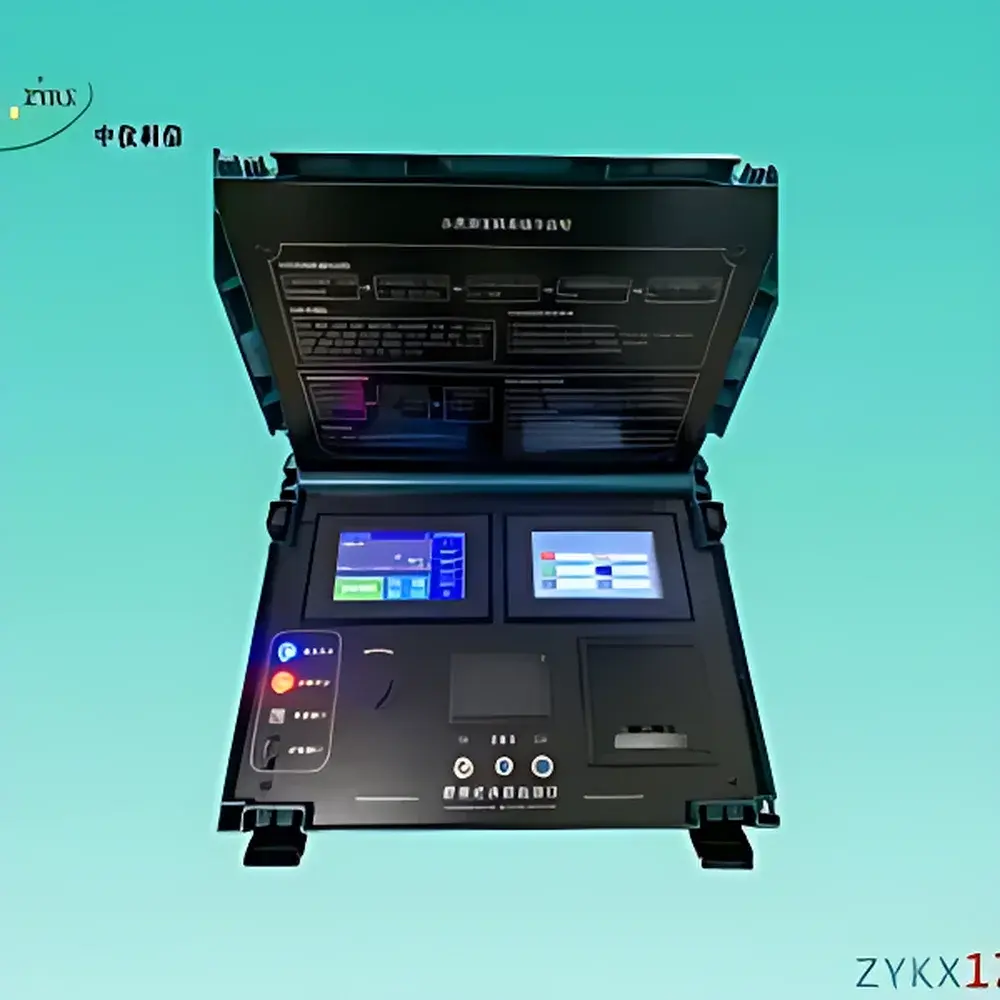
ZYKX PTB-2020 Portable Multi-Parameter Water Quality Analyzer
| Brand | ZYKX |
|---|---|
| Origin | Beijing, China |
| Manufacturer Type | Authorized Distributor |
| Country of Origin | China |
| Model | PTB-2020 |
| Pricing | Upon Request |
Overview
The ZYKX PTB-2020 Portable Multi-Parameter Water Quality Analyzer is an integrated field-deployable instrument engineered for simultaneous quantitative analysis of physical, chemical, and electrochemical water quality parameters. It combines thermal digestion, photometric colorimetry (tube-based), and direct electrode-based measurement in a single compact platform—enabling on-site or laboratory use without external instrumentation dependencies. The system operates on the principles of Beer-Lambert law for absorbance-based assays (e.g., COD, ammonia nitrogen, total phosphorus) and Nernst equation-driven potentiometric/electrochemical detection (e.g., pH, ORP, dissolved oxygen, conductivity, TDS). Its dual-mode architecture eliminates inter-method interference, while the built-in PID-controlled digestion block ensures precise, reproducible thermal treatment across standardized protocols (e.g., ISO 6060 for COD, ISO 7150-1 for ammonia nitrogen). Designed for regulatory-compliant environmental monitoring, the PTB-2020 supports method traceability, audit-ready data logging, and alignment with routine QA/QC workflows required by municipal water authorities, industrial effluent managers, and academic research teams.
Key Features
- Dual high-resolution color touchscreens with intuitive Chinese-language GUI—guiding users step-by-step through calibration, digestion, measurement, and report generation.
- Modular assay architecture: Users may configure initial purchase with selected parameter modules (e.g., COD + NH₃-N + TP) and expand functionality post-purchase via firmware-uploaded method packages—no hardware modification required.
- Integrated digestion–colorimetry tube system: Eliminates cuvette handling errors; reduces reagent consumption by up to 40% compared to traditional spectrophotometric formats; enhances measurement repeatability (RSD < 3% at mid-range concentrations).
- Self-contained power management: Rechargeable 16 V lithium battery enables ≥8 hours of continuous operation—including simultaneous digestion (up to 6 tubes) and photometric reading—without AC mains connection.
- Intelligent diagnostics engine: Real-time fault detection (e.g., sensor drift, temperature deviation, optical path obstruction) with contextual error codes and corrective action prompts.
- Robust environmental rating: Operational within 5–40 °C ambient temperature and ≤85% RH (non-condensing); EMI-hardened design ensures stable performance near industrial variable-frequency drives or radio transmitters.
- Optical subsystem: Semiconductor cold-light source with >50,000-hour service life; wavelength-specific LED arrays calibrated per APHA/Hazen (color), ISO 7027 (turbidity), and EPA-approved absorption bands.
Sample Compatibility & Compliance
The PTB-2020 accommodates raw surface water, treated wastewater, groundwater, and process water samples—with optional filtration or centrifugation preprocessing for turbid or particulate-laden matrices. All pre-programmed curves comply with internationally referenced methodologies: ASTM D1253 (residual chlorine), ISO 15705 (COD by dichromate), ISO 11732 (ammonia nitrogen by indophenol), and ISO 11908 (total phosphorus by ascorbic acid reduction). For electrochemical sensors, calibration follows ISO 17025-aligned procedures using NIST-traceable standards. Data integrity meets GLP/GMP documentation requirements: time-stamped records include operator ID, sample ID, method version, calibration history, and environmental metadata (ambient T/RH, battery voltage). Optional 21 CFR Part 11-compliant software module available for regulated pharmaceutical or drinking water applications.
Software & Data Management
Onboard storage retains up to 10,000 test records with full metadata (date/time, parameter name, measured value, unit, operator code, curve ID, digestion temperature/time profile). USB 2.0 interface enables secure export to Windows-based desktop software—supporting CSV/Excel export, statistical summary (mean, SD, CV%), trend charting, and customizable PDF report generation. Internal real-time clock maintains accuracy (<10 s/month drift); all stored data survive power interruption due to non-volatile flash memory and auto-save-on-write architecture. Firmware updates are delivered via encrypted USB key with digital signature verification to prevent unauthorized modification.
Applications
- Field-based compliance monitoring for municipal wastewater discharge permits (e.g., NPDES, EU Urban Wastewater Treatment Directive).
- Rapid screening of source water quality during emergency response (e.g., chemical spills, algal bloom events).
- Process control in water treatment plants—tracking coagulant dosing efficiency via turbidity/pH/ORP correlation.
- Academic and NGO-led watershed assessment campaigns requiring multi-analyte profiling under resource-constrained conditions.
- Industrial pretreatment verification—measuring heavy metals (Cr⁶⁺, Cd²⁺, Ni²⁺), nutrients (TN/TP), and oxidants (ClO₂, O₃) prior to sewer discharge.
FAQ
Can the PTB-2020 perform certified reference method testing?
Yes—pre-installed curves align with ISO, ASTM, and EPA standard methods; however, formal method validation must be conducted per local regulatory requirements using site-specific matrix spikes and recovery studies.
Is remote data transmission supported?
No built-in Wi-Fi or cellular modem; data transfer requires physical USB connection to a host PC running the dedicated ZYKX DataLink software.
How often must optical components be recalibrated?
Factory calibration remains valid for 12 months under normal use; annual verification against certified neutral density filters and spectral standards is recommended.
Are consumables proprietary?
Digestion–colorimetry tubes are compatible with third-party ISO-compliant reagent kits; electrode sensors follow standard BNC or DIN connectors for cross-brand interchangeability.
Does the instrument support custom curve development?
Yes—users may import up to 100 user-defined calibration curves via USB, including polynomial, logarithmic, or multi-point linear regressions with R² validation feedback.







