
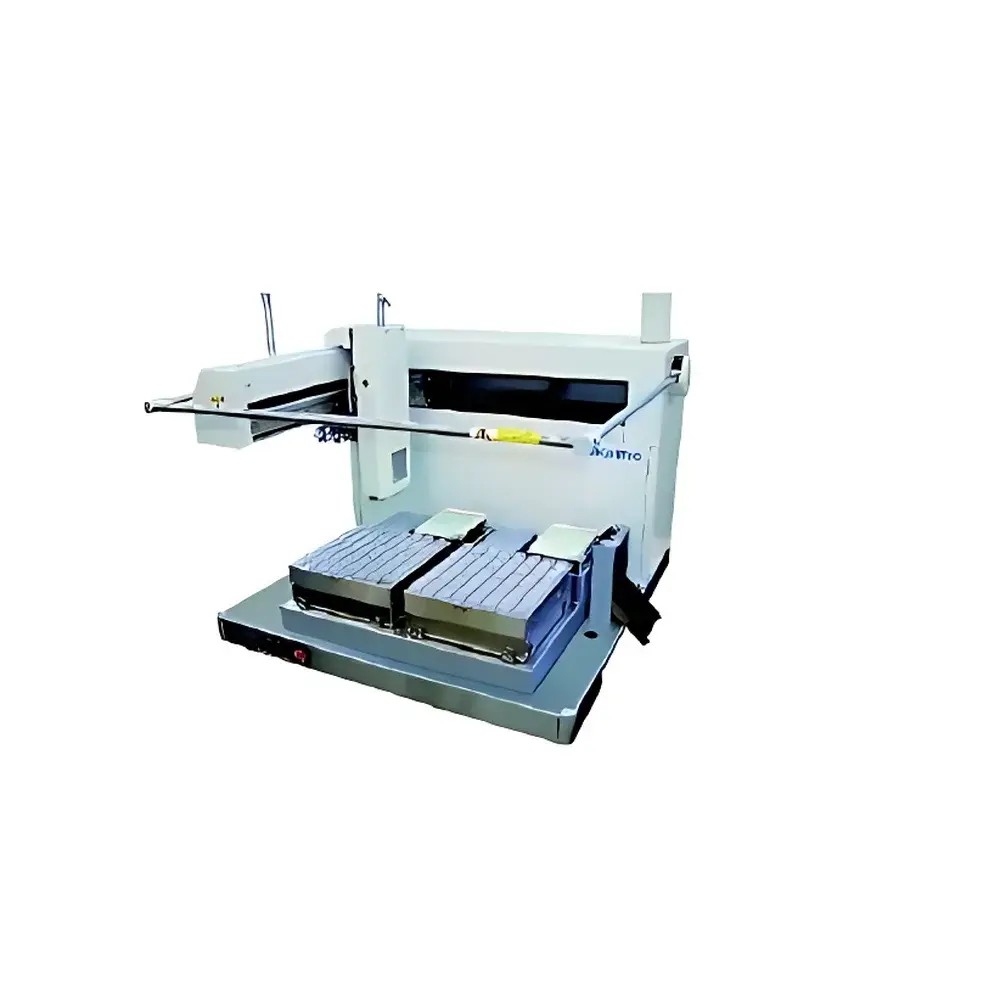
Nichiryo NSS-1000II Basic Customizable Robotic Liquid Handling System
| Brand | Nichiryo |
|---|---|
| Origin | Japan |
| Model | NSS-1000II Basic |
| Type | Benchtop Robotic Liquid Handler |
| Configuration | Standalone or Integrated Platform |
| Programming Interface | C-language or Visual Basic SDK |
| Compliance | Designed for GLP/GMP-aligned lab environments |
| Application Scope | Life Sciences, Pharmaceutical R&D, Clinical Diagnostics, Chemical Laboratories |
Overview
The Nichiryo NSS-1000II Basic is a modular, benchtop robotic liquid handling system engineered for precision, repeatability, and adaptability in regulated and research-intensive laboratory environments. Built on a kinematically stable Cartesian coordinate architecture, the system employs high-resolution stepper motor-driven X-Y-Z motion control to position pipetting tools with sub-millimeter accuracy. Its core operation relies on air displacement pipetting principles—compatible with standard positive-displacement and fixed-volume tips—enabling volumetric delivery across a typical range of 1 µL to 1,000 µL per aspiration/dispense cycle, with coefficient of variation (CV) values ≤3% at volumes ≥10 µL under calibrated conditions. Unlike fixed-format liquid handlers, the NSS-1000II Basic is not preconfigured; instead, its physical footprint, deck layout, and tool carriage configuration are specified during order placement to align with existing lab infrastructure, incubator integration, or multi-instrument automation workflows.
Key Features
- Modular mechanical design permitting user-defined deck dimensions (standard base: 450 mm × 400 mm, expandable up to 600 mm × 500 mm)
- Dual independent Z-axis carriages supporting simultaneous use of up to two pipetting tools (e.g., single-channel + 8-channel, or two multi-tip heads)
- Open software architecture with native C-language and Visual Basic SDKs—enabling full low-level command access to motion control, tip detection, liquid level sensing, and error logging
- Integrated tip ejection and waste management module with programmable collision avoidance and force-limited tip pickup
- Real-time positional feedback via optical encoders on all three axes, ensuring traceable movement calibration per ISO 9001–aligned internal verification protocols
- No proprietary operating system dependency: compatible with Windows 10/11 (64-bit) and supports deployment within virtualized lab network environments
Sample Compatibility & Compliance
The NSS-1000II Basic accommodates standard ANSI/SLAS-compliant microplates (96-, 384-, and 1536-well), tube racks (including 1.5 mL, 2.0 mL, and 15 mL conical formats), and custom labware fixtures secured via magnetic or vacuum-based deck clamping. All fluidic components contacting reagents—including tubing, seals, and pipette tips—are chemically inert (FDA-listed silicone, PTFE, and polypropylene) and autoclavable where applicable. The system meets CE marking requirements for laboratory equipment (2014/30/EU EMC Directive and 2014/35/EU LVD Directive). While not certified as a medical device, its architecture supports implementation within FDA 21 CFR Part 11–compliant workflows when paired with validated third-party electronic lab notebook (ELN) or LIMS platforms that enforce audit trails, electronic signatures, and role-based access control.
Software & Data Management
Control is executed via Nichiryo’s open-architecture Command Suite—a lightweight runtime environment that loads user-compiled C or VB scripts directly into the onboard motion controller. No cloud dependency or vendor-hosted license server is required; all protocol logic resides locally. Raw motion logs (timestamped axis positions, pressure transducer readings, tip status flags) are exported in CSV format with nanosecond-precision timestamps. Integration with enterprise systems is achieved through TCP/IP socket communication or OPC UA interfaces, allowing bidirectional data exchange with Thermo Fisher SampleManager, LabVantage, or custom Python-based orchestration layers. Audit trail functionality—including operator ID, script version hash, start/end timestamps, and exception records—is maintained in encrypted local SQLite databases compliant with ALCOA+ data integrity principles.
Applications
- High-throughput assay setup for ELISA, qPCR master mix preparation, and cell-based screening (e.g., IC50 dose-response matrices)
- Automated serial dilution series generation with dynamic volume adjustment based on real-time absorbance feedback from integrated spectrophotometers
- Reagent redistribution across biobank sample tubes under temperature-controlled deck modules (optional -20°C to +40°C environmental enclosure)
- Support for Good Manufacturing Practice (GMP) environment qualification: IQ/OQ documentation templates available upon request for installation and operational verification
- Custom workflow development for CRISPR library normalization, NGS library prep, and MALDI-TOF target plate spotting
FAQ
Is the NSS-1000II Basic compatible with third-party liquid handling accessories such as barcode readers or centrifuges?
Yes—its I/O expansion port supports TTL-level digital signals and 0–10 V analog inputs/outputs, enabling hardware synchronization with commercial barcode scanners, lid lifters, and centrifuge interlock circuits.
Can the system be validated for use in regulated pharmaceutical quality control labs?
The platform provides full traceability of motion parameters and execution logs; however, final validation must be performed by the end user per ICH Q2(R2) and USP guidelines using site-specific test protocols.
Does Nichiryo provide factory calibration certificates with each unit?
Each system ships with a Certificate of Conformance detailing axis linearity, repeatability, and tip alignment measurements conducted per ISO 230-2:2014 methodology, including uncertainty budgets at 95% confidence.
What is the expected mean time between failures (MTBF) for the motion subsystem?
Based on accelerated life testing of 50,000 operational hours, the X-Y-Z drive assembly demonstrates an MTBF exceeding 25,000 hours under continuous 8-hour/day laboratory usage profiles.
Related Products



