
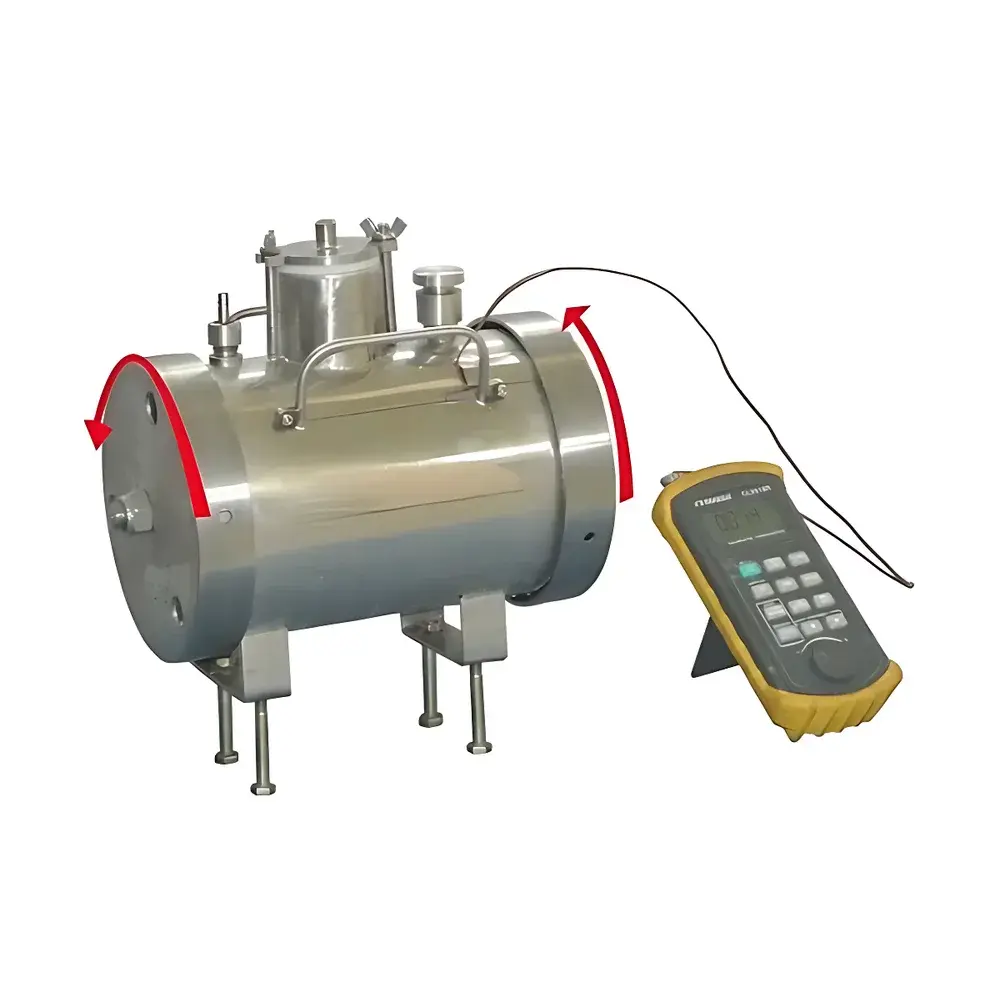
PTFE Cryogenic Ball Mill Jar with Liquid Nitrogen Cooling Jacket – LN-600 by Hefei Kejing
| Brand | Hefei Kejing |
|---|---|
| Origin | Anhui, China |
| Model | LN-600 |
| Material | PTFE inner liner + stainless steel outer jacket |
| Effective Volume | 600 mL |
| Inner Dimensions | Ø79 mm (ID) × 127 mm (L) |
| Outer Diameter | 92 mm |
| Liquid Nitrogen Jacket Volume | 1.5 L |
| Vacuum Insulation Layer | Yes |
| Safety Burst Disc Activation Pressure | >3.7 atm |
| Compatible Roller Distance | 150–185 mm |
| Operating Temperature Range | <−130°C (standard), down to −150°C (with optional cryogenic torch) |
| Max. Sample Throughput per Batch | Not specified |
| Final Particle Size | 0.01–0.5 mm |
| Sample Type | Cryo-sensitive, ductile, or highly reactive materials |
| Weight | 10 kg |
| Overall Dimensions | 270 × 185 × 320 mm (L×W×H) |
| Ambient Humidity Limit | <48% RH |
| Thermal Monitoring | T-type thermocouple port (instrument not included) |
| Optional Accessories | Vacuum pump, digital temperature indicator, compatible roller mill |
Overview
The LN-600 is a specialized cryogenic ball mill jar engineered for high-integrity mechanical alloying, homogenization, and particle size reduction of temperature-sensitive, ductile, or air-reactive materials. Unlike conventional grinding vessels, it integrates a dual-layer thermal management system: an inner PTFE (polytetrafluoroethylene) grinding chamber surrounded by a stainless steel liquid nitrogen (LN₂) cooling jacket and an outer vacuum insulation layer. This architecture enables sustained operation at temperatures below −130°C—achievable through controlled LN₂ circulation—and extends to −150°C when used with an optional cryogenic torch to prevent axle freezing during rotation. The design adheres to fundamental principles of cryomilling: suppressing atomic diffusion, inhibiting cold welding, and preserving metastable phases by minimizing thermal energy input during impact-based comminution. Its compatibility with standard horizontal roller mills (with inter-roller spacing of 150–185 mm) ensures seamless integration into existing laboratory workflows without requiring proprietary drive systems.
Key Features
- Chemically inert 600 mL PTFE inner chamber (ID 79 mm × L 127 mm) resistant to strong acids, bases, and solvents—ideal for contamination-sensitive synthesis.
- Integrated stainless steel LN₂ jacket (1.5 L capacity) positioned between the PTFE vessel and vacuum layer, enabling rapid and uniform thermal equilibration.
- High-efficiency vacuum insulation layer minimizes convective and conductive heat ingress from ambient environments, extending LN₂ hold time and stabilizing sub-130°C operating conditions.
- Pressure-relief safety burst disc calibrated to rupture at >3.7 atm—certified fail-safe mechanism preventing over-pressurization of the cryogenic jacket.
- T-type thermocouple port integrated into the vessel wall for real-time temperature monitoring; compatible with standard industrial-grade temperature indicators (sold separately).
- Optimized mechanical interface: designed for use with roller mills featuring 185 mm diameter rollers and adjustable axle spacing (150–185 mm), ensuring stable rotational coupling and minimal vibration-induced fatigue.
- Compact footprint (270 × 185 × 320 mm) and lightweight construction (10 kg) facilitate handling in gloveboxes or low-humidity controlled rooms (RH <48% required to prevent condensation-induced axle freezing).
Sample Compatibility & Compliance
The LN-600 is validated for processing materials that undergo phase decomposition, oxidation, or plastic deformation at ambient temperatures—including Mg-based alloys, polymer blends, pharmaceutical co-crystals, and pyrophoric metal powders (e.g., Al, Ti, Fe). Its PTFE chamber complies with USP Class VI biocompatibility requirements and meets ISO 10993-5 cytotoxicity screening thresholds. While not certified to ASTM E2913 (Standard Guide for Cryogenic Grinding), its thermal performance aligns with best practices defined in ASTM F2102 (Cryogenic Processing of Metals) and supports GLP-compliant documentation when paired with traceable temperature logging systems. Operation requires adherence to OSHA 1910.101 (compressed gases) and CGA G-1.1 (liquid nitrogen handling) safety protocols. No CE or UL marking is applied, as the jar functions as a component—not a standalone instrument—under IEC 61000-6-2/6-4 EMC directives.
Software & Data Management
As a passive mechanical component, the LN-600 does not incorporate embedded electronics, firmware, or proprietary software. Temperature data acquisition relies on external instrumentation: users connect the integrated T-type thermocouple to third-party data loggers (e.g., Omega OM-DAQPRO-5300, Keysight 34972A) capable of 0.1°C resolution and time-stamped recording. When deployed within regulated environments (e.g., FDA-regulated API development labs), the system supports 21 CFR Part 11 compliance via audit-trail-enabled logging platforms that enforce electronic signature, user access control, and raw data integrity. Vacuum level monitoring (if using optional vacuum pump) follows ISO 21873:2020 guidelines for vacuum-assisted thermal insulation verification.
Applications
- Cryo-mechanical alloying of nanocrystalline Ni-Fe-Cr composites where grain growth suppression below −130°C yields enhanced hardness (>850 HV) and thermal stability up to 600°C.
- Preparation of oxygen-sensitive battery cathode precursors (e.g., Li-rich NMC) without surface carbonate formation observed in ambient milling.
- Size reduction of elastomeric polymers (e.g., silicone rubber, TPU) for SEM-compatible particulate analysis—eliminating melt-agglomeration artifacts.
- Homogenization of cryopreserved biological matrices (e.g., frozen tissue powders) prior to proteomic extraction, maintaining native enzyme conformation.
- Synthesis of metastable intermetallic phases (e.g., Al₃Sc) via reactive milling under inert atmosphere, enabled by the sealed PTFE chamber and low-temperature kinetic trapping.
FAQ
Is the LN-600 compatible with planetary ball mills?
No. It is mechanically optimized for horizontal roller mills only, requiring precise axle spacing (150–185 mm) and 185 mm roller diameter. Planetary motion induces unbalanced torque and thermal stress incompatible with the LN₂ jacket’s pressure containment design.
What vacuum level is recommended for the insulation layer?
A residual pressure ≤5 × 10⁻² mbar is sufficient to suppress convective heat transfer; higher vacuums (>10⁻³ mbar) yield diminishing returns and increase pump maintenance frequency.
Can zirconia grinding media be used inside the PTFE chamber?
Yes. Standard YSZ (yttria-stabilized zirconia) balls (1–10 mm diameter) are chemically compatible with PTFE and withstand cryogenic impact without fracturing. Avoid tungsten carbide or steel media due to potential PTFE abrasion and metallic contamination.
Does the LN-600 require pre-cooling before operation?
Yes. A minimum 30-minute pre-chill with LN₂—prior to sample loading—is mandatory to stabilize thermal gradients and prevent localized boiling or pressure spikes during rotation.
Is temperature calibration traceable to NIST standards?
The T-type thermocouple port supports NIST-traceable calibration when connected to a certified reference instrument; the jar itself carries no intrinsic calibration certificate.



