
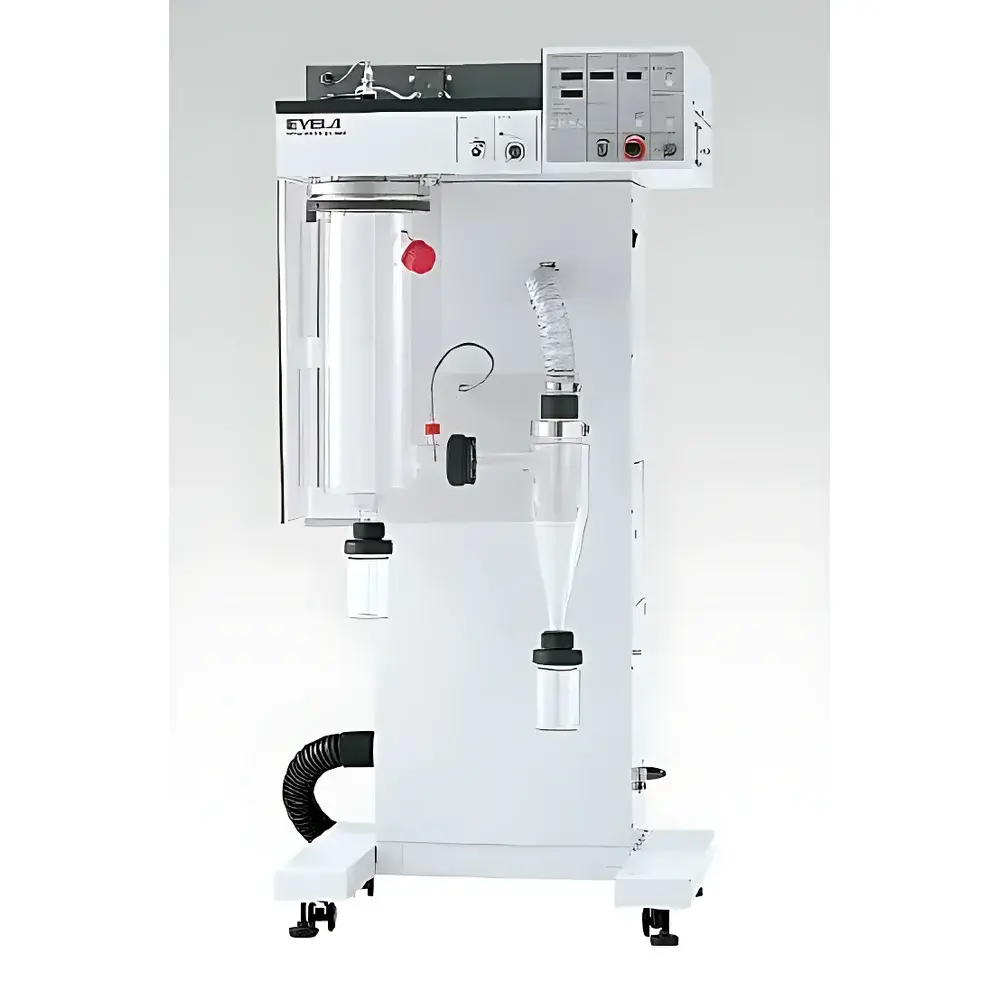
EYELA SD-1000 Benchtop Spray Dryer
| Brand | EYELA (Tokyo Rikakikai Co., Ltd.) |
|---|---|
| Origin | Japan |
| Model | SD-1000 |
| Inlet Temperature Range | 40–200 °C |
| Temperature Control Accuracy | ±1 °C |
| Max. Evaporation Rate | 1500 mL/h |
| Drying Air Flow | 0.2–0.75 m³/min |
| Atomizing Air Pressure | 20–245 kPa |
| Feed Pump Flow Rate | 150–1700 mL/h |
| Stirrer Speed | 100–1000 rpm |
| Sample Vessel Capacity | 50 mL–2 L |
| Heater Power | 3 kW |
| Nozzle Type | Twin-fluid nozzle (standard orifice ID: 0.4 mm) |
| Construction | Borosilicate glass evaporation chamber & cyclonic separator |
| Powder Collection Vessel | 600 mL borosilicate glass |
| Safety Features | Real-time diagnostics for inlet/outlet temperature deviation, airflow anomaly, heater fault, and feed pressure failure |
| Auto-cleaning Interval | Programmable 1–20 min cycles |
| Analog Output | 0–10 mV (inlet temp, outlet temp, air flow) |
| Dimensions (W×D×H) | 700 × 620 × 1500 mm |
| Weight | ~110 kg |
Overview
The EYELA SD-1000 is a benchtop twin-fluid spray dryer engineered for reproducible, small-scale powder production in research laboratories and pilot development settings. It operates on the principle of rapid solvent evaporation via atomization—where liquid feed is dispersed into fine droplets using compressed gas (typically nitrogen or filtered air), then exposed to a controlled stream of heated drying air. This process enables direct transition from solution or suspension to free-flowing micro-powder within seconds, minimizing thermal degradation and eliminating downstream unit operations such as filtration, concentration, or mechanical milling. Designed for precision and operational transparency, the SD-1000 integrates real-time digital monitoring of critical process parameters—including inlet/outlet temperature, drying air flow, atomizing pressure, and feed rate—ensuring full traceability and alignment with GLP-compliant workflows.
Key Features
- Twin-fluid nozzle system with standard 0.4 mm orifice diameter, enabling consistent droplet size distribution and high powder yield across diverse feed viscosities (up to ~500 mPa·s).
- Digital PID-controlled inlet temperature regulation (40–200 °C, ±1 °C accuracy) with independent outlet temperature monitoring for thermal profile validation.
- Adjustable drying air flow (0.2–0.75 m³/min) via calibrated rotary valve and integrated mass flow sensing, supporting optimization for heat-sensitive biologics or thermolabile APIs.
- Peristaltic feed pump with linear flow range (150–1700 mL/h) and DC brushless stirrer (100–1000 rpm, 6 W output) for homogeneous suspension feeding and anti-settling agitation.
- Borosilicate glass evaporation chamber and cyclonic separator—chemically inert, optically transparent, and compatible with routine cleaning validation protocols per ISO 14644-1 Class 5 cleanroom maintenance standards.
- Programmable auto-cleaning function with adjustable interval (1–20 min) targeting nozzle and atomizer passages; manual needle-clearing port included for crystalline residue removal.
- Comprehensive safety architecture: self-diagnostic monitoring of heater continuity, airflow interruption, feed line occlusion, and temperature excursion—triggering automatic shutdown and status logging.
Sample Compatibility & Compliance
The SD-1000 accommodates aqueous and organic solvent-based solutions, colloidal suspensions, polymer emulsions, and nano-dispersions. Its inert glass-wetted path supports processing of pharmaceutical actives (including peptides and mRNA-LNPs), food-grade ingredients (e.g., whey protein, maltodextrin), ceramic precursors, and catalyst slurries. The system complies with IEC 61010-1 for laboratory electrical safety and meets structural requirements for CE marking. While not certified for GMP manufacturing, its analog output (0–10 mV) and parameter logging capability facilitate integration into validated data acquisition systems aligned with FDA 21 CFR Part 11 expectations when paired with compliant software and audit-trail-enabled controllers.
Software & Data Management
The SD-1000 features native analog signal outputs for inlet temperature, outlet temperature, and drying air flow—enabling connection to external DAQ systems (e.g., LabVIEW, MATLAB, or PLC-based SCADA) for time-synchronized process recording. All setpoints and real-time values are displayed digitally on the front panel with tactile rotary encoders for intuitive adjustment. Though no embedded PC or proprietary software is included, the device’s deterministic control logic and stable thermal response support method transfer to automated platforms under ASTM E2500-23 guidance for equipment qualification. Optional third-party data loggers may be deployed to generate IQ/OQ-relevant documentation packages.
Applications
- Rapid formulation screening of amorphous solid dispersions for enhanced bioavailability assessment.
- Production of inhalable dry powders with controlled particle size distribution (typically 1–10 µm) for pulmonary delivery studies.
- Stabilization of labile biomolecules (e.g., enzymes, antibodies) via trehalose or leucine co-spray drying.
- Synthesis of nanostructured metal oxide powders (e.g., TiO₂, SiO₂) from sol-gel precursors.
- Development of functional food ingredients—encapsulated probiotics, omega-3 oils, or anthocyanin extracts—with minimized oxidative degradation.
- Academic teaching labs for hands-on instruction in mass/heat transfer, aerosol science, and continuous pharmaceutical manufacturing principles.
FAQ
What types of solvents are compatible with the SD-1000?
The system is suitable for water, ethanol, methanol, acetone, and other low-boiling-point solvents commonly used in lab-scale spray drying. Flammable solvent operation requires external inert gas (N₂) purging and explosion-proof exhaust ducting per NFPA 30 guidelines.
Can the SD-1000 be used for sterile powder production?
No—the instrument lacks ISO Class 5 cleanroom certification, HEPA-filtered air supply, or steam-in-place (SIP) capability. It is intended for non-sterile R&D use only.
Is the glassware autoclavable?
Yes, all borosilicate glass components (evaporation chamber, cyclone, collection vessel) are autoclavable at 121 °C for 20 minutes, supporting cleaning verification per USP <1058>.
What maintenance intervals are recommended?
Daily visual inspection of nozzle and glass surfaces; weekly cleaning of air filters and exhaust ducting; quarterly calibration check of temperature sensors using NIST-traceable reference probes.
Does the SD-1000 support continuous feed mode?
Yes—feed rate is continuously adjustable across its full 150–1700 mL/h range, enabling steady-state operation for extended batch runs up to 8 hours with appropriate cooling and condensate management.
Related Products



