
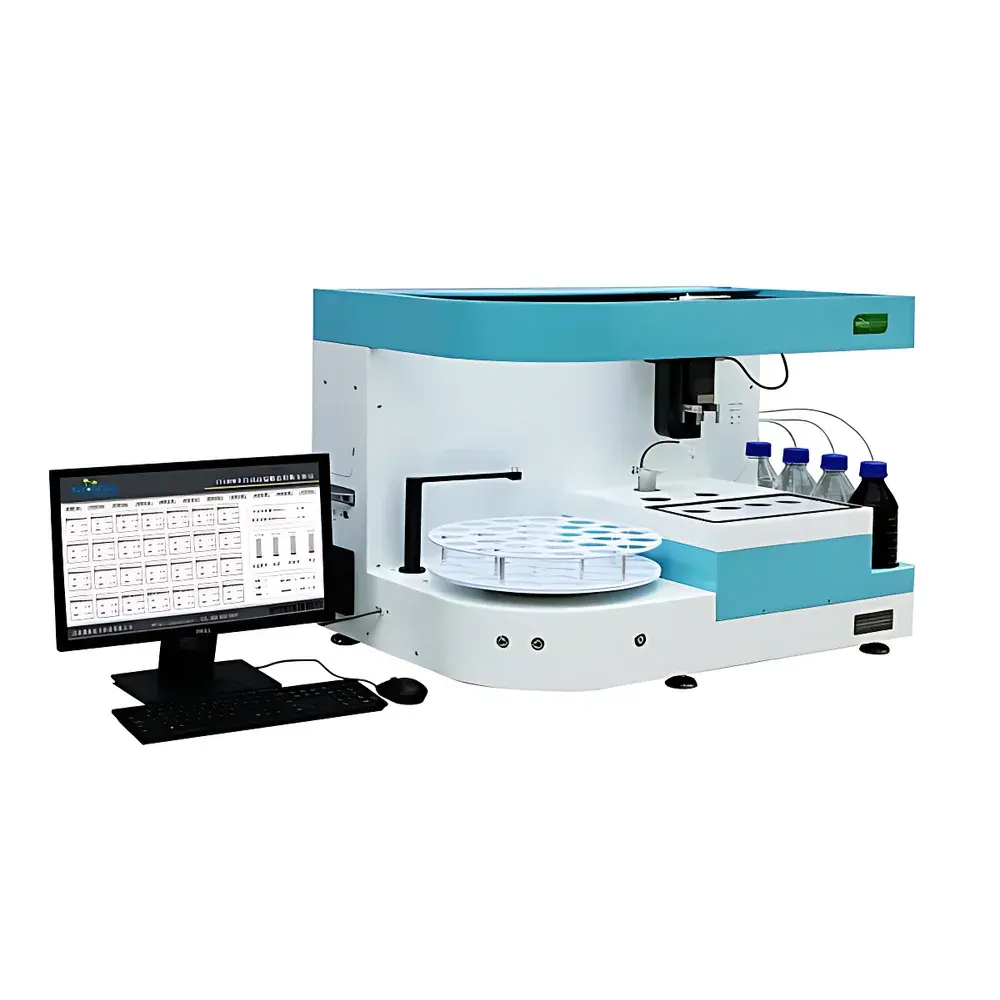
SENTE ST1900 Advanced Permanganate Index Analyzer (CODMn Analyzer)
| Brand | SENTE |
|---|---|
| Origin | Shandong, China |
| Manufacturer Type | Direct Manufacturer |
| Model | ST1900 |
| Measurement Principle | Potassium Permanganate Oxidation with ORP Endpoint Detection |
| Instrument Type | Benchtop Laboratory Analyzer |
| Range | 0.05–5.0 mg/L as O₂ |
| Repeatability | ≤4% RSD |
| Accuracy | ±5% of reading |
| LOD | 0.05 mg/L |
| Resolution | 0.02 mg/L |
| Sample Throughput | 7.5 min per test |
| Sample Capacity | 29 positions |
| Heating Zones | 6 independent water-bath stations |
| Reagent Stations | 5 (H₂SO₄, Na₂C₂O₄, KMnO₄, NaOH, DI water) |
| Titration Precision | ≤0.03 mL |
| Power Supply | 220 V / 50 Hz |
| Main Unit Power | 3300 W |
| Auto-sampler Power | 800 W |
| Dimensions (W×D×H) | 1000 × 710 × 700 mm |
Overview
The SENTE ST1900 Advanced Permanganate Index Analyzer is a fully automated benchtop instrument engineered for precise, standardized determination of the permanganate index (CODMn) in natural waters, drinking water sources, and surface waters. It implements the classical potassium permanganate oxidation method—per ASTM D1252 (Method B), ISO 8467:1993, and GB/T 11892–1989—with rigorous adherence to thermal, stoichiometric, and endpoint-detection requirements. Unlike manual titrimetric procedures, the ST1900 integrates controlled water-bath heating (60–80 °C, with automatic water-level maintenance), reagent metering, redox titration, and optical endpoint recognition into a single, unattended workflow. Its core measurement principle relies on the stoichiometric oxidation of organic and inorganic reductants by KMnO₄ under acidic conditions, followed by back-titration of residual KMnO₄ with standardized sodium oxalate; the endpoint is detected via high-sensitivity colorimetric sensing calibrated to the characteristic purple-to-colorless transition, eliminating subjective visual interpretation.
Key Features
- 29-position intelligent auto-sampler with integrated tube-cleaning protocol to prevent carryover between samples
- Three-axis robotic sample handler enabling precise, repeatable transfer from sampling zone → digestion zone → titration zone
- Dual-mode reagent dispensing: programmable addition of H₂SO₄, KMnO₄, Na₂C₂O₄, NaOH, and DI water across five independent fluidic channels
- Automated dilution capability: user-selectable dilution factors applied dynamically to samples exceeding the upper detection limit (5.0 mg/L)
- High-precision syringe pumps (±0.3% volumetric accuracy) for reagent delivery and titrant dosing, minimizing volumetric uncertainty
- Optical endpoint detection system with spectral sensitivity optimized for MnO₄⁻ decolorization kinetics—superior to human visual acuity in low-light or turbid matrices
- PLC-based control architecture ensuring deterministic timing, fault logging, and operational robustness across extended unattended runs
- Boiling-water bath module compliant with GB/T 11892’s thermal uniformity requirement, including real-time water-level monitoring and auto-refill
- Integrated safety interlocks: emergency stop button, overtemperature cutoff, and reagent reservoir level sensors with audible/visual alerts
Sample Compatibility & Compliance
The ST1900 is validated for use with raw and treated potable water, groundwater, river and lake surface water, and low-to-moderately polluted effluents. It accommodates standard 50–100 mL sample volumes in borosilicate glass or polypropylene vials. All operational parameters—including digestion time, temperature ramp, titrant concentration, and endpoint threshold—are configurable to align with regional regulatory protocols. The analyzer supports full traceability per GLP and GMP frameworks: audit trails record operator ID, timestamp, method version, calibration history, and raw sensor data for every analysis. Data export complies with ISO/IEC 17025 documentation requirements and facilitates integration into LIMS environments via CSV, XML, or direct ODBC connection.
Software & Data Management
The embedded control software provides a validated, password-protected interface with role-based access (Operator, Supervisor, Administrator). Method templates are preloaded for GB/T 11892, ISO 8467, and US EPA-referenced adaptations. Each analysis generates a digital report containing sample ID, measured CODMn, %RSD, reagent lot numbers, instrument status logs, and optical absorbance curves. Results are automatically archived with SHA-256 hash integrity verification. Optional 21 CFR Part 11 compliance package includes electronic signatures, biometric login support, and immutable audit trail export. Raw data files retain native timestamp resolution (100 ms) and are stored in vendor-neutral formats compatible with third-party statistical platforms (e.g., JMP, Minitab).
Applications
- Regulatory compliance testing for municipal drinking water utilities under national hygiene standards
- Source water quality assessment in watershed management programs
- Performance evaluation of oxidation-based treatment units (e.g., ozone, UV/H₂O₂)
- Long-term trend analysis of organic loading in lakes and reservoirs
- Validation of membrane filtration efficiency via pre-/post-filtration CODMn differentials
- Research-grade kinetic studies of permanganate-reactive organic fractions (PROF) in humic-rich waters
FAQ
What standards does the ST1900 comply with?
It conforms to GB/T 11892–1989, ISO 8467:1993, and ASTM D1252 (Method B); method parameters are fully adjustable to meet local regulatory variants.
Can the instrument handle turbid or colored samples?
Yes—the optical endpoint algorithm incorporates baseline correction for matrix absorbance drift, and the 0.05 mg/L LOD ensures reliable quantification even in highly chromatic waters.
Is manual intervention required during analysis?
Only initial sample placement into the 29-position carousel is needed; all liquid handling, heating, titration, calculation, and reporting are fully automated.
How is reagent consumption monitored?
Each reagent reservoir features ultrasonic level sensors that trigger low-volume alerts and suspend analysis if thresholds fall below safe operational limits.
Does the system support remote diagnostics?
Yes—via optional Ethernet/Wi-Fi module, technicians can perform firmware updates, view real-time sensor diagnostics, and retrieve error logs without physical access.
Related Products







