
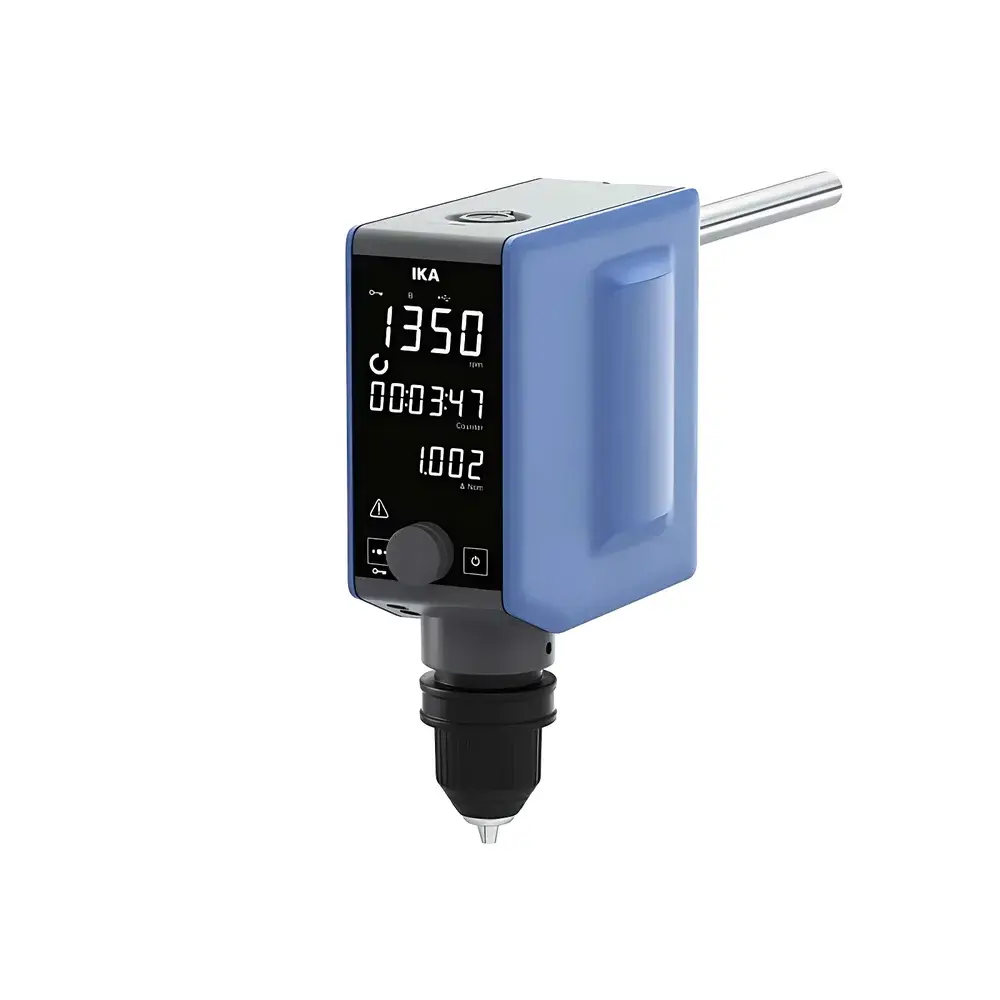
IKA EUROSTAR 60 digital Overhead Stirrer
| Brand | IKA |
|---|---|
| Origin | Germany |
| Model | EUROSTAR 60 digital |
| Max. Volume (H₂O) | 40 L |
| Motor Input Power | 176 W |
| Motor Output Power | 126 W |
| Drive Type | Brushless DC Motor |
| Speed Range | 0/30–2000 rpm |
| Speed Display | LED, 7-segment |
| Speed Control | Electronic, Continuous |
| Speed Setting Accuracy | ±1 rpm |
| Speed Measurement Deviation | ±1% (n > 300 rpm), ±3 rpm (n < 300 rpm) |
| Max. Viscosity | 50,000 mPa·s |
| Max. Torque | 60 N·cm |
| Rated Torque | 0.6 N·m |
| Duty Cycle | 100% |
| Shaft Clamping Range | 0.5–10 mm |
| Hollow Shaft ID | 11 mm |
| Hollow Shaft Functionality | Yes (insertion possible at standstill) |
| Support Arm Diameter | 16 mm |
| Support Arm Length | 220 mm |
| Housing Material | Cast Aluminum Coated / Thermoplastic Polymer |
| Dimensions (W×H×D) | 86 × 248 × 208 mm |
| Weight | 3.9 kg |
| Ambient Temperature Range | 5–40 °C |
| Relative Humidity Limit | 80% RH |
| Protection Class | IP 42 (per DIN EN 60529) |
| Voltage | 230 V AC |
| Frequency | 50/60 Hz |
| Safety Features | Electronic overload protection, stall detection, automatic shutdown, error code display |
| Acoustic Noise Level | Low |
| Design | Compact, benchtop overhead stirrer with integrated microprocessor-based speed regulation and real-time speed feedback loop |
Overview
The IKA EUROSTAR 60 digital is a high-precision, microprocessor-controlled overhead stirrer engineered for reproducible mixing, dispersion, and homogenization in research laboratories, quality control environments, and pilot-scale development workflows. Operating on brushless DC motor technology, it eliminates carbon brush wear and delivers consistent torque output across its full speed range — from gentle agitation at 30 rpm to vigorous dispersion up to 2000 rpm. Its core measurement principle relies on closed-loop speed regulation: an integrated optical or Hall-effect sensor continuously monitors actual shaft rotation, comparing it against the user-defined setpoint and dynamically adjusting power delivery to maintain deviation within ±1 rpm (for n > 300 rpm) or ±3 rpm (for n < 300 rpm). This ensures process stability even when sample viscosity changes dynamically during operation — a critical requirement for polymer dissolution, suspension preparation, or enzymatic reaction mixing where shear history affects outcome fidelity.
Key Features
- Brushless DC motor architecture for maintenance-free, long-term operational reliability and consistent torque delivery up to 60 N·cm
- Real-time closed-loop speed control with continuous feedback, enabling stable rotational performance under variable load conditions
- Digital LED display with 7-segment readout for unambiguous speed visualization and intuitive parameter verification
- Hollow shaft design (11 mm internal diameter) permitting insertion of temperature probes, pH electrodes, or sampling needles without interrupting agitation
- Integrated electronic safety system featuring stall detection, thermal overload monitoring, and automatic shutdown with diagnostic error code reporting
- Compact cast aluminum housing with thermoplastic polymer coating, optimized for chemical resistance and mechanical robustness in multi-user lab settings
- IP 42-rated enclosure per DIN EN 60529, providing protection against solid objects >1 mm and vertically falling water droplets — suitable for standard laboratory ambient conditions (5–40 °C, ≤80% RH)
Sample Compatibility & Compliance
The EUROSTAR 60 digital accommodates a broad spectrum of sample types — from low-viscosity aqueous solutions to highly structured non-Newtonian systems such as hydrogels, pastes, and filled polymer melts (up to 50,000 mPa·s). Its universal chuck accepts stirring elements with diameters from 0.5 mm to 10 mm, supporting propeller, paddle, anchor, and helical impellers commonly used in ASTM D1893 (viscosity of paints) and ISO 2557-2 (plastic dispersion testing) protocols. While not certified for GMP manufacturing environments, its repeatable speed control, error logging capability, and stable torque response align with GLP documentation requirements for method validation and equipment qualification. The device complies with IEC 61000-6-3 (EMC emission standards) and IEC 61000-6-2 (immunity), ensuring electromagnetic compatibility in instrument-dense analytical labs.
Software & Data Management
The EUROSTAR 60 digital operates as a standalone instrument with no proprietary software dependency. All operational parameters — including set speed, actual speed, torque status, and fault codes — are accessible via the front-panel interface. Though it lacks USB or Ethernet connectivity, its precise speed repeatability (±1 rpm) and built-in error diagnostics support manual audit trails required under FDA 21 CFR Part 11 Annex 11 principles when paired with lab notebook entries or LIMS-integrated procedural logs. For users requiring automated data capture, third-party analog output modules (e.g., 0–10 V speed signal) can be interfaced externally for integration into SCADA or custom LabVIEW acquisition systems.
Applications
- Preparation of uniform suspensions and emulsions in pharmaceutical formulation development (e.g., oral suspensions per USP <701>)
- Controlled dissolution testing of solid dosage forms using USP Apparatus 2 (paddle) configurations
- Mixing of high-solids-content battery electrode slurries under inert atmosphere gloveboxes
- Homogenization of microbial culture media prior to sterilization and inoculation
- Dispersion of nanomaterials (e.g., graphene oxide, metal oxides) in solvent matrices for rheological or spectroscopic characterization
- Long-duration polymerization reactions requiring constant shear input over hours or days
FAQ
Is the EUROSTAR 60 digital compatible with corrosion-resistant stirring shafts for aggressive solvents?
Yes — stainless steel (SS316), Hastelloy C-276, and PTFE-coated shafts within the 0.5–10 mm clamping range are mechanically and electrically compatible.
Can it operate continuously for 24 hours without thermal derating?
Yes — rated for 100% duty cycle at ambient temperatures ≤35 °C and relative humidity ≤70%, provided adequate ventilation around the base unit.
Does it support external start/stop or speed modulation via TTL or analog signals?
No — the unit has no factory-installed analog or digital I/O ports; optional external relay kits may be used for basic remote on/off control only.
What is the maximum recommended vessel diameter for optimal top-entry mixing efficiency?
For laminar-to-transitional flow regimes, vessels up to 250 mm in diameter are advised when using standard 4-blade propellers at ≥500 rpm.
How is calibration traceability maintained for regulatory audits?
Speed accuracy is verified using NIST-traceable tachometers during IQ/OQ; no field-adjustable calibration constants exist — all performance specifications are factory-set and immutable.



