
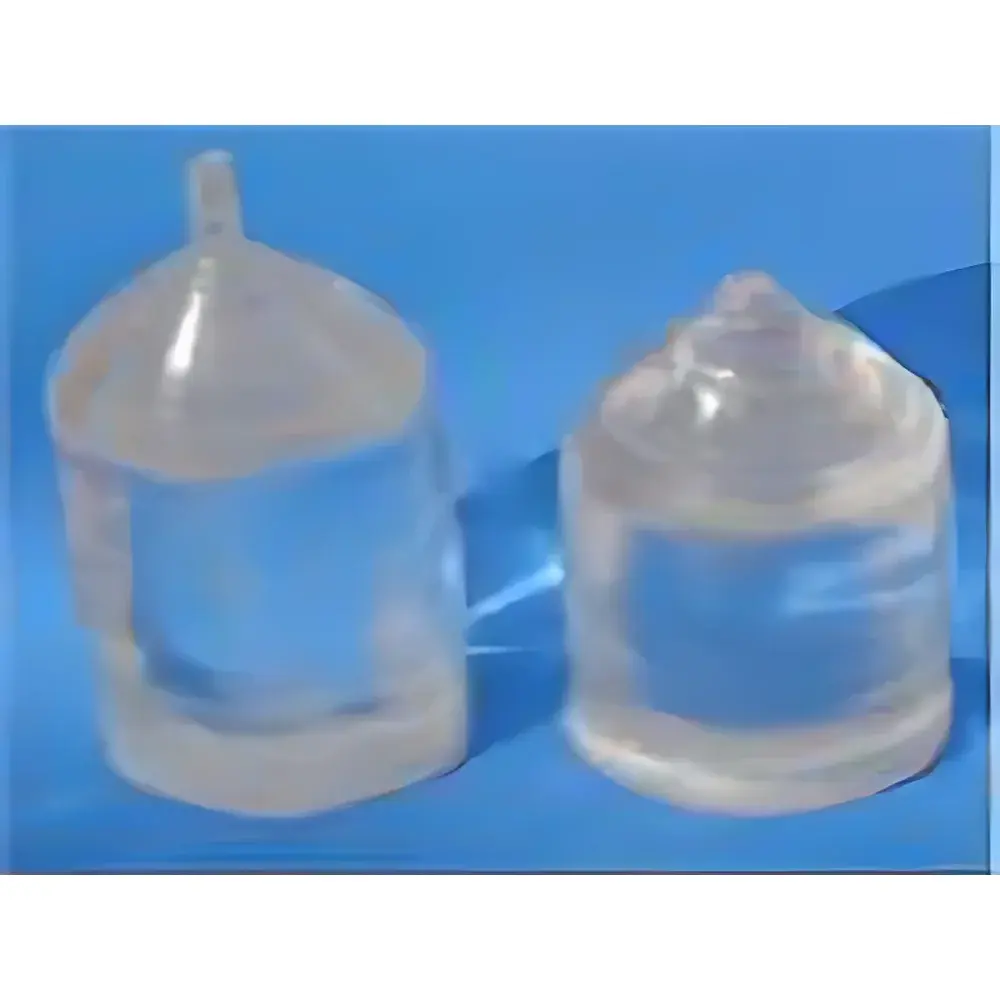
AL2O3 Sapphire Crystal Rod (C-plane, a-plane, m-plane) –合肥科晶 Quartz Crystal Microbalance Sensor Substrate
No specifications available.
Overview
The AL2O3 Sapphire Crystal Rod is a high-purity single-crystal substrate engineered for precision applications in quartz crystal microbalance (QCM) systems, thin-film epitaxy, and optical/IR window assemblies. Composed of aluminum oxide (Al2O3) in its stable corundum phase, this material exhibits exceptional thermal stability (melting point: 2040 °C), mechanical hardness (9 on the Mohs scale), and chemical inertness—making it ideal for harsh-environment sensing platforms and vacuum-compatible deposition processes. Its hexagonal crystal structure (space group P63/mmc) provides anisotropic physical properties: dielectric constants of ~9.4 along the *a*-axis and ~11.58 along the *c*-axis at 300 K, with tangent loss values below 2×10⁻⁵ (a-axis) and 5×10⁻⁵ (c-axis). These characteristics ensure minimal energy dissipation and high-frequency resonance stability—critical for QCM-based mass sensitivity down to sub-nanogram resolution.
Key Features
- Ultra-high purity (>99.99% Al2O3), low metallic impurity content verified by GDMS analysis
- Controlled crystallographic orientation: standard options include (0001) *c*-plane, (11–20) *a*-plane, and (10–10) *m*-plane; custom orientations available upon request
- Dimensional precision: standard diameter 2″ (50.8 mm) × thickness 0.5 mm, with thickness tolerance ±0.05 mm
- Surface finish: double-side polished to ≤0.2 nm RMS roughness, compatible with atomic-layer epitaxy (ALE) and MBE growth
- Processing environment: fabricated and packaged in ISO Class 4 (100-level) cleanroom conditions inside nitrogen-purged Class 1000 clean bags
- Thermal performance: coefficient of thermal expansion 7.5×10⁻⁶/°C; thermal conductivity 46.06 W/(m·K) at 0 °C, decreasing predictably with temperature
Sample Compatibility & Compliance
These sapphire rods are designed for integration into certified QCM sensor modules used in GLP- and GMP-regulated laboratories. Their chemical resistance to acids (except hot phosphoric and hydrofluoric), alkalis, and organic solvents ensures long-term operational integrity in corrosive electrochemical cells or plasma etch environments. The material complies with ASTM F1240-21 for sapphire substrates used in semiconductor and optoelectronic applications. Surface cleanliness meets SEMI F57-1107 standards for particle count (<5 particles ≥0.3 µm per cm²) and total organic carbon (TOC) limits (<10 ng/cm²). For FDA-regulated biosensor development, traceability documentation—including batch-specific GDMS reports and orientation verification via X-ray diffraction (XRD)—is provided upon order.
Software & Data Management
While the AL2O3 crystal rod itself is a passive substrate, its use in QCM instrumentation requires strict calibration traceability. When deployed in systems compliant with FDA 21 CFR Part 11, the substrate’s lot number and orientation data must be recorded within the instrument’s audit trail during sensor initialization. Compatible QCM platforms (e.g., Q-Sense E4, Stanford Research Systems QCM200) support automated frequency–mass conversion using Sauerbrey’s equation, with optional Voigt-model correction for viscoelastic films. All raw resonance data (fundamental and overtones) can be exported in CSV or HDF5 format for third-party analysis in MATLAB, Python (SciPy), or OriginPro—enabling full reproducibility under ISO/IEC 17025-compliant workflows.
Applications
- Quartz crystal microbalance (QCM-D) sensor fabrication for real-time monitoring of protein adsorption, polymer film swelling, and nanoparticle binding kinetics
- Heteroepitaxial template for GaN, AlN, and ZnO growth in UV-LED and laser diode manufacturing
- Infrared-transparent window material for FTIR spectroscopy cells operating up to 5000 cm−1
- High-temperature piezoelectric transducer substrate in combustion diagnostics and aerospace propulsion testing
- Reference standard in surface acoustic wave (SAW) device R&D due to low acoustic attenuation and high velocity anisotropy
- Substrate for diamond-like carbon (DLC) and h-BN coating studies requiring extreme wear resistance and thermal management
FAQ
What crystallographic orientations are available as standard?
Standard orientations include (0001) *c*-plane, (11–20) *a*-plane, and (10–10) *m*-plane. Orientation verification is performed via Laue X-ray diffraction with angular accuracy ±0.1°.
Can these rods be bonded directly to AT-cut quartz resonators?
Yes—they are compatible with eutectic Au–Sn or low-stress epoxy bonding; thermal expansion mismatch is mitigated by controlled ramp profiles during curing.
Is surface metallization (e.g., Cr/Au electrodes) offered as an option?
Metallization is not included but can be added through our partner cleanroom services; minimum feature size 5 µm, sheet resistance <10 Ω/sq for 100 nm Au layers.
What documentation accompanies each shipment?
Each lot includes a Certificate of Conformance (CoC), XRD orientation report, surface roughness AFM scan summary, and GDMS impurity assay data.
Do you supply sapphire rods with pre-patterned interdigitated electrodes (IDEs)?
Custom IDE patterning is available under NDA; typical configurations include 10–50 µm line/space, Ti/Pt/Au stack, with impedance matching to 50 Ω RF interfaces.




