
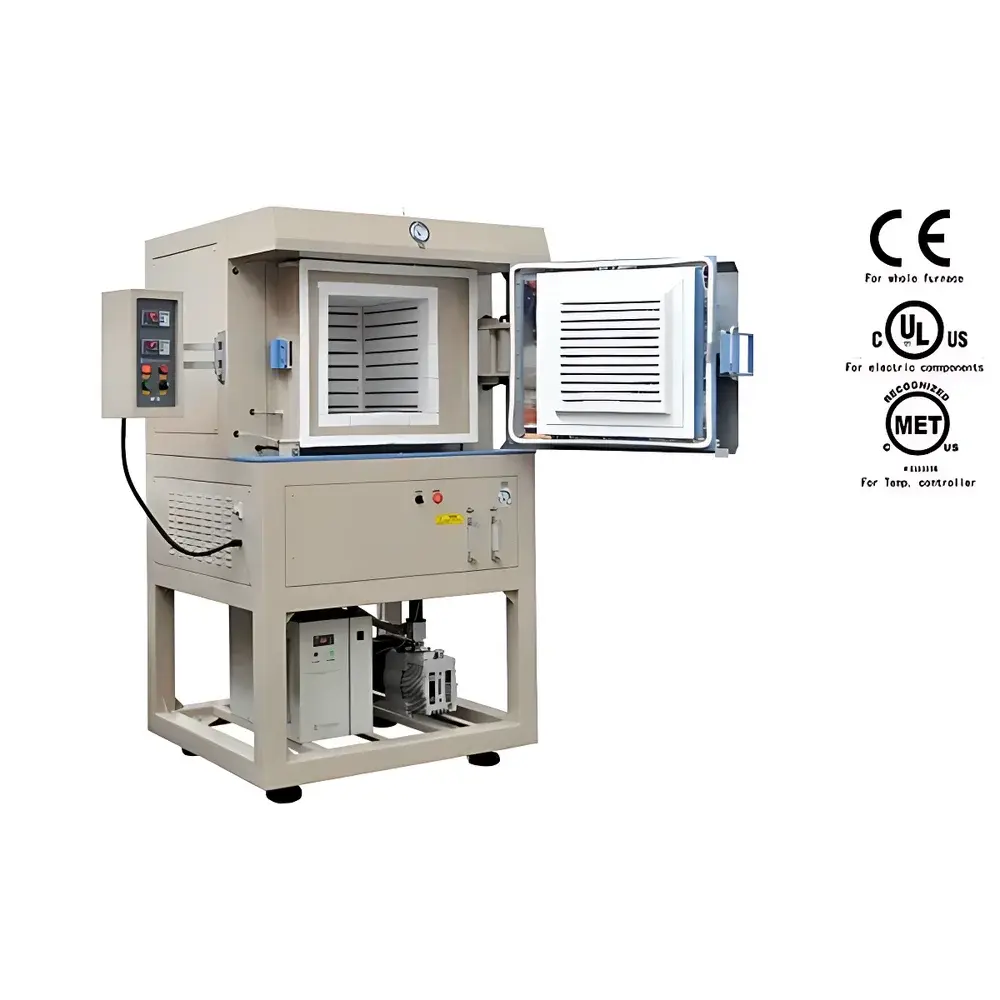
KSL-1200X-AC-5S Box-Type Atmosphere Furnace with Five-Sided Heating
| Brand | Hefei Kejing |
|---|---|
| Origin | Anhui, China |
| Manufacturer Type | Authorized Distributor |
| Product Category | Domestic |
| Model | KSL-1200X-AC-5S |
| Instrument Type | Box Furnace |
| Max Temperature | 1200°C |
| Temperature Control Accuracy | ±1°C |
| Max Power | 10 kW |
| Max Ramp Rate | 20°C/min |
| Heating Method | Resistance Wire (Kanthal Fe-Cr-Al with ZrO₂ Coating) |
| Internal Chamber Dimensions | 400 × 400 × 400 mm |
| Chamber Volume | 64 L |
| Temp Uniformity | ±5°C within 250 mm³ zone |
| Continuous Operating Temp | 1100°C |
| Max Sample Load | 35 kg |
| Vacuum Level | –0.1 Pa |
| Positive Pressure Capability | 0.2 MPa |
| Cooling | Water-Cooled Seals & Flanges |
| Thermal Insulation | High-Purity Al₂O₃ Fiber with High-Temp Al₂O₃ Coating |
| Control Interface | RS485 (optional PC software), Dual K-Type Thermocouples, 30-Stage PID Programmable Controller |
| Safety Features | Over-Temperature Protection, Thermocouple Break Detection |
| Certifications | CE |
Overview
The KSL-1200X-AC-5S is a high-performance box-type atmosphere furnace engineered for precise thermal processing under controlled inert or reducing atmospheres. Designed around the principle of five-sided resistive heating—applied to the left, right, front, rear, and bottom walls—it achieves superior temperature uniformity compared to conventional three-sided configurations. This architecture minimizes radial and axial thermal gradients across the 64 L chamber (400 × 400 × 400 mm), enabling reproducible heat treatment of advanced ceramics, battery electrode materials, catalysts, and sintered composites. The furnace operates up to 1200°C for short-duration cycles (≤1 hr) and maintains stable continuous operation at 1100°C. Its sealed stainless-steel double-wall construction supports both vacuum (down to –0.1 Pa) and positive pressure (up to 0.2 MPa), making it suitable for processes requiring strict gas composition control—such as carburizing, nitriding, annealing, and controlled-oxidation synthesis.
Key Features
- Five-sided Kanthal® Fe-Cr-Al heating elements rated to 1350°C, surface-coated with stabilized zirconia (ZrO₂) to inhibit oxidation and extend service life under cyclic thermal stress.
- High-purity alumina fiber insulation (≥99.7% Al₂O₃) with proprietary high-temperature alumina coating—enhancing thermal reflectivity, reducing standby heat loss, and improving ramp efficiency by ~12% relative to uncoated equivalents.
- Water-cooled flange seals and gasket interfaces ensure long-term integrity during repeated vacuum/pressure cycling; cooling lines integrate directly with standard laboratory water supply (flow rate ≥2 L/min).
- Dual K-type thermocouples—one for control, one for independent monitoring—enable real-time cross-verification and support GLP-compliant audit trails when paired with optional data logging software.
- 30-segment programmable PID controller with overshoot suppression logic, configurable ramp/soak profiles, and built-in safety interlocks (over-temperature cutoff, thermocouple failure detection).
- Integrated gas management system: two calibrated stainless-steel float flowmeters (0–10 L/min range), manual stainless gate valves, and pre-connected 3 L/s oil-free scroll vacuum pump via ISO-KF 40 waveguide.
Sample Compatibility & Compliance
The KSL-1200X-AC-5S accommodates samples up to 35 kg and 400 mm in maximum dimension, supporting crucibles (alumina, quartz, graphite), boat assemblies, and custom fixtures. It complies with CE Directive 2014/35/EU (Low Voltage) and 2014/30/EU (EMC). Vacuum and pressure operations adhere to EN 13445-1:2021 design principles for unfired pressure equipment. While not intrinsically rated for explosive atmospheres, its sealed construction and purge capability make it compatible with ATEX Zone 2 workflows when integrated into externally certified gas cabinets. All thermal insulation materials meet ASTM C711 classification for high-temperature refractory fibers and contain no regulated carcinogens per EU REACH Annex XIV.
Software & Data Management
An optional RS485-to-USB interface enables bidirectional communication with third-party SCADA systems or Kejing’s proprietary LabFurnaceControl™ software (Windows 10/11 compatible). The software provides real-time graphing, automated CSV export, user-level access controls, and electronic signature support aligned with FDA 21 CFR Part 11 requirements—including audit trail generation, data immutability enforcement, and session time-out policies. Raw thermocouple voltage, setpoint history, power draw, and gas flow logs are timestamped with microsecond resolution. Firmware updates are delivered via signed binary packages verified using SHA-256 checksums.
Applications
- Solid-state synthesis of Li-ion cathode precursors (e.g., NMC, LFP) under Ar/H₂ mixtures at 750–900°C.
- Graphitization of carbonaceous anodes with controlled ramp rates (<5°C/min) to minimize structural defects.
- Thermal aging studies of polymer-derived ceramics (PDCs) under dynamic N₂ flow with in-situ mass loss monitoring.
- Pre-oxidation of TiAl alloys prior to hot isostatic pressing (HIP), leveraging the furnace’s ±5°C uniformity over 250 mm³ volume.
- Calibration of thermocouples and reference materials per ISO/IEC 17025-accredited laboratories’ internal procedures.
FAQ
What atmosphere gases are compatible with this furnace?
N₂, Ar, H₂ (≤5% in N₂), CO, and forming gas (5% H₂/95% N₂) are routinely used. For H₂ service above 5%, consult engineering documentation for additional leak-test protocols and venting requirements.
Can the furnace be upgraded for higher vacuum performance?
Yes—by replacing the standard scroll pump with a turbomolecular pumping station (e.g., Pfeiffer HiPace 300) and upgrading to metal-sealed CF-63 flanges, ultimate vacuum can reach 1×10⁻⁶ Pa.
Is remote monitoring supported out-of-the-box?
No—remote access requires integration with a local industrial Ethernet gateway (e.g., Moxa EDS-G205A) and configuration of Modbus RTU over TCP/IP; Kejing provides register mapping documentation upon request.
How often should the alumina fiber insulation be inspected?
Visual inspection is recommended every 200 operating hours or after any thermal shock event (>150°C/min ramp); compression-set degradation is assessed via dimensional stability checks per ASTM C168 guidelines.
Does the CE marking cover EMC immunity testing?
Yes—the unit underwent full EN 61326-1:2013 testing for electrostatic discharge (±8 kV contact), radiated RF immunity (10 V/m, 80 MHz–2.7 GHz), and fast transient burst (±2 kV), with all functional criteria met at Performance Class A.



