
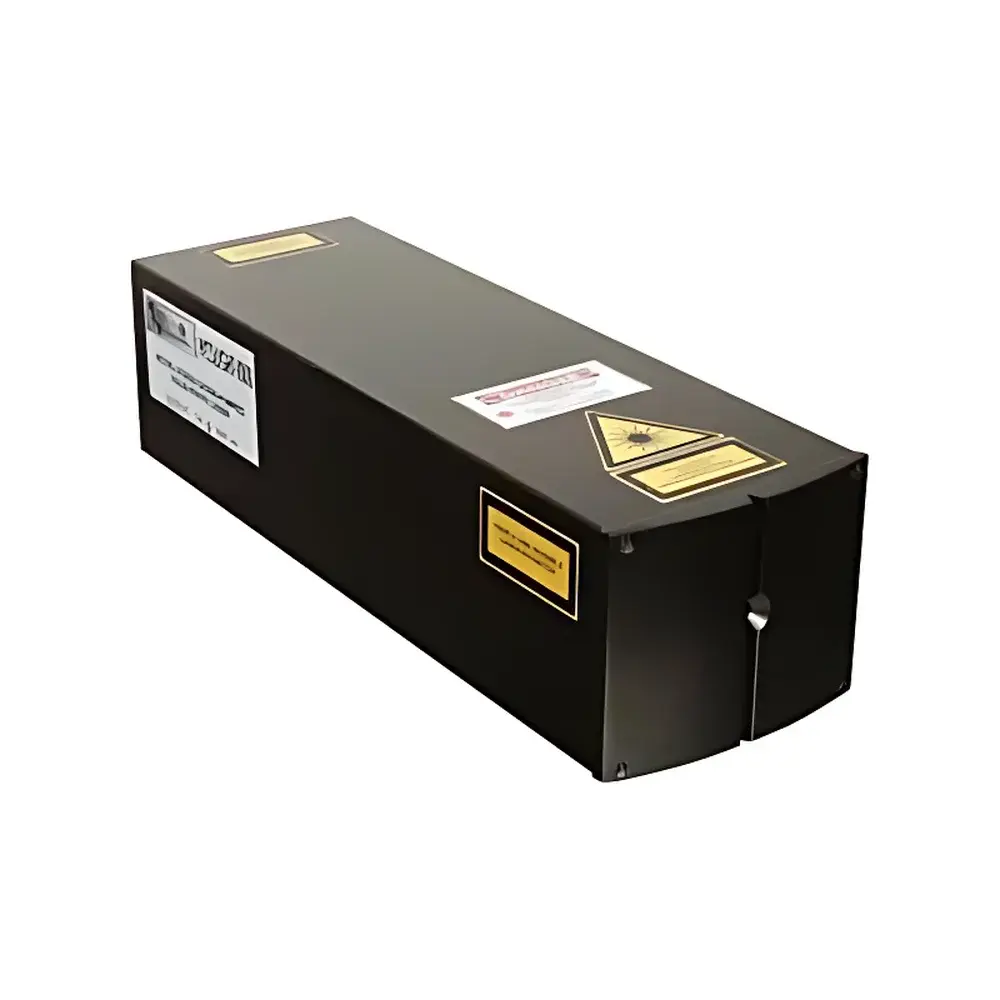
AlphaLas PICOPOWER Series DPSS Mode-Locked Picosecond Laser System
| Brand | AlphaLas |
|---|---|
| Origin | Germany |
| Model | PICOPOWER |
| Wavelength | 1064 nm (IR) or 532 nm (Green) |
| Pulse Width | < 10 ps (customizable) |
| Repetition Rate | 100 MHz (customizable) |
| Beam Quality | TEM₀₀ |
| Beam Diameter (1/e²) | 1 mm at output |
| Beam Divergence | 1 mrad |
| Pointing Stability | 40 µrad |
| Output Power | ≥10 W @ 1064 nm (PICOPOWER 10 IR), ≥5 W @ 532 nm (PICOPOWER 5G) |
| Power Stability | <1% peak-to-peak (24 h) |
| Polarization Ratio | >300:1 linear |
| Optical Noise (30 Hz–2 MHz) | <0.5% |
| Pump Diode Lifetime | >10,000 h |
| Electrical Input | 85–240 V AC, single-phase |
| Max. Power Consumption | <800 W |
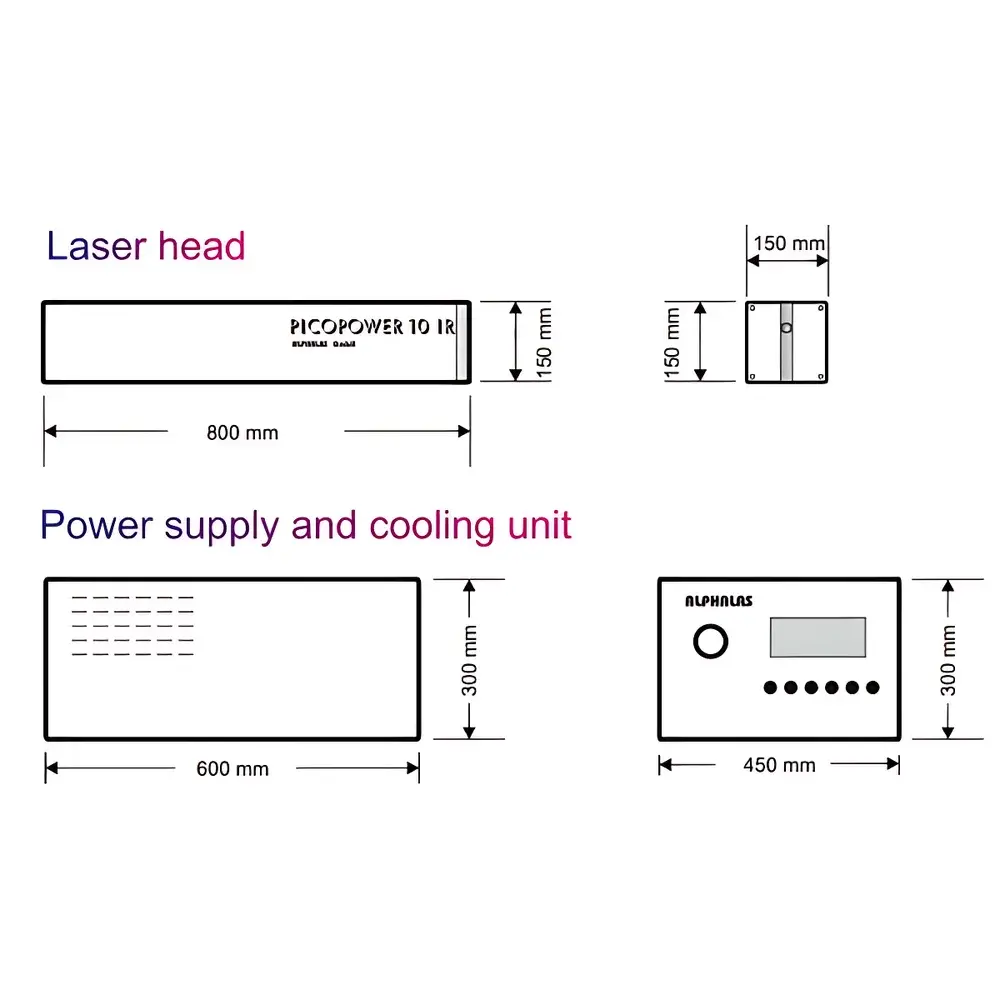
| Laser Head Dimensions | 150 × 150 × 800 mm³ |
| PSU & Cooling Unit Dimensions | 450 × 300 × 600 mm³ |
| Operating Temperature | 10–35 °C |
Overview
The AlphaLas PICOPOWER Series is a high-reliability, diode-pumped solid-state (DPSS) mode-locked picosecond laser system engineered for precision applications requiring ultrashort pulses with exceptional temporal stability and low amplitude noise. Based on Nd:YVO₄ gain media and passive mode-locking architecture, the system delivers transform-limited pulses under 10 ps in duration at fundamental 1064 nm or frequency-doubled 532 nm output. Its monolithic cavity design ensures inherent mechanical robustness and long-term pointing stability (<40 µrad), while the integrated harmonic generation modules enable efficient third- and fourth-harmonic conversion — supporting extended spectral utility without external nonlinear stages. Designed for continuous-duty operation in demanding laboratory and industrial environments, the PICOPOWER platform meets stringent requirements for pulse-to-pulse consistency, thermal management, and electromagnetic compatibility per IEC 61000-6-3/6-4.
Key Features
- Diode-pumped all-solid-state architecture with Nd:YVO₄ gain crystal — eliminating flashlamp degradation and enabling >10,000 h pump diode lifetime
- Passively mode-locked oscillator delivering sub-10 ps pulses at 100 MHz repetition rate (customizable to 50–200 MHz)
- TEM₀₀ spatial profile with M² < 1.1 and beam diameter of 1 mm (1/e²) at output port; divergence limited to ≤1 mrad
- Integrated SHG module for stable green output (≥5 W @ 532 nm); optional THG/FHG units available for UV extension
- Amplitude noise <0.5% RMS (30 Hz–2 MHz bandwidth), verified per ANSI Z136.1 measurement protocols
- Power stability <1% peak-to-peak over 24 hours, traceable to NIST-calibrated photodiode standards
- Linear polarization ratio >300:1, maintained across full power range and thermal operating window (10–35 °C)
- Compact laser head (150 × 150 × 800 mm³) with air-cooled PSU and chiller unit (450 × 300 × 600 mm³)
Sample Compatibility & Compliance
The PICOPOWER system is compatible with standard optical tables, breadboard-mounted harmonic separators, and vacuum-compatible beam delivery optics. Its output meets Class 4 laser safety requirements per IEC 60825-1:2014 and is supplied with interlock-ready connectors compliant with EN 61511 functional safety standards. All firmware and control logic adhere to ISO 9001-certified manufacturing workflows. The system supports integration into GLP/GMP-regulated environments via optional analog monitoring outputs (0–10 V) for real-time power and temperature logging, and includes configurable TTL sync outputs for synchronization with oscilloscopes, streak cameras, or time-resolved spectrometers. Harmonic generation modules are qualified per ISO 11146-2 for beam parameter measurements and comply with ASTM F2793 for UV laser safety classification when operated with THG/FHG options.
Software & Data Management
AlphaLas provides the PICOCONTROL suite — a Windows-based application supporting remote configuration of repetition rate, output power scaling (via internal AOM), and harmonic selection via GUI-driven presets. All operational parameters are logged with UTC timestamps and stored in HDF5 format for post-acquisition analysis in MATLAB, Python (h5py), or OriginLab. Audit trails include user login metadata, firmware version, and calibration certificate expiry dates — satisfying FDA 21 CFR Part 11 requirements for electronic records and signatures when deployed in regulated QC/QA labs. Optional LabVIEW and Python SDKs enable seamless integration into automated test benches and custom metrology platforms.
Applications
- Time-resolved photoluminescence spectroscopy (TRPL) for semiconductor defect analysis and carrier lifetime mapping
- Pump-probe experiments in ultrafast physics, including coherent phonon dynamics and spin relaxation studies
- Two-photon polymerization (2PP) and direct laser writing (DLW) for micro-optical component fabrication
- Laser-induced breakdown spectroscopy (LIBS) with enhanced signal-to-noise ratio via precise ablation control
- Seed source for chirped-pulse amplification (CPA) systems targeting high-energy femtosecond output
- Calibration of streak cameras and fast photodetectors requiring known pulse width and jitter specifications
FAQ
Is the pulse width tunable?
No — the PICOPOWER series delivers fixed sub-10 ps pulses from its monolithic mode-locked oscillator; however, external pulse compressors or stretchers may be integrated downstream for dispersion management.
Can the repetition rate be adjusted in real time during operation?
Yes — via the PICOCONTROL software interface or external TTL modulation input, the repetition rate can be varied between 50 MHz and 200 MHz without interrupting lasing.
What cooling method is required?
The system uses forced-air cooling for the laser head and a closed-loop recirculating chiller for the pump diode module; no external water supply is needed.
Does it support OEM integration?
Yes — RS232, USB, and Ethernet interfaces are provided; mechanical mounting templates and electrical pinouts are included in the OEM Integration Manual (Rev. 3.2).
Are calibration certificates included with shipment?
Each unit ships with a factory calibration report traceable to PTB (Physikalisch-Technische Bundesanstalt) standards, covering output power, pulse width verification (via autocorrelation), and beam profile characterization.





