
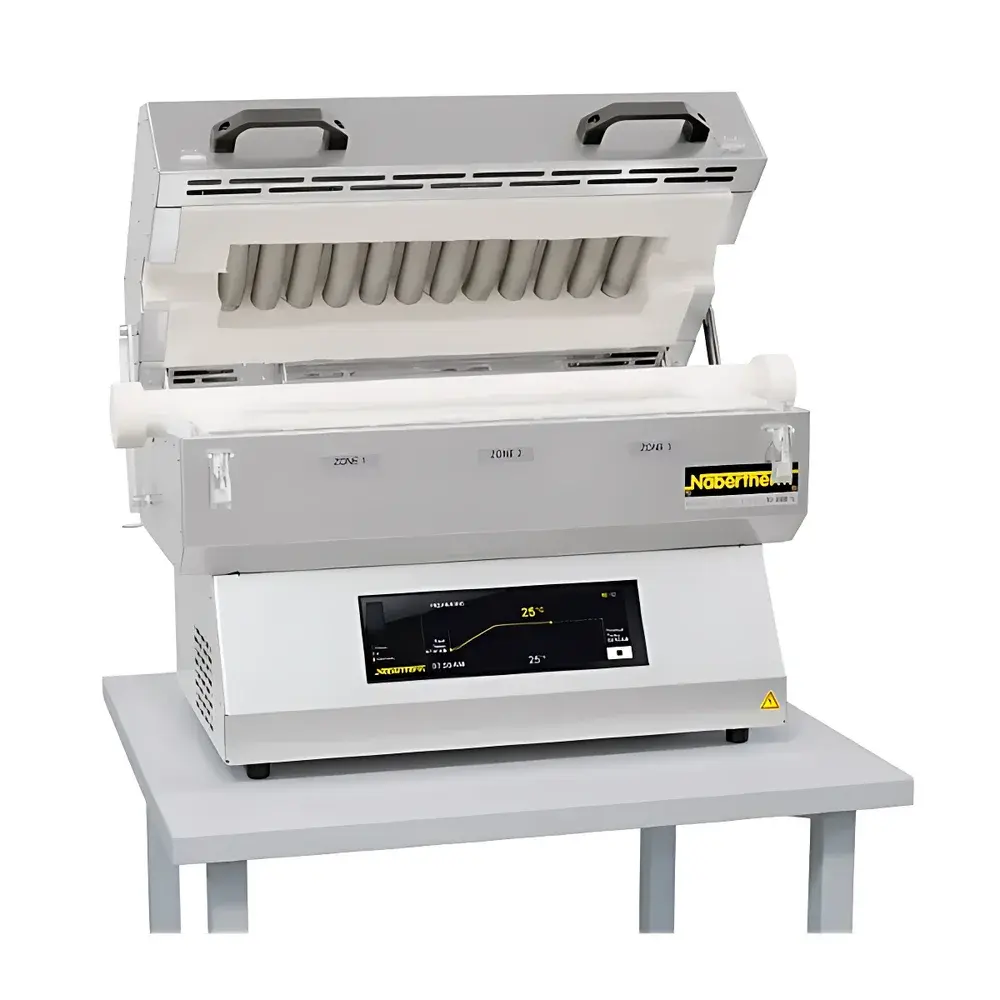
Nabertherm RSH Series Tube Furnace
| Brand | Nabertherm |
|---|---|
| Origin | Germany |
| Model | RSH |
| Heating Configuration | Single-zone or Three-zone |
| Max Operating Temperature | 1100 °C or 1300 °C |
| External Dimensions (W×D×H, mm) | up to 1170 × 490 × 630 |
| Tube Diameter Ø | 50–170 mm |
| Tube Length | 250–1000 mm |
| Uniformity Zone | ±5 K over specified length |
| Power Supply | 1-phase (230 V) or 3-phase (400 V, 3/N/PE) |
| Total Power | 1.9–13.7 kW |
| Weight | 25–491 kg |
| Heating Element | Free-radiating, mounted on support tube |
| Thermocouple Type | Type N (≤1100 °C) or Type S (≤1300 °C) |
| Controller | Nabertherm NTLog-capable, wall- or cabinet-mounted, USB data logging |
| Compliance | CE-marked, designed per IEC 61000-6-2/-4, EN 60519-1 (safety of industrial electroheating equipment) |
Overview
The Nabertherm RSH Series Tube Furnace is a precision-engineered horizontal tubular furnace system designed for controlled thermal processing in research laboratories, materials science departments, and quality control environments. Built upon Nabertherm’s decades-long heritage in high-reliability industrial heating technology, the RSH platform employs free-radiating heating elements mounted on a refractory support tube—ensuring uniform heat distribution and minimal thermal lag. Its operational principle relies on resistive heating combined with optimized thermal insulation and precise thermocouple-based feedback control. The furnace supports both ambient-air and controlled-atmosphere applications (including inert, reducing, oxidizing, and vacuum conditions), making it suitable for sintering, annealing, calcination, crystal growth pre-treatment, and catalyst activation protocols. With maximum operating temperatures of either 1100 °C (Type N thermocouple) or 1300 °C (Type S thermocouple), the RSH series meets stringent requirements for reproducible high-temperature experimentation under GLP-compliant workflows.
Key Features
- Robust stainless-steel housing with brushed finish, engineered for long-term mechanical stability and corrosion resistance in laboratory environments.
- Modular single-zone or three-zone heating configuration—enabling axial temperature profiling and enhanced uniformity (±5 K over defined zone lengths).
- Free-radiating heating elements mounted on ceramic support tubes—minimizing thermal mass and improving response time while avoiding direct contact with process atmosphere.
- Dedicated vertical variant (RSV model) with integrated vertical frame and reinforced base, supporting upright operation for gravity-sensitive sample configurations.
- Separate wall- or cabinet-mounted control unit housing the Nabertherm NTLog controller—providing electromagnetic isolation, simplified service access, and compliance with laboratory space constraints.
- Standard inclusion of C530-grade quartz or high-purity alumina working tubes (air-rated), with optional custom tube materials (e.g., SiC, MoSi₂) available for specialized atmospheres.
- Integrated cooling system with regulated exhaust port and non-return valve—preventing back-draft of ambient air during cooldown and enabling rapid thermal cycling without compromising atmosphere integrity.
Sample Compatibility & Compliance
The RSH furnace accommodates cylindrical samples, powders, pellets, thin films, and crucibles placed inside standardized working tubes (Ø50–170 mm, length 250–1000 mm). It is compatible with a wide range of process gases—including nitrogen, argon, hydrogen, forming gas, and synthetic air—via optional gas manifolds and pressure-regulated inlet kits. Vacuum operation down to 10⁻² mbar is supported using standard flange interfaces (KF or ISO-F). All RSH units are CE-marked and conform to EN 60519-1 (safety requirements for electroheating equipment) and IEC 61000-6-2/-4 (EMC immunity and emissions). When operated with validated procedures and calibrated thermocouples traceable to national standards, the system supports audit readiness for ISO/IEC 17025, ASTM E1142, and USP thermal validation frameworks.
Software & Data Management
The integrated Nabertherm NTLog controller provides real-time temperature monitoring, programmable ramp-soak profiles, and event-triggered data capture. Process parameters—including setpoint, actual temperature (furnace and optional internal tube sensor), power output, and alarm status—are logged at user-defined intervals (down to 1 s resolution) onto removable USB flash drives. The controller supports password-protected user levels, electronic signature capability, and audit-trail generation compliant with FDA 21 CFR Part 11 when deployed with appropriate IT infrastructure and procedural controls. Optional add-ons include external thermocouple inputs for simultaneous measurement of sample surface or internal tube temperature, enhancing thermal profile fidelity for method development and validation studies.
Applications
- Thermal treatment of battery electrode materials (e.g., LiCoO₂, NMC cathodes) under inert or reducing atmospheres.
- Pre-sintering and binder burnout of ceramic green bodies prior to final densification.
- Controlled oxidation of metal foils and thin-film substrates for oxide layer formation studies.
- Thermogravimetric analysis (TGA) coupling via compatible sample carriers and purge gas integration.
- Heat treatment of semiconductor precursors and nanomaterial synthesis (e.g., CVD precursor decomposition).
- Calibration reference furnaces for secondary thermocouple verification per ASTM E230/E230M.
FAQ
What is the difference between RSH and RSV models?
The RSH is configured for horizontal operation; the RSV includes an integrated vertical support frame and reinforced base for upright tube orientation—critical for sedimentation-sensitive reactions or vertical diffusion studies.
Can the RSH operate under vacuum or reactive gas?
Yes—standard flanged ports accept vacuum fittings and gas manifolds. Optional gas kits include pressure regulators, flow meters, and purge interlocks for safe handling of flammable or toxic gases.
Is temperature uniformity validated across the heating zone?
Nabertherm specifies axial uniformity as ±5 K over the stated “uniformity zone” length; users may perform in-situ mapping using multi-point thermocouple probes per ASTM E220 or ISO 9001 calibration protocols.
Does the controller support remote monitoring or network integration?
The NTLog controller features RS485 Modbus RTU interface for integration into lab-wide SCADA or LIMS systems; Ethernet gateway modules are available as accessories.
What maintenance is required for long-term reliability?
Annual inspection of heating element continuity, thermocouple drift verification, and insulation resistance testing are recommended. Nabertherm provides certified service documentation and spare parts traceability for GxP-regulated facilities.



