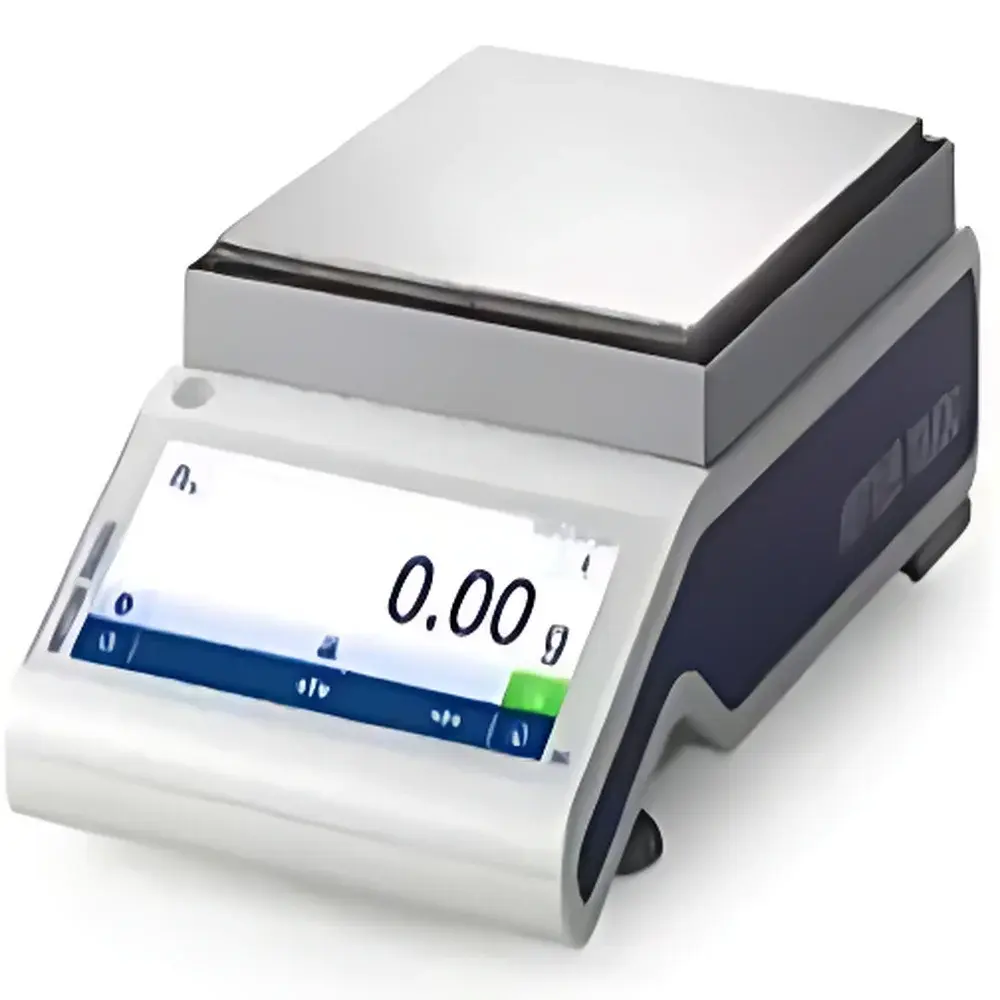
METTLER TOLEDO MS-TS Precision Balance
| Brand | METTLER TOLEDO |
|---|---|
| Origin | Switzerland |
| Type | Precision Balance |
| Model | MS-TS |
| Compliance | ISO/IEC 17025-compatible operation |
| Calibration | FACT (Fully Automatic Calibration Technology) with internal calibration weights |
| Sensor | MonoBloc single-module high-resolution electromagnetic force compensation sensor |
| Leveling System | 3 fixed feet + 2 locking leveling feet with LevelControl real-time tilt monitoring |
| Overload Protection | Integrated mechanical and electronic overload safeguard |
| Readability | Typically 0.1 mg to 1 mg (model-dependent) |
| Repeatability | ≤ ±0.0002 g (at full capacity, per ISO 9001 verification protocol) |
Overview
The METTLER TOLEDO MS-TS Precision Balance is an entry-level yet rigorously engineered analytical weighing instrument designed for routine laboratory applications requiring consistent accuracy, operational robustness, and long-term measurement stability. Built upon METTLER TOLEDO’s proprietary MonoBloc single-module sensor architecture, the MS-TS employs electromagnetic force compensation (EMFC) technology—ensuring high linearity, minimal drift, and exceptional resistance to thermal and mechanical perturbations. Unlike multi-component load cell systems, the monolithic sensor design eliminates interfacial errors and enhances signal integrity across the entire weighing range. The balance operates within a controlled environmental envelope optimized for standard lab conditions (20 ± 5 °C, <70 % RH), and its internal metrological architecture complies with foundational requirements of ISO/IEC 17025 for test and calibration laboratories—particularly in areas of traceability, uncertainty estimation, and procedural documentation.
Key Features
- MonoBloc High-Stability Sensor: A single-piece, temperature-compensated electromagnetic force transducer delivering superior repeatability (≤ ±0.0002 g at full capacity) and long-term zero stability under variable ambient loads.
- FACT Fully Automatic Calibration Technology: Integrated motor-driven internal calibration masses enable periodic, user-initiated or time-scheduled recalibration—ensuring continuous traceability without external weights. FACT compensates for both time- and temperature-induced drift.
- LevelControl Real-Time Tilt Monitoring: An embedded inclinometer continuously verifies horizontal alignment. When deviation exceeds ±0.5°, the display activates a dynamic on-screen leveling wizard with directional prompts—reducing setup time and eliminating subjective interpretation.
- Enhanced Mechanical Stability: Five-point base configuration—three fixed support feet plus two lockable leveling feet—distributes mass uniformly and dampens low-frequency vibrations from bench surfaces, critical for achieving stable settling times <2 seconds (per 95 % response criteria).
- Integrated Overload Protection: Dual-stage safeguarding includes mechanical stop limits and software-enforced upper-range cutoffs, preventing sensor saturation and preserving metrological integrity over extended service life.
Sample Compatibility & Compliance
The MS-TS accommodates standard laboratory sample containers—including weighing boats, crucibles, volumetric flasks, and tared glassware—within its pan diameter (typically 120 mm) and height clearance (≥ 220 mm). It supports GLP/GMP-relevant workflows through audit-trail-capable event logging (when connected to LabX or via optional RS232/USB interface), including timestamped calibration records, leveling status, and overload events. While not certified to FDA 21 CFR Part 11 out-of-the-box, its data export protocols (CSV, XML) are compatible with validated LIMS and ELN systems meeting ALCOA+ principles. The balance conforms to OIML R76-1 (2021) for non-automatic weighing instruments and meets essential requirements of the EU Measuring Instruments Directive (MID) for Class II precision balances.
Software & Data Management
The MS-TS features a built-in alphanumeric LCD with intuitive icon-driven navigation and multilingual UI (English, German, French, Spanish, Chinese). For enhanced traceability, it supports direct connection to METTLER TOLEDO’s LabX software via USB or RS232—enabling automated data capture, customizable report generation (PDF/Excel), and integration into enterprise quality management systems. All calibration, leveling, and error events are stored locally with date/time stamps and operator ID fields (when configured with optional user authentication module). Data export adheres to ISO/IEC 17025 clause 7.7.2 on result reporting integrity.
Applications
This balance is routinely deployed in QC laboratories for raw material verification (e.g., API batch release per USP ), formulation pre-weighing in pharmaceutical manufacturing, sample preparation for ICP-MS and HPLC analysis, educational titration labs, and environmental testing (e.g., filter weighing per EPA Method 1695). Its stability profile makes it suitable for gravimetric moisture determination when paired with a compatible halogen moisture analyzer, and its repeatability supports statistical process control (SPC) charting for in-house reference standards.
FAQ
Does the MS-TS support external calibration with user-provided weights?
Yes—the balance accepts manual calibration using certified external weights compliant with OIML R111 Class E2 or better. Internal FACT calibration remains the recommended method for routine use.
Is LevelControl compatible with vibration-isolation tables?
LevelControl functions independently of table type but requires the balance to be placed on a rigid, non-resonant surface. Vibration-dampening tables must not introduce angular instability during operation.
Can the MS-TS be integrated into a 21 CFR Part 11-compliant environment?
Standalone, it lacks electronic signature and role-based access control. However, when interfaced with LabX (with appropriate validation package), full Part 11 compliance—including audit trails, electronic signatures, and data integrity controls—is achievable.
What is the typical warm-up time before first use?
Minimum 30 minutes at stable ambient temperature (20 ± 2 °C) is recommended to ensure thermal equilibrium of the MonoBloc sensor and internal electronics.
How often should FACT internal calibration be performed?
METTLER TOLEDO recommends initiating FACT calibration after power-on, following significant ambient temperature shifts (>2 °C), and at user-defined intervals (e.g., every 2–4 hours in high-precision environments).