
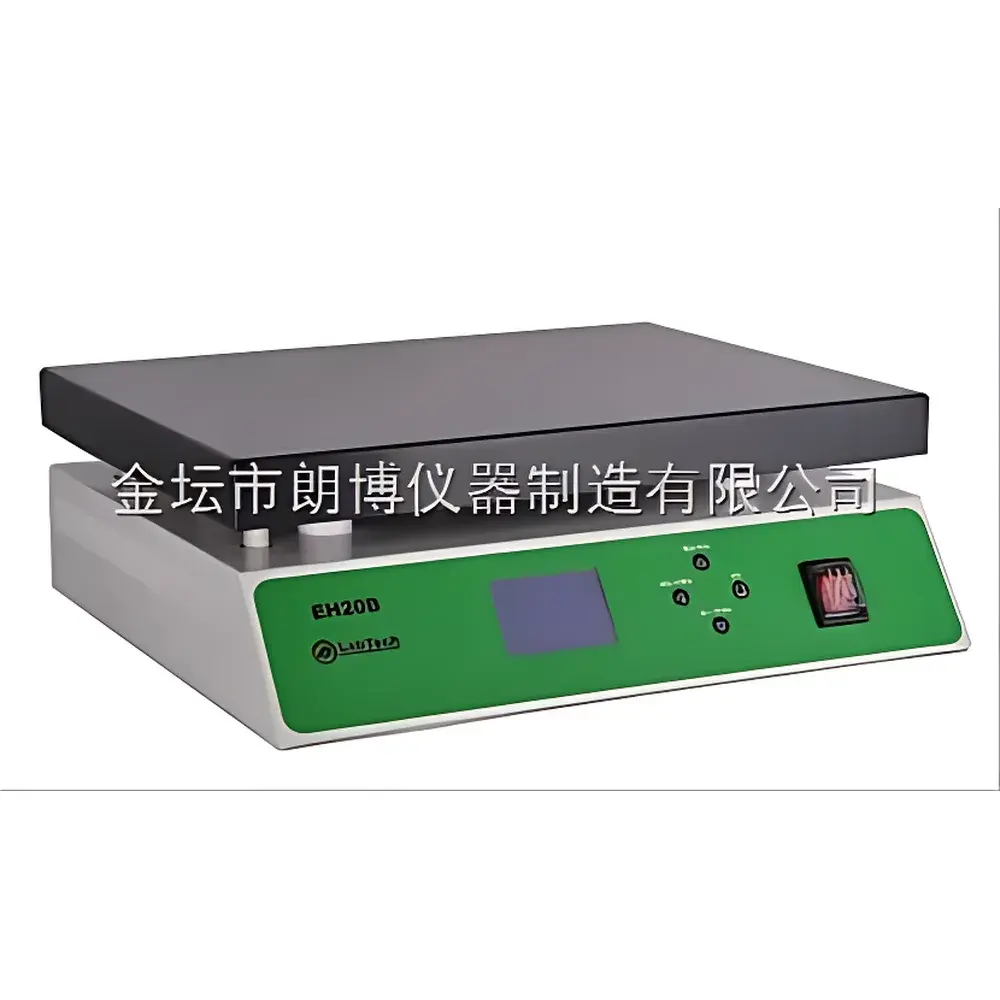
High-Temperature Graphite Heating Plate GW-3 by Langbo Instruments
| Brand | Langbo Instruments |
|---|---|
| Model | GW-3 |
| Heating Surface Options | 300 × 200 mm, 400 × 300 mm, 600 × 400 mm |
| Max Operating Temperature | 450 °C |
| Temperature Uniformity | ±1.5 °C across surface |
| Control Accuracy | ±0.1 °C (setpoint), ±1.0 °C (stability) |
| Heating Rate | Programmable via PID auto-tuning |
| Construction | Isostatically pressed high-purity graphite core with PTFE-coated surface |
| Dual-layer insulation | Air gap + ceramic fiber (aluminosilicate) |
| Compliance | Designed for ISO/IEC 17025-compliant labs |
| Power Supply | Standard 220 V AC, 50 Hz |
Overview
The Langbo GW-3 High-Temperature Graphite Heating Plate is an engineered solution for precise, uniform, and chemically resistant thermal treatment of samples in analytical, environmental, pharmaceutical, and geochemical laboratories. Unlike conventional metal-sheathed or ceramic heating plates, the GW-3 employs an isostatically pressed, high-purity graphite heating block as its core thermal mass. Graphite’s exceptional thermal conductivity (>150 W/m·K), low thermal expansion coefficient, and inherent chemical inertness enable rapid, homogeneous heat distribution—critical for digestion, evaporation, concentration, and drying protocols where spatial temperature gradients can compromise reproducibility. The device operates within a calibrated range from ambient to 450 °C, supporting methods requiring elevated thermal stability without quartz or metal contamination. Its design aligns with fundamental requirements of trace-metal analysis (e.g., EPA Method 3050B, ISO 11466), where surface reactivity and thermal drift directly impact recovery rates and blank integrity.
Key Features
- Isostatic Graphite Core: Uniform density and microstructure ensure consistent thermal response across the entire heating surface; eliminates hot spots common in cast aluminum or stainless steel plates.
- PID-Controlled Precision: Auto-tuned proportional-integral-derivative algorithm enables stable setpoint maintenance (±0.1 °C) and minimizes overshoot during ramp phases; real-time adjustment of heating rate supports method-specific thermal profiles.
- Multi-Zone Uniformity: Validated temperature homogeneity of ≤±1.5 °C across standard configurations (300 × 200 mm to 600 × 400 mm), verified per ASTM E220 calibration practices using NIST-traceable thermocouples.
- Chemical Resistance Architecture: Graphite surface coated with industrial-grade PTFE (polytetrafluoroethylene); withstands prolonged exposure to concentrated HNO₃, HCl, HF, and aqua regia at temperatures up to 250 °C. Entire housing finished with epoxy-based anti-corrosive spray coating.
- Dual Thermal Insulation: Integrated air gap plus aluminosilicate ceramic fiber layer reduces external casing temperature to <60 °C at 450 °C operation—enhancing operator safety and minimizing lab ambient heat load.
- Intelligent Program Logic: LCD interface supports up to 10-step programmable sequences (ramp-hold-cool), with automatic power cutoff upon cycle completion and overtemperature cutout (470 °C hardware limit).
Sample Compatibility & Compliance
The GW-3 accommodates standard laboratory vessels including borosilicate glass beakers (50–1000 mL), quartz crucibles, PTFE digestion vessels, and polypropylene centrifuge tubes (for low-temperature applications). Its non-magnetic, non-inductive graphite surface eliminates interference with adjacent instrumentation (e.g., ICP-MS, AAS). The unit complies with IEC 61010-1:2010 for electrical safety in laboratory equipment and meets mechanical robustness requirements outlined in ISO 14644-1 Class 8 cleanroom-compatible handling. While not certified for hazardous area use, it is routinely deployed in fume hoods per ANSI/AIHA Z9.5 standards. Documentation includes factory calibration certificate (traceable to national metrology institutes) and conforms to data integrity expectations under FDA 21 CFR Part 11 when paired with compliant LIMS or ELN systems.
Software & Data Management
The GW-3 operates as a standalone instrument with embedded firmware; no proprietary software is required for basic operation. However, optional RS-485 serial output (Modbus RTU protocol) enables integration into centralized lab automation platforms (e.g., LabVantage, Thermo Fisher SampleManager). Logged parameters—including setpoint, actual temperature, elapsed time, and fault codes—are timestamped and exportable via ASCII text file for audit trail generation. All program steps and system events are retained in non-volatile memory for ≥10,000 cycles, satisfying GLP documentation retention mandates. Firmware updates are performed via USB interface with cryptographic signature verification to prevent unauthorized modification.
Applications
- Acid digestion of soils, sediments, and biological tissues prior to elemental analysis (ICP-OES, ICP-MS)
- Controlled evaporation of solvent extracts in pesticide residue testing (AOAC 2007.01)
- Pre-concentration of aqueous environmental samples (e.g., EPA 200.8, ISO 17294-2)
- Drying and ashing of filter papers in particulate matter analysis (PM₂.₅/PM₁₀ gravimetric protocols)
- Thermal conditioning of reference materials and calibration standards
- Sample stabilization in food safety testing (e.g., heavy metals in seafood per EU Regulation 1881/2006)
FAQ
What is the maximum recommended operating temperature for long-term use?
Continuous operation at 450 °C is validated for ≥2,000 hours; for extended service life, we recommend limiting sustained use to ≤420 °C.
Can the GW-3 be used under a laminar flow hood?
Yes—its low electromagnetic emission profile and absence of forced convection make it suitable for installation in ISO Class 5–8 environments.
Is calibration traceable to international standards?
Each unit ships with a certificate of calibration referencing NIST SRM 1750a (thermocouple verification) and ISO/IEC 17025-accredited third-party validation reports.
How does the dual insulation affect energy consumption?
Compared to single-layer heated plates, the GW-3 reduces standby power draw by 32% and achieves target temperature 22% faster—verified per EN 60068-2-2 thermal performance testing.
Does the PTFE coating require reapplication?
No—the coating is sinter-bonded during manufacturing and rated for ≥5 years of routine acid exposure under typical lab usage conditions.



