
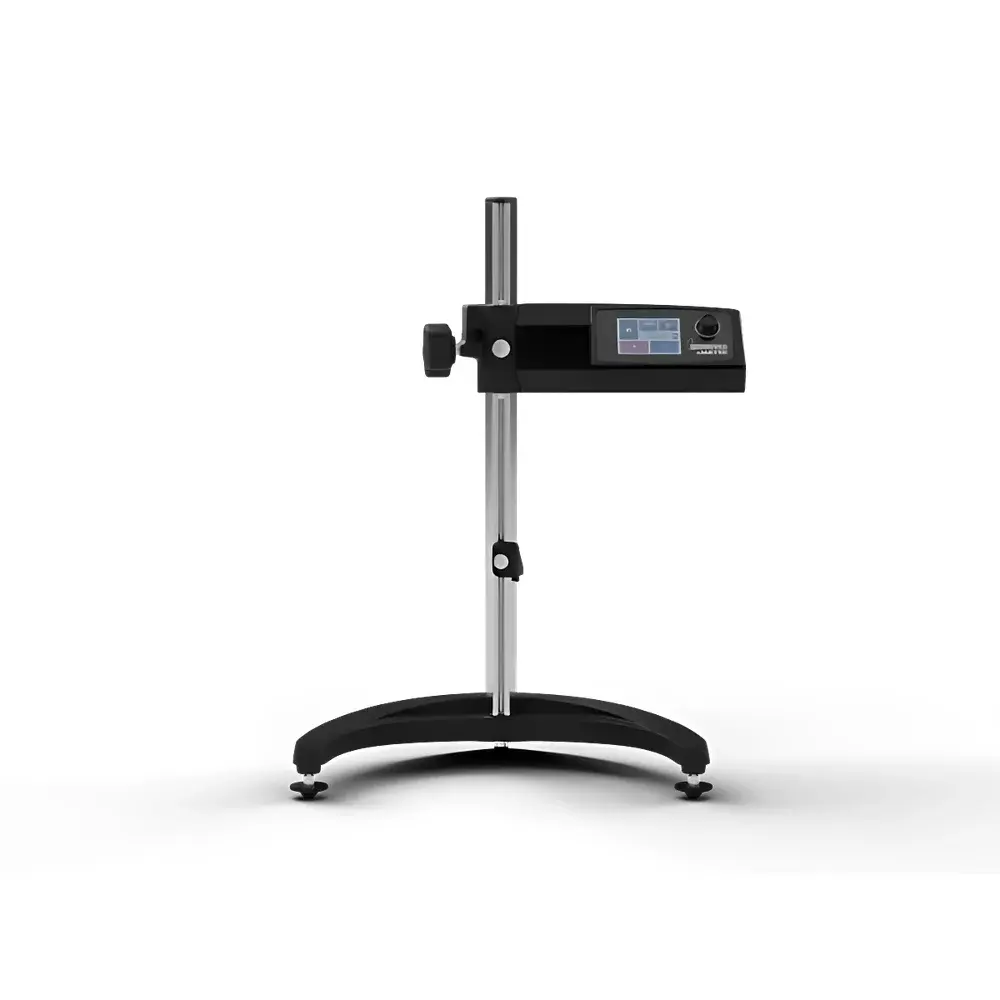
Brookfield HPQA™ Helipath Quick-Positioning Stand
| Brand | Brookfield |
|---|---|
| Origin | USA |
| Manufacturer Type | Authorized Distributor |
| Origin Category | Imported |
| Model | HPQA |
| Pricing | Available Upon Request |
Overview
The Brookfield HPQA™ Helipath Quick-Positioning Stand is an engineered mechanical positioning accessory designed specifically for rheological and viscometric characterization of non-flowing, semi-solid, and highly structured materials—including gels, pastes, creams, putties, caulks, and gelatinous systems. Unlike conventional spindle immersion methods, the HPQA employs a precision-guided vertical helical path mechanism that enables controlled, repeatable, and programmable axial displacement of the measuring spindle into the sample. This architecture is grounded in standardized rotational viscometry principles (ASTM D2196, ISO 2555), where torque response under defined shear history is translated into apparent viscosity or consistency index. The stand integrates seamlessly with Brookfield’s full line of digital viscometers (DV1, DV2T, DVNext) and rheometers (DVNext Advanced), extending their capability beyond Newtonian liquids into the domain of yield-stress and time-dependent structured fluids.
Key Features
- Motorized helical-path vertical drive with joystick-controlled positioning—supports both rapid coarse movement (up to 40 mm/s) and fine-step incremental control for precise depth calibration.
- Touchscreen interface synchronized with physical joystick input, enabling intuitive programming of initial position, test depth, dwell time, and return-to-home sequence.
- One-touch auto-positioning functionality: pre-defined positions (e.g., “clean,” “immersion,” “test start”) are stored and recalled without manual adjustment—reducing operator variability and cycle time.
- Magnetic rotor coupling option available: facilitates tool-free attachment/detachment of spindles (including T-bar, vane, and helical geometries), minimizing mechanical stress on shafts and reducing cross-contamination risk during high-throughput QC workflows.
- Robust aluminum-alloy frame with integrated leveling feet and anti-vibration damping—designed for stable operation on standard laboratory benches or production-line QA stations.
Sample Compatibility & Compliance
The HPQA stand is validated for use with materials exhibiting yield stress ≥ 10 Pa and plastic viscosity > 10⁴ mPa·s—covering formulations commonly encountered in personal care (toothpaste, moisturizers), adhesives (silicones, epoxies), pharmaceutical semisolids (ointments, suppositories), and industrial sealants. It supports compliance with GLP/GMP-aligned testing protocols when used with instruments equipped with audit-trail-capable firmware (e.g., DVNext with Rheo3000 software). While the HPQA itself carries no standalone regulatory certification, its mechanical design conforms to IEC 61000-6-2 (EMC immunity) and IEC 61000-6-3 (EMC emissions) standards as part of the broader Brookfield instrument ecosystem.
Software & Data Management
When paired with DVNext instruments running Rheo3000 v4.0+ software, the HPQA enables automated multi-depth consistency profiling—recording torque, speed, and position data synchronously at user-defined intervals. All positional parameters (Z-axis coordinates, dwell duration, ramp rate) are embedded in the raw data file (.RHEO) and exported alongside viscosity, shear stress, and thixotropic loop metrics. Full traceability is maintained via instrument-generated timestamps, operator ID fields, and optional 21 CFR Part 11-compliant electronic signatures when deployed in regulated environments. Export formats include CSV, Excel (.XLSX), and PDF reports with embedded metadata for LIMS integration.
Applications
- Final-product release testing for cosmetic creams and hair gels—ensuring batch-to-batch consistency in extrudability and spreadability.
- QC screening of pharmaceutical ointments per USP “Rheological Properties of Semisolid Dosage Forms.”
- Adhesive formulation development—quantifying sag resistance and green strength via controlled penetration depth vs. torque curves.
- Food texture analysis of dairy spreads, margarines, and confectionery fillings using standardized T-bar or heli-rotor geometries.
- Materials R&D labs performing comparative yield stress mapping across temperature or aging conditions.
FAQ
Is the HPQA compatible with legacy Brookfield viscometers such as the DV-I Prime or DV-II+ Pro?
Yes—the HPQA interfaces via standard RS-232/USB communication and analog trigger signals; however, full touchscreen synchronization and auto-position recall require DVNext-series instruments or DV2T/DV3T models updated to firmware v3.20 or later.
Can the HPQA be used for ASTM D1091 yield value determination?
It supports the prescribed spindle immersion protocol and controlled speed ramping; however, final yield calculation requires post-test analysis using Brookfield’s Rheo3000 or third-party rheological modeling software.
Does the magnetic rotor system affect measurement accuracy?
No—magnetic coupling introduces negligible torsional compliance (<0.005° angular deflection at 100 mN·m), well within the torque resolution specifications of all compatible Brookfield sensors.
What maintenance is required for long-term positional repeatability?
Annual verification of Z-axis encoder linearity using NIST-traceable gauge blocks is recommended; routine cleaning of the helical guide rail with isopropyl alcohol prevents particulate-induced hysteresis.



