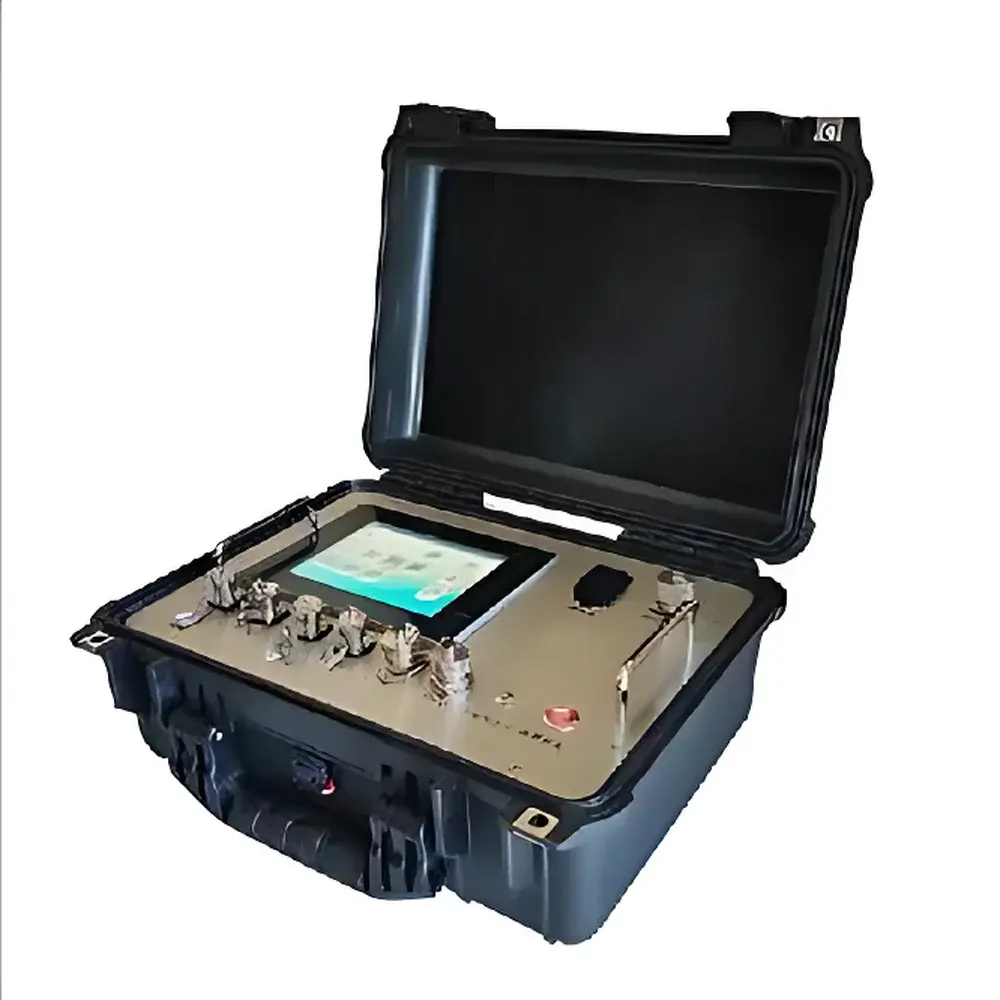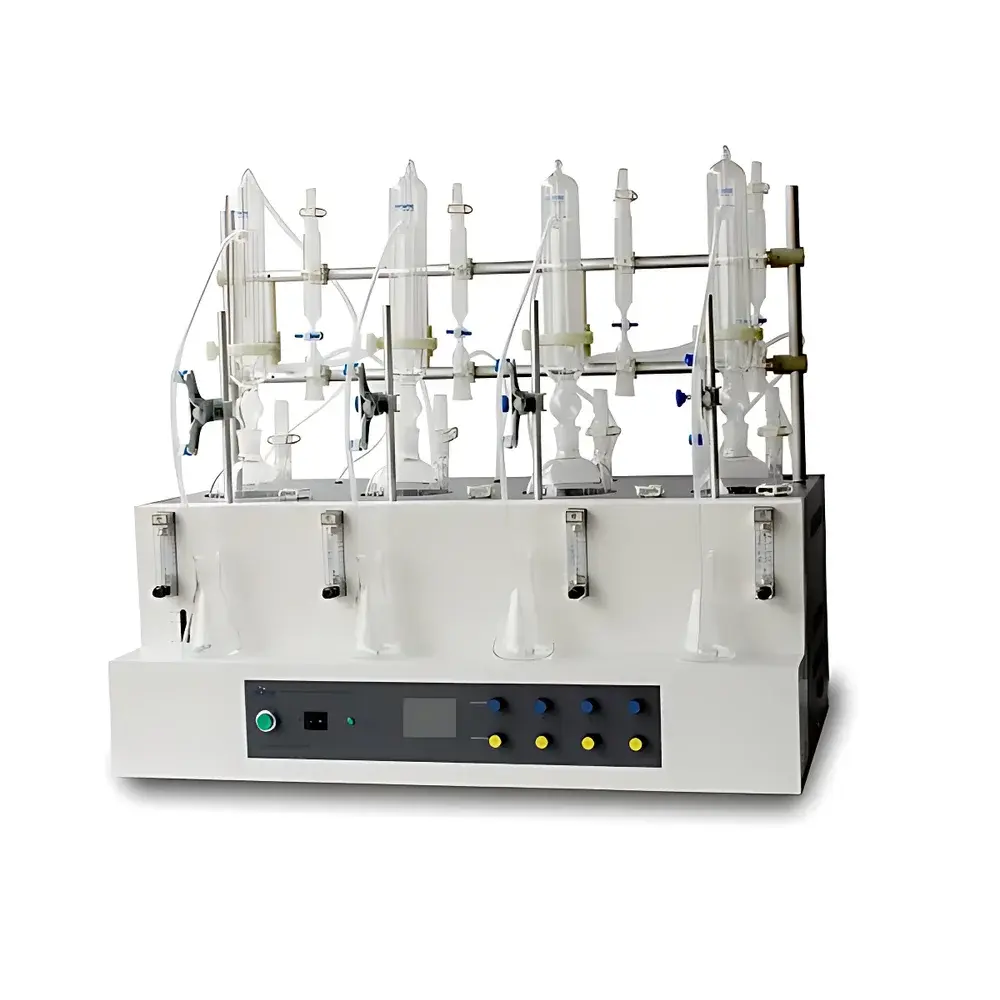
SENTE ST107-1P Pharmacopoeia-Compliant Sulfur Dioxide Residue Analyzer for Traditional Chinese Medicinal Materials
| Brand | SENTE |
|---|---|
| Origin | Shandong, China |
| Manufacturer Type | Direct Manufacturer |
| Product Type | Intelligent Integrated SO₂ Distillation System |
| Model | ST107-1P |
| Detection Range | 0.1–50 mg |
| Detection Limit | >30 mg |
| Sample Capacity | 4 parallel channels |
| Nitrogen Flow Control | 60–600 mL/min per channel (independent) |
| Heating Method | Far-infrared ceramic heater |
| Cooling System | Closed-loop auto-recirculating chiller (no tap water required) |
| Compliance | Designed per Chinese Pharmacopoeia (2015 Edition) Method for SO₂ Residue in TCM materials |
Overview
The SENTE ST107-1P is an intelligent, fully integrated sulfur dioxide (SO₂) residue analyzer engineered specifically for compliance with the Chinese Pharmacopoeia (ChP) 2015 Edition—particularly Chapter 2331 “Determination of Sulfur Dioxide Residue in Traditional Chinese Medicinal Materials and Decoction Pieces.” It implements the official acid-base titration-based distillation method, which remains the statutory, widely adopted analytical protocol across provincial and municipal drug inspection institutes, GMP-certified TCM manufacturers, and research laboratories where cost-effectiveness, regulatory traceability, and operational simplicity are critical. Unlike high-end instrumental alternatives (e.g., GC or IC), the ST107-1P delivers pharmacopoeial equivalence through precise control of distillation kinetics, nitrogen-assisted volatilization, and standardized condensation geometry—ensuring reproducible recovery of SO₂ from complex herbal matrices without reliance on chromatographic separation or ion-selective detection.
Key Features
- Six-function integration in a single benchtop unit: far-infrared heating, reflux distillation, closed-loop cooling, nitrogen purging, magnetic stirring, and receiving-stage agitation—all synchronized and independently controllable.
- Patented sealed recirculating cooling system eliminates dependency on municipal tap water, reducing lab infrastructure requirements and enabling stable operation in environments with inconsistent water pressure or temperature.
- Far-infrared ceramic heating elements provide uniform thermal distribution, enhanced corrosion resistance against acidic distillates, and superior energy efficiency compared to conventional electric heating mantles or wire-wound coils.
- Four independent reaction channels with per-channel adjustable heating power (via analog rotary controls) and individually tunable nitrogen flow (60–600 mL/min), allowing method optimization across diverse sample types—from volatile rhizomes to dense mineral-containing formulas.
- Pharmacopoeia-accurate reflux condenser geometry, modeled directly from ChP 2015 schematic diagrams, ensures consistent condensate return rate and minimizes analyte loss during steam distillation.
- Magnetic stirrers embedded in each receiver flask base enable continuous homogenization of the absorbing solution (e.g., hydrogen peroxide or formaldehyde reagent), improving titration endpoint precision and inter-laboratory reproducibility.
Sample Compatibility & Compliance
The ST107-1P supports solid and semi-solid TCM matrices including raw herbs, sliced decoction pieces, powdered extracts, and processed formulations (e.g., honey-fried or vinegar-baked variants). Its design accommodates samples with varying moisture content, volatile oil composition, and acid-labile constituents—critical for avoiding false-negative results common in poorly controlled distillation setups. The instrument meets core validation prerequisites for ChP-compliant testing: linearity across 0.1–50 mg SO₂ range, repeatability ≤3% RSD (n=6), and robustness under variable ambient humidity and ambient temperature (15–30°C). While not a standalone analytical instrument, it fulfills the sample preparation requirement for Method 2331, and its operational parameters are fully documentable for GLP/GMP audit trails—including nitrogen flow logs, heating duration timestamps, and cooling system status records.
Software & Data Management
The ST107-1P operates via an embedded industrial-grade controller with tactile rotary interface and LED status indicators—intentionally omitting cloud connectivity or proprietary software to ensure long-term maintainability, cybersecurity resilience, and compatibility with regulated laboratory IT environments. All parameter settings (heating power, nitrogen flow, run time) are manually entered and retained in non-volatile memory. For full 21 CFR Part 11 compliance, users integrate the instrument into existing LIMS or ELN workflows by recording setup configurations and raw titration data externally. Optional RS-232 output enables direct logging of runtime events (e.g., start/stop signals, overtemperature alerts) into validated electronic notebooks.
Applications
- Routine SO₂ residue screening in provincial and municipal drug control laboratories performing ChP-mandated batch release testing.
- Method development and validation studies for SO₂ removal process optimization in TCM processing facilities (e.g., sulfur fumigation mitigation).
- Stability testing of sulfur-treated herbs under accelerated storage conditions (40°C/75% RH).
- Reference standard preparation and calibration verification using potassium metabisulfite spike recovery protocols.
- Training platform for pharmacopoeial technique standardization across regional inspection centers and university pharmacognosy labs.
FAQ
Does the ST107-1P replace titration equipment?
No—it performs only the distillation and absorption steps per ChP 2331; manual or automated titration (e.g., with a certified burette or autotitrator) remains required for final quantification.
Can it be used for non-TCM samples such as food or soil?
While technically feasible, its configuration, validation data, and user documentation are exclusively aligned with ChP 2015 TCM matrices; alternative applications require full method revalidation per ISO/IEC 17025.
Is external cooling water mandatory?
No—the built-in closed-loop chiller operates autonomously; tap water connection is neither required nor supported.
What maintenance is required for long-term reliability?
Annual inspection of ceramic heater integrity, nitrogen flowmeter calibration, and condenser tube descaling using dilute nitric acid solution—procedures detailed in the bilingual (EN/CN) technical manual.
How is regulatory compliance demonstrated during audits?
Through documented IQ/OQ protocols (provided), ChP-schematic alignment verification report, and traceable calibration certificates for all adjustable subsystems (flow meters, temperature sensors, timer circuits).