
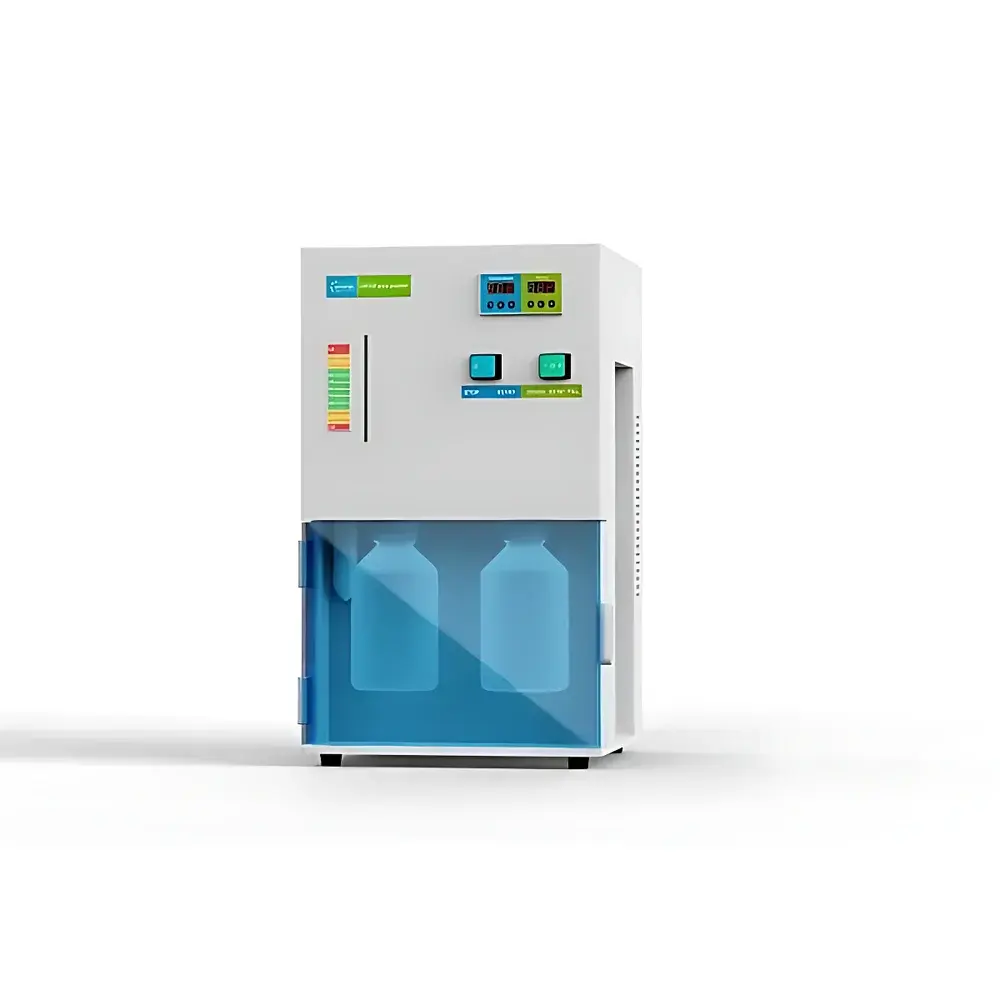
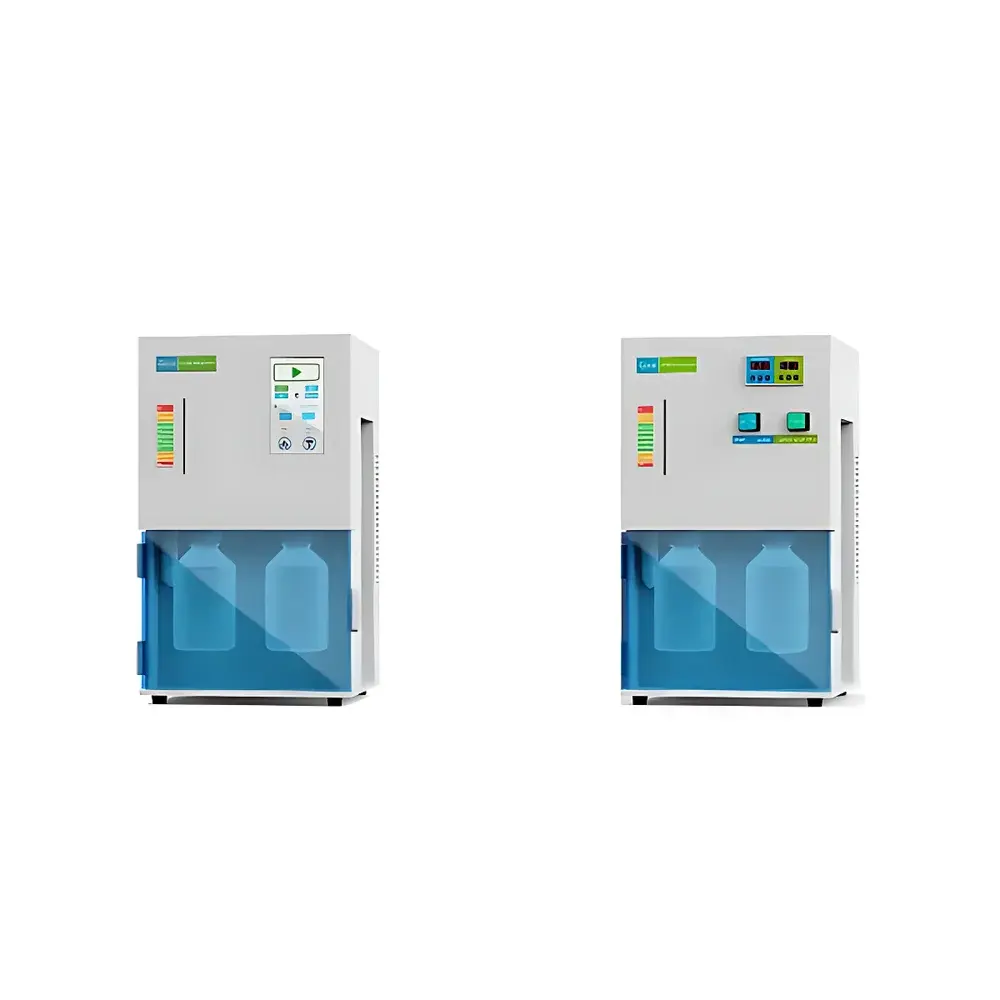
Amerlab AP300S Fully Automated Sub-Boiling Acid Distillation System
| Brand | Amerlab |
|---|---|
| Origin | Guangdong, China |
| Manufacturer Type | Direct Manufacturer |
| Country of Origin | China |
| Model | AP300S |
| Instrument Type | Fluoropolymer (PTFE/PFA) Distillation Apparatus |
| Heating Method | PTC Semiconductor Heating |
| Cooling Method | Integrated Air-Cooled Condenser (No External Chiller Required) |
| Distillation Rate | 70 mL/h (for 65% HNO₃) |
| Ramp Time | 60 min (from 25°C to 110°C) |
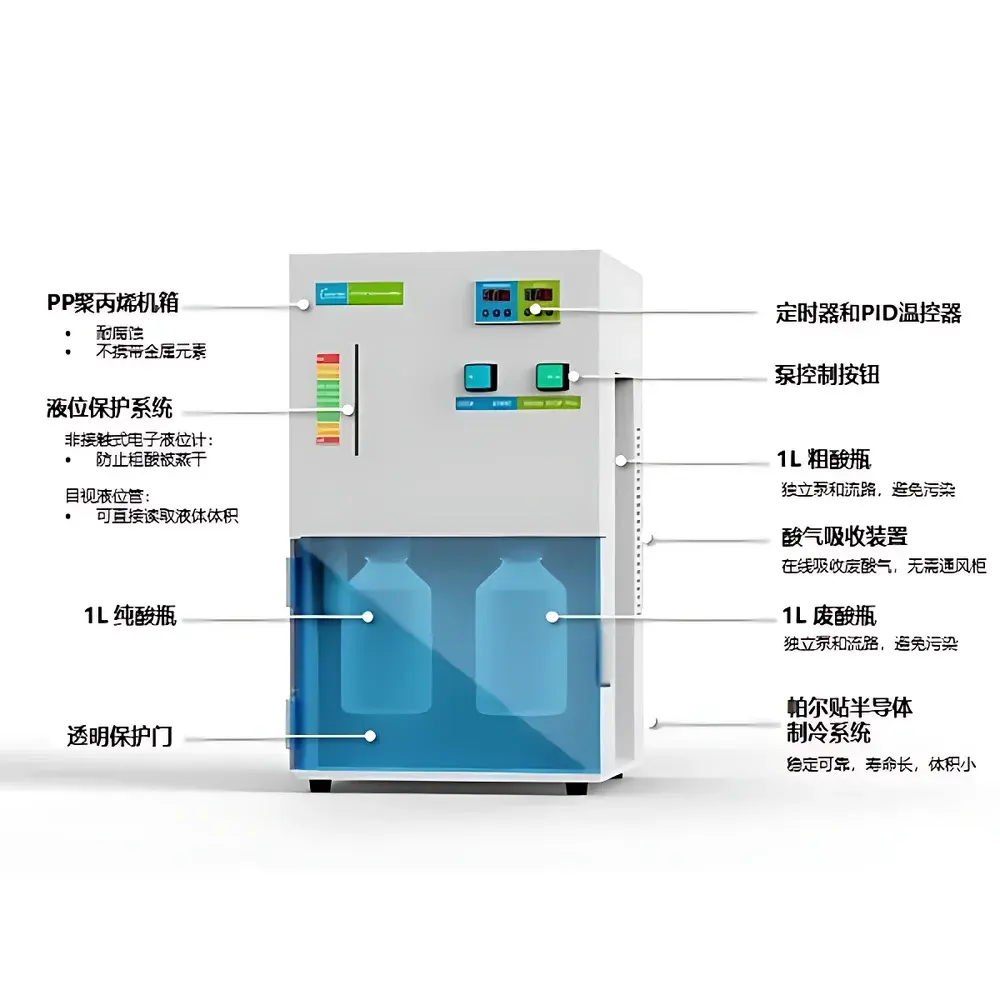
| Endpoint Control | Precision Photoelectric Liquid-Level Sensor |
| Dual Independent Pump System | Acid Feed + Waste Drain |
| Safety Interlocks | Real-Time Level Monitoring (Crude Acid Low/High, Pure Acid Overflow), RTC Immersion Temperature Sensing, Self-Limiting PTC Thermal Regulation |
| Acid Vapor Recovery Efficiency | >99% (Integrated Neutralization & Adsorption) |
| Dimensions | 38 × 35 × 60 cm (W × D × H) |
| Material Contact Path | PTFE, PFA, and Quartz Only |
Overview
The Amerlab AP300S Fully Automated Sub-Boiling Acid Distillation System is engineered for the production of ultra-high-purity mineral acids—specifically nitric, hydrochloric, and hydrofluoric acids—required in trace and ultratrace elemental analysis. Unlike conventional boiling-point distillation, sub-boiling distillation operates below the atmospheric boiling point of the acid, minimizing volatile impurity carryover and thermal decomposition. The AP300S achieves this through precise control of liquid-phase temperature (not heater surface temperature) via RTC (Real-Temperature Calibration) immersion probes—chemically resistant sensors directly immersed in the acid matrix—ensuring sustained operation within the thermodynamically optimal sub-boiling regime (e.g., ~105–110°C for 65% HNO₃ at ambient pressure). This principle underpins its ability to reduce metal contaminants to sub-ppt levels, making it suitable for demanding applications including ICP-MS, HR-ICP-OES, GF-AAS, and hydride-generation atomic fluorescence spectrometry.
Key Features
- Fully automated dual-pump architecture: independent peristaltic pumps for crude acid feeding and waste acid removal—eliminating cross-contamination between feed and product lines.
- Integrated air-cooled condensation system: eliminates dependency on external chillers or tap water, reducing infrastructure requirements and operational complexity.
- RTC immersion temperature sensing: high-stability, acid-resistant Pt100 sensor directly contacting the boiling liquid ensures true bulk-phase temperature feedback—not inferred heater surface readings—enabling reliable sub-boiling maintenance.
- Triple-level electronic liquid monitoring: real-time detection of low crude acid level (prevents dry-heating), high crude acid level (prevents overflow into vapor path), and full pure acid collection vessel (triggers automatic shutdown).
- Passive acid vapor abatement: built-in neutralizing cartridge (CaCO₃-based) and activated carbon adsorption stage achieves >99% removal efficiency for acidic fumes—no external ventilation ducting or fume hood integration required.
- Post-distillation auto-rinse function: programmable ultra-pure water flush cycle cleans the PTFE distillation chamber between runs, ensuring batch-to-batch integrity.
Sample Compatibility & Compliance
The AP300S is compatible with common high-purity-grade mineral acids including HNO₃ (up to 69%), HCl (up to 37%), and HF (up to 49%), all processed exclusively through fluoropolymer (PTFE, PFA) and quartz-wetted components. It conforms to material compatibility standards referenced in ASTM D512 (chloride in water), ISO 17025 Clause 5.5.2 (equipment suitability for intended use), and supports GLP/GMP-aligned workflows through audit-trail-capable operation logging. While not a regulated medical device, its design aligns with safety expectations outlined in ANSI Z9.5–2012 (Laboratory Ventilation) and OSHA 1910.1200 (Hazard Communication), particularly regarding enclosed acid handling and emission control.
Software & Data Management
The AP300S operates via an embedded industrial-grade controller with a 7-inch capacitive touchscreen interface. All critical parameters—including real-time temperature curves, liquid level status, pump actuation timestamps, and distillation duration—are logged internally with UTC timestamping. Data export is supported via USB flash drive in CSV format, enabling integration into LIMS or QA/QC documentation systems. Optional RS-485 Modbus RTU output allows remote monitoring and centralized fleet management in multi-unit laboratory environments. No proprietary software installation is required; exported logs comply with FDA 21 CFR Part 11 principles when paired with institutional electronic signature and access control policies.
Applications
- Preparation of ≤10 ppt metal-grade acids for calibration standard preparation in ICP-MS laboratories.
- Generation of low-blank reagents for digestion of environmental samples (soil, sediment, biota) prior to multi-element quantification.
- Support of semiconductor metrology labs requiring ultra-low sodium, potassium, and transition metal contamination in etchants.
- Refurbishment of partially degraded high-purity acids post-opening—extending usable shelf life beyond vendor-specified expiration windows.
- On-demand acid purification in resource-constrained settings where supply-chain reliability for commercial ultrapure acids is limited.
FAQ
Does the AP300S require connection to a fume hood or external exhaust system?
No. Its integrated acid vapor abatement module—comprising neutralization and adsorption stages—meets occupational exposure limits without auxiliary ventilation.
Can the system distill hydrofluoric acid (HF)?
Yes, provided HF is introduced as ≤49% aqueous solution and handled using appropriate PFA labware; all wetted materials are HF-compatible.
What is the expected lifetime of the PTC heating element and immersion sensor?
Under normal operation (≤8 h/day, proper acid grade input), PTC modules exceed 10,000 operating hours; RTC probes are rated for ≥2 years continuous immersion in hot HNO₃/HCl.
Is validation support available for method transfer or regulatory audits?
Amerlab provides IQ/OQ documentation templates, calibration certificates for RTC sensors, and material compliance statements (RoHS, REACH) upon request.
How does the AP300S compare to glass-based sub-boiling stills in terms of blank performance?
Fluoropolymer construction eliminates alkali metal leaching inherent to borosilicate glass, resulting in consistently lower Na⁺, K⁺, and Ca²⁺ blanks—particularly critical for low-mass ICP-MS isotopes.



