
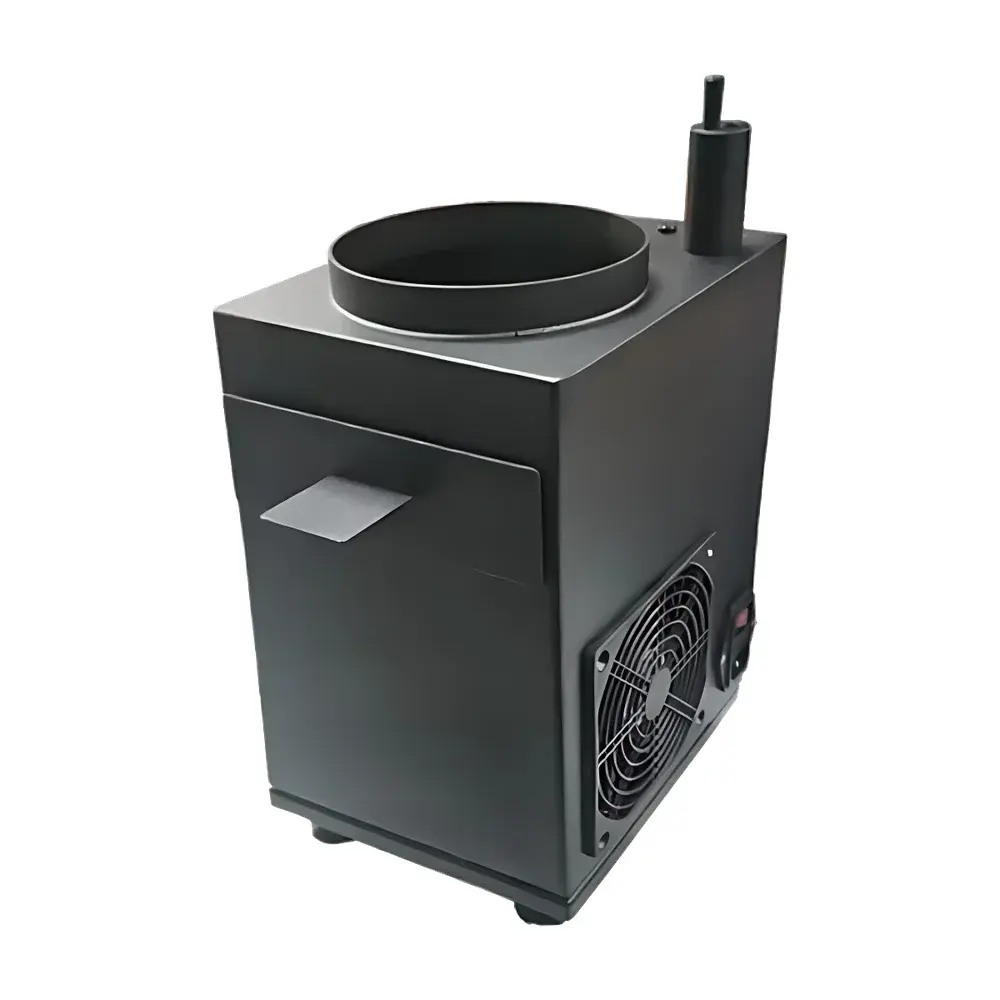
RoacheLab RL-200 AATCC 200 Fabric Drying Rate Tester (Airflow Method)
| Brand | RoacheLab |
|---|---|
| Model | RL-200 |
| Origin | Shanghai, China |
| Power Supply | AC 230 V, 50/60 Hz |
| Wind Tunnel Dimensions | 165 × 165 × 27.5 mm ±1 mm |
| Aperture Diameter | 130.0 mm ±1 mm |
| Air Velocity Range | 0.2–4.5 m/s ±0.1 m/s |
| Temperature Measurement Range (IR Sensor) | 15–50 °C ±0.1 °C |
| Water Dispensing Volume Range | 0.05–4.5 mL |
| Data Interface | USB 2.0 |
| Overall Dimensions | 500 × 500 × 560 mm (L×W×H) |
| Weight | ~40 kg |
Overview
The RoacheLab RL-200 AATCC 200 Fabric Drying Rate Tester is an automated, airflow-based instrumentation system engineered for precise quantification of moisture evaporation kinetics in textile specimens under standardized environmental conditions. It operates in strict accordance with the AATCC Test Method 200–2022, “Drying Rate of Fabrics,” which defines a controlled convective drying protocol using regulated air velocity and thermal monitoring to determine time-resolved water loss profiles. The instrument employs a dual-sensor synchronized acquisition architecture: high-resolution infrared temperature sensing (15–50 °C, ±0.1 °C) captures surface thermal dynamics during desorption, while a calibrated capacitive or resistive moisture sensor tracks real-time mass change. An integrated precision micro-dosing module delivers repeatable water application (0.05–4.5 mL, programmable volume and drop timing), and a closed-loop fan control system maintains air velocity within ±0.1 m/s across the full operational range (0.2–4.5 m/s). This configuration enables reproducible simulation of ambient drying environments relevant to garment performance evaluation, sportswear functional testing, and technical textile development.
Key Features
- Compliance-certified airflow chamber with geometrically defined aperture (130.0 mm ±1 mm) and wind tunnel (165 × 165 × 27.5 mm ±1 mm) per AATCC 200 specifications
- High-stability air velocity regulation via feedback-controlled DC blower, supporting stepwise or ramped airflow profiles
- Synchronized IR surface temperature monitoring and gravimetric/moisture sensing for concurrent thermal and hygric response tracking
- Programmable micro-dosing unit with volumetric accuracy ≤±1% full scale, enabling standardized wetting protocols
- USB 2.0 interface for real-time bidirectional communication between embedded controller and host PC
- Modular hardware design facilitating routine calibration verification and field serviceability without disassembly
- Rugged aluminum alloy chassis (40 kg) with vibration-damped base, optimized for benchtop deployment in QC labs and R&D facilities
Sample Compatibility & Compliance
The RL-200 accommodates flat textile specimens up to 150 mm × 150 mm, secured via optional sample pressure bars to ensure consistent airflow boundary conditions. It supports woven, knitted, nonwoven, laminated, and coated fabrics—including hydrophobic, hydrophilic, and phase-change material (PCM)-integrated substrates. All measurement sequences adhere to AATCC TM200 procedural requirements for initial saturation, dwell time, airflow initiation, and endpoint determination (e.g., <5% residual moisture or asymptotic drying rate). Instrument validation documentation includes traceable calibration certificates for airflow, temperature, and dispensing subsystems. While not certified to ISO/IEC 17025, the system supports GLP-compliant operation when paired with version-controlled software and audit-trail-enabled data management protocols.
Software & Data Management
The proprietary RL-200 Control Suite (v3.x) runs on Windows 10/11 and provides full test sequence orchestration: wetting parameter definition, airflow ramp scheduling, sensor synchronization, and automatic endpoint detection. Raw data streams (time-stamped velocity, temperature, moisture signal) are logged at ≥10 Hz and stored in HDF5 format for integrity and long-term archival. Visualization tools generate overlay plots of drying curves (moisture % vs. time), derivative drying rate profiles (dM/dt), and comparative bar charts across multiple specimens. Export options include CSV, PDF reports with embedded metadata (operator ID, timestamp, calibration status), and image-capturable graphical summaries. Software supports FDA 21 CFR Part 11–aligned user access controls (role-based login), electronic signatures, and immutable audit logs for regulatory submissions.
Applications
- Quantitative comparison of wicking efficiency and evaporative cooling capacity in athletic apparel textiles
- Validation of finish durability after repeated laundering cycles (per AATCC TM135)
- Development benchmarking of smart textiles incorporating moisture-responsive polymers or nanocoatings
- Quality conformance testing for medical gowns, wound dressings, and hygiene products requiring rapid dry-back performance
- Correlation studies between drying kinetics and fiber morphology (e.g., cross-sectional shape, pore distribution) via SEM–drying rate mapping
- Supporting ASTM D737 (air permeability) and ISO 11092 (thermal and water-vapor resistance) method harmonization efforts
FAQ
Does the RL-200 comply with AATCC TM200 revision year 2022?
Yes — all mechanical dimensions, airflow tolerances, sensor specifications, and procedural logic align with the current AATCC TM200–2022 edition.
Can the system be integrated into a LIMS environment?
Direct LIMS integration is not built-in, but CSV/PDF exports and timestamped HDF5 archives support manual or scripted ingestion into third-party laboratory information management systems.
Is calibration traceable to NIST or equivalent national standards?
Air velocity and IR temperature sensors are calibrated using NIST-traceable reference instruments; calibration certificates are supplied with each unit and updated annually upon service.
What maintenance intervals are recommended for sustained accuracy?
Fan filter replacement every 6 months; annual verification of dispensing volume accuracy and thermal sensor drift; biannual airflow profile mapping using anemometer cross-check.
Is the software validated for GMP-regulated environments?
The software is not formally 21 CFR Part 11 validated out-of-the-box, but its audit trail, electronic signature, and configuration lock features enable customer-led validation per internal SOPs.



