
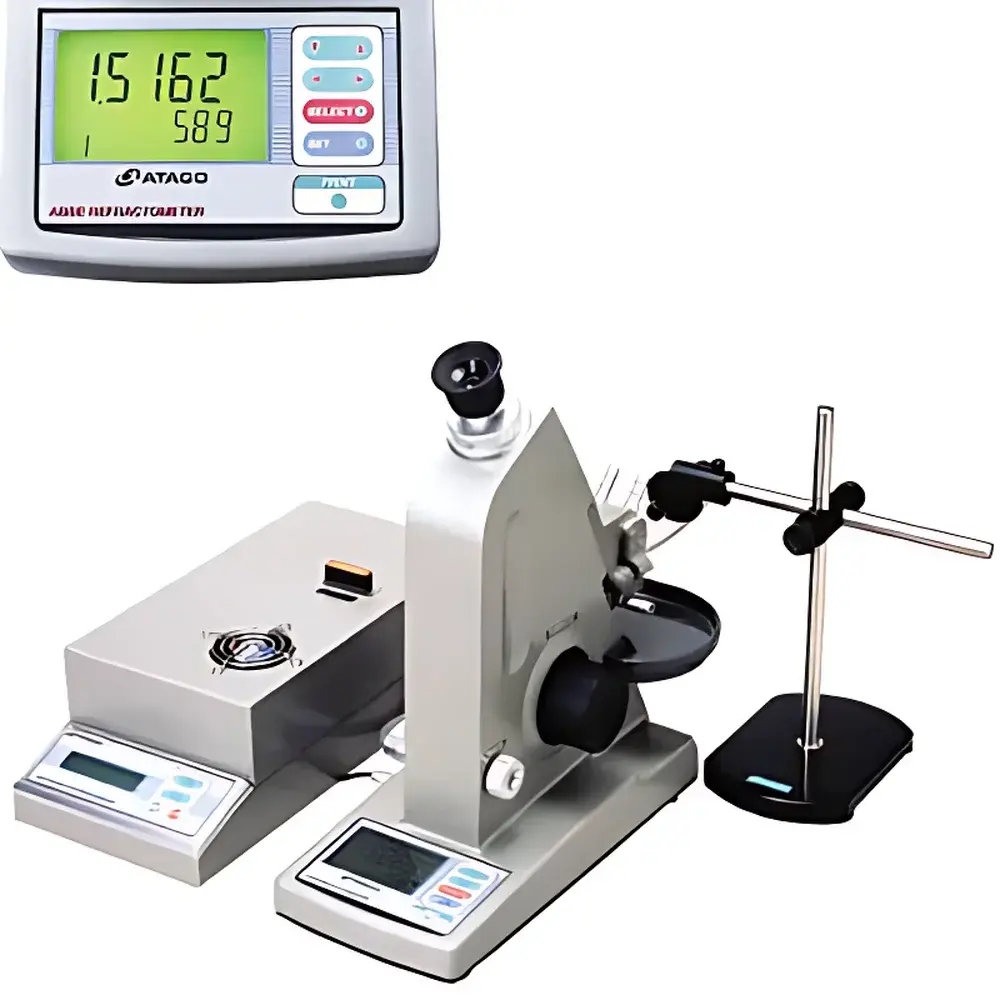
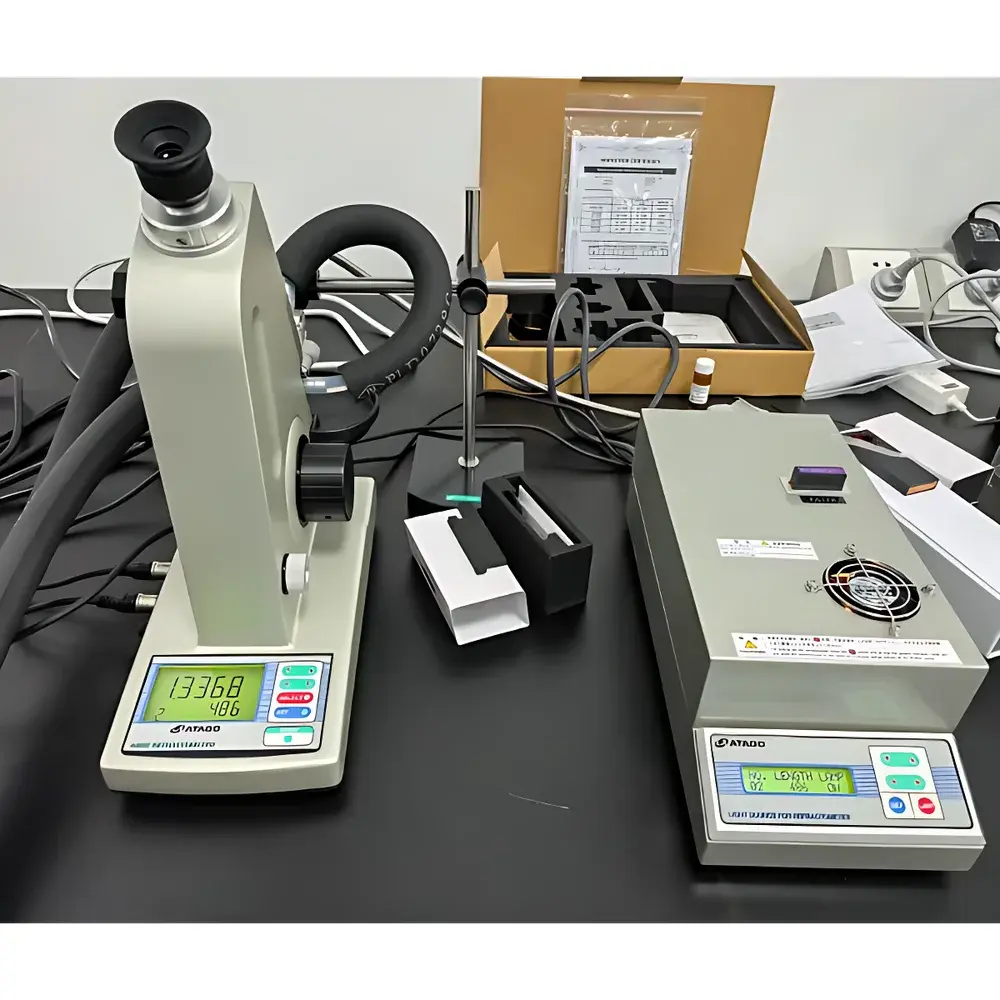
ATAGO DR-M2 Multi-Wavelength Abbe Refractometer for Liquid Crystal Thin Films and Solid Materials
| Brand | ATAGO |
|---|---|
| Origin | Japan |
| Model | DR-M2 |
| Type | Benchtop Refractometer |
| Temperature Control | Yes |
| Digital Display | Yes |
| Refractive Index Range | 1.3278–1.6840 |
| Accuracy | ±0.0002 |
Overview
The ATAGO DR-M2 Multi-Wavelength Abbe Refractometer is a precision optical instrument engineered for high-accuracy refractive index (nD) measurement of both transparent liquids and solid materials—including liquid crystal thin films, optical polymers, glasses, and crystalline substrates—across multiple discrete wavelengths (typically 486.1 nm, 589.3 nm, and 656.3 nm, corresponding to the C-, D-, and F-lines of the Fraunhofer spectrum). Based on the classical Abbe principle, it employs a collimated light beam incident at the critical angle onto a prism-sample interface; the resulting total internal reflection boundary is optically detected and converted into a digital refractive index value via calibrated angular encoding. Unlike single-wavelength refractometers, the DR-M2 enables dispersion analysis (dn/dλ) by acquiring nλ at standardized spectral lines—critical for characterizing wavelength-dependent optical behavior in advanced photonic materials and anisotropic thin-film systems.
Key Features
- Multi-wavelength capability with selectable spectral lines (e.g., 486.1 nm, 589.3 nm, 656.3 nm) for full dispersion profiling and Cauchy coefficient derivation
- High-resolution digital readout with ±0.0002 refractive index accuracy and 0.0001 resolution, traceable to NIST-certified reference standards
- Integrated Peltier temperature control (±0.1 °C stability) ensuring thermally stabilized measurements compliant with ISO 21147 and ASTM D1218
- Benchtop design with ergonomic sample stage, dual-mode prism interface (liquid drop or solid contact), and anti-vibration base for stable operation in QC labs
- Optimized optical path for low-stray-light performance and minimal chromatic aberration across visible spectrum
- Compliance with GLP documentation requirements through audit-trail-enabled data logging (when paired with optional PC software)
Sample Compatibility & Compliance
The DR-M2 accommodates a broad range of sample types: homogeneous liquids (e.g., solvents, monomers, LC mixtures), viscous media (polymer precursors, resins), and flat, polished solids (optical glass wafers, sapphire substrates, ITO-coated films, and aligned liquid crystal cells ≥0.5 mm thickness). For solid measurement, the instrument utilizes direct-contact prism coupling with index-matching fluid (refractive index matched to prism material, typically n ≈ 1.70), enabling reliable nλ determination without destructive sectioning. All operational protocols align with ISO 17025-accredited testing practices and support regulatory submissions under FDA 21 CFR Part 11 when used with validated software configurations. Calibration verification follows ATAGO’s documented procedure using certified reference oils (e.g., Cargille Series AA) and NIST-traceable solid standards.
Software & Data Management
The DR-M2 operates as a standalone instrument with real-time LCD display, but integrates seamlessly with ATAGO’s optional WinCT-Refracto software (Windows-based) for advanced data handling. This software supports multi-point dispersion curve plotting, automatic Cauchy equation fitting (n(λ) = A + B/λ² + C/λ⁴), batch report generation (PDF/CSV), user-access-level management, and electronic signature functionality compliant with 21 CFR Part 11 Annex 11 requirements. Audit trails record operator ID, timestamp, calibration status, environmental parameters (temperature), and raw angular encoder values—ensuring full data integrity for GMP/GLP audits.
Applications
- Optical Materials R&D: Characterization of dispersion properties in photoresists, OLED encapsulation layers, AR/HR coatings, and cholesteric LC films for tunable filters and reflective displays
- Pharmaceutical Manufacturing: Identity testing and concentration monitoring of active pharmaceutical ingredients (APIs) and excipients where nD serves as a release specification per USP
- Advanced Electronics: Refractive index mapping of spin-coated polymer dielectrics and low-k films in semiconductor packaging and flexible electronics fabrication
- Food & Beverage QA: Non-destructive verification of sugar content (Brix), purity assessment of honey and syrups, and authenticity screening of essential oils via spectral dispersion fingerprints
- Chemical Process Control: Real-time monitoring of polymerization degree in acrylic resins and epoxy formulations through refractive index drift trends
FAQ
Can the DR-M2 measure anisotropic liquid crystal films in their aligned state?
Yes—when mounted on a rotation stage with precise azimuthal alignment, the DR-M2 can resolve ordinary (no) and extraordinary (ne) indices in uniaxial nematic or smectic phases using polarized illumination mode (optional accessory).
Is temperature calibration required before each measurement?
No—the integrated Peltier system maintains setpoint stability within ±0.1 °C; however, daily verification with a certified thermometer and reference fluid is recommended per ISO/IEC 17025 clause 7.7.
Does the instrument comply with pharmacopeial standards for refractive index testing?
Yes—its measurement uncertainty, repeatability, and traceability meet the requirements of USP , EP 2.2.6, and JP 2.05 for official refractive index determinations.
What solid sample preparation is necessary?
Samples must be optically flat (surface roughness < λ/10), parallel-faced, and ≥5 mm × 5 mm in area. No polishing is required if supplied with manufacturer-certified surface finish (e.g., λ/4 flatness).
How is dispersion data used in optical design workflows?
Measured n(λ) values feed directly into ray-tracing software (e.g., Zemax OpticStudio, CODE V) for lens prescription optimization, coating stack design, and tolerance analysis of chromatic aberration.




