
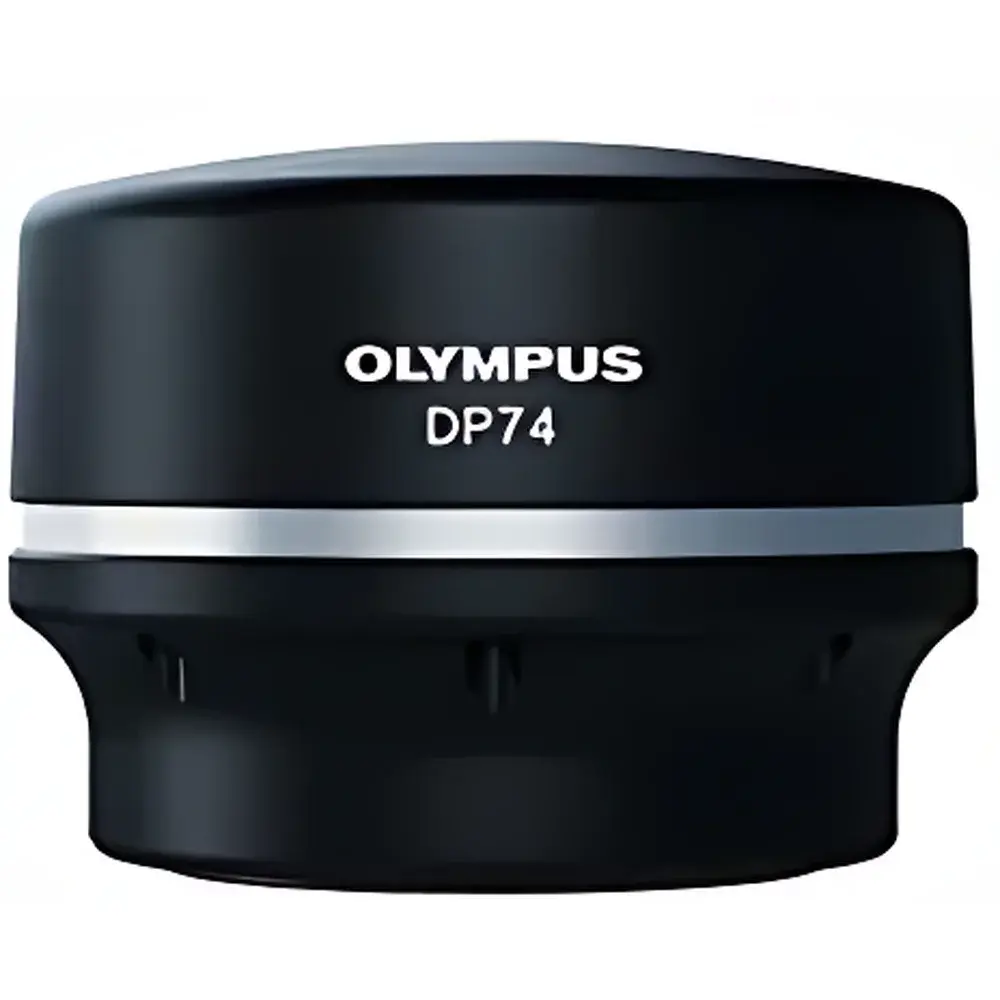
Olympus DP74 Digital Microscope Camera
| Brand | Olympus |
|---|---|
| Origin | Japan |
| Manufacturer | Olympus Corporation |
| Origin Category | Imported |
| Model | DP74 |
| Pricing | Upon Request |
Overview
The Olympus DP74 is a high-performance digital microscope camera engineered for precision industrial inspection, materials science research, and semiconductor quality control. Built around a globally synchronized 1920 × 1200 CMOS sensor, the DP74 delivers full-HD live imaging at 60 frames per second (fps) without binning or interpolation—enabling real-time focusing, rapid navigation, and dynamic observation of moving or thermally sensitive specimens. Its optical architecture is optimized for integration with Olympus BX3M, BX53, and other upright and inverted research-grade microscopes, supporting brightfield, darkfield, differential interference contrast (DIC), and fluorescence modalities. The camera operates on a true hardware-based timing engine that ensures pixel-level synchronization between exposure, readout, and trigger signals—critical for time-resolved metrology and automated inspection workflows.
Key Features
- Real-time 1920 × 1200 resolution imaging at 60 fps with zero latency and no image degradation during continuous acquisition
- Live HDR (High Dynamic Range) mode: captures and fuses multiple exposures in real time to preserve detail in both highlight and shadow regions—essential for inspecting reflective surfaces (e.g., chromium-coated wafers) or low-contrast defects on LED dies
- Position Navigator: generates an auto-updating macro-map of the specimen field-of-view in a dedicated window; maintains spatial context across objective changes and manual stage movements—even without motorized or encoded stages
- Advanced 3-CMOS pixel-shift technology: combines sub-pixel sensor translation with RGB color interpolation to achieve effective 20.7 megapixel resolution from a native 2.3 MP sensor—delivering enhanced edge acuity and chromatic fidelity without compromising frame rate
- Wide signal gain range (ISO 200–6400 equivalent): enabled by low-noise analog front-end electronics and optimized CMOS drive circuitry—supports low-light fluorescence imaging of semiconductor particulates and weakly stained biological samples
Sample Compatibility & Compliance
The DP74 is validated for use in ISO/IEC 17025-accredited laboratories and supports GLP/GMP-aligned documentation workflows when paired with Olympus Stream software. It complies with IEC 61000-6-3 (EMC emission standards) and IEC 61000-6-2 (immunity), ensuring stable operation in electromagnetically noisy cleanroom environments. Its optical interface adheres to the C-mount standard (17.526 mm flange focal distance) and is compatible with all Olympus microscope trinocular ports equipped with standardized photo tubes. For regulated industries—including semiconductor fabrication, medical device QA, and advanced materials R&D—the system supports audit-ready metadata embedding (timestamp, objective ID, magnification, illumination settings) and optional FDA 21 CFR Part 11-compliant user authentication and electronic signature modules via Stream software configuration.
Software & Data Management
The DP74 is natively supported by Olympus Stream 2.5+ software—a modular, workflow-driven platform designed for industrial metrology and scientific imaging. Stream provides calibrated measurement tools (line, area, particle count, grain size analysis per ASTM E112), multi-focus extended depth-of-field (EFI) reconstruction, and mosaic image assembly (MIA) with automatic seam blending and distortion correction. All acquired images retain embedded EXIF-style metadata—including exposure parameters, sensor temperature, and hardware calibration flags—for traceable data lineage. Raw image files are saved in TIFF format with 12-bit linear intensity values; processed reports export as PDF/A-1b or Excel-compatible CSV with configurable templates aligned to internal SOPs or ISO 9001 documentation requirements.
Applications
- Semiconductor wafer inspection: high-fidelity capture of photolithographic patterns, etch residues, and micro-defects on 200 mm and 300 mm substrates
- Advanced materials characterization: surface topography analysis of thin films, graphene layers, and nanostructured coatings under reflected light or darkfield illumination
- Failure analysis labs: correlation of optical imaging with SEM/FIB cross-section data via georeferenced coordinate mapping using Position Navigator
- Quality assurance in precision manufacturing: dimensional verification of micro-machined components, solder joint integrity assessment, and coating uniformity evaluation
- Fluorescence-based contamination detection: low-SNR imaging of fluorescent particles on silicon wafers or optical substrates with adaptive gain control
FAQ
Does the DP74 support hardware triggering for synchronized multi-camera or stage-motion acquisition?
Yes—the DP74 features TTL-compatible input/output trigger ports with programmable delay and pulse width, enabling precise coordination with motorized stages, shutters, or external sensors.
Can Position Navigator maps be exported and reused across sessions or instruments?
Yes—navigation maps are saved as standalone .map files alongside image data and can be reloaded into Stream to restore spatial context or align legacy datasets.
Is Live HDR processing performed on-device or in software?
All HDR fusion, tone mapping, and noise suppression are executed in real time by the camera’s onboard FPGA—no host CPU load or latency penalty is incurred.
What is the maximum sustained frame rate at full resolution during TIFF sequence capture?
At 1920 × 1200, the DP74 sustains 60 fps over USB 3.0 with lossless compression enabled; raw burst capture is limited only by host storage bandwidth and buffer depth.
Does the 3-CMOS mode affect dynamic range or read noise performance?
No—the pixel-shift sequence preserves full well capacity and read noise characteristics of the base sensor; dynamic range remains consistent across all operational modes.



