
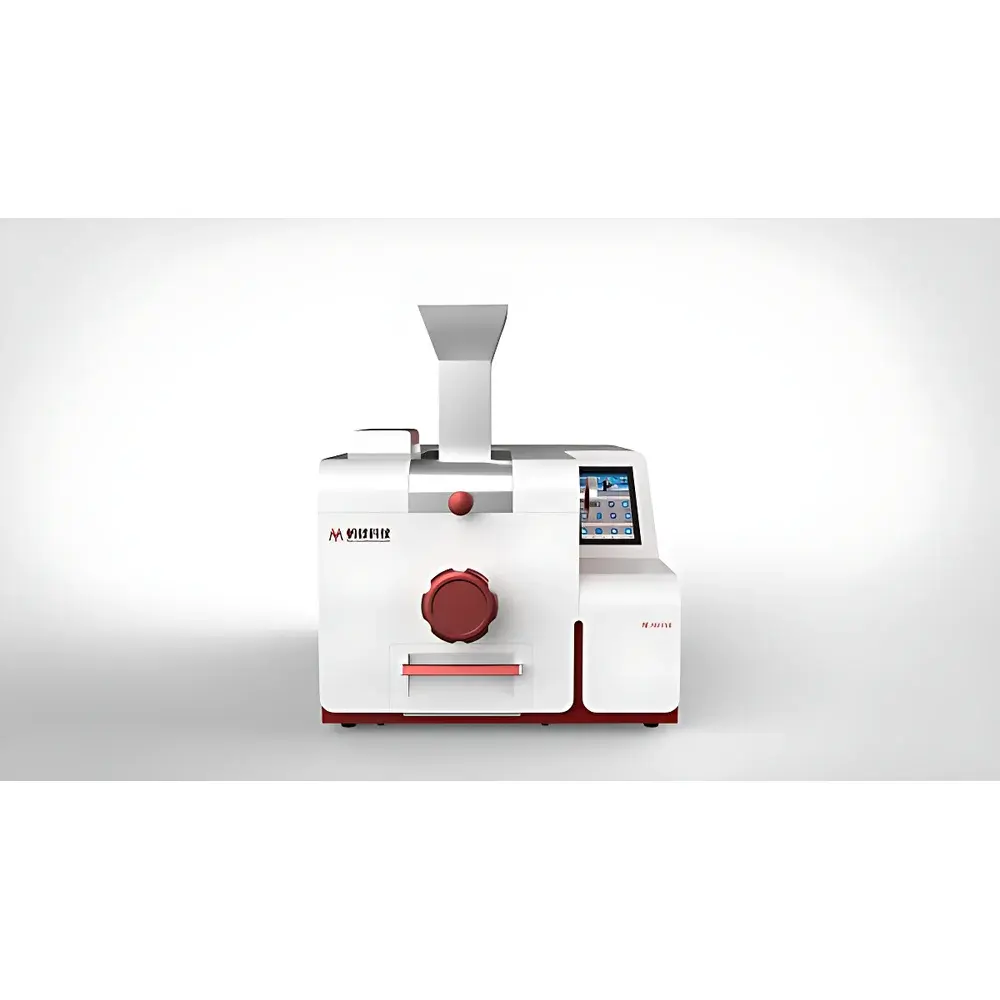
Ants Scientific Instruments AM750 Laboratory Jaw Crusher
| Brand | Ants Scientific Instruments |
|---|---|
| Origin | Beijing, China |
| Manufacturer Type | Authorized Distributor |
| Country of Origin | China |
| Model | AM750 |
| Instrument Type | Jaw Crusher |
| Sample Suitability | Hard, Brittle, and Medium-Hard Materials |
| Output Particle Size | 0.01–0.5 mm |
| Maximum Feed Size | 40 mm |
| Adjustable Discharge Gap | 0.01–5 mm (digital readout) |
| Batch Capacity | 100 mL / 500 mL / 1 L / 3 L |
| Jaw Plate Materials | Six optional compositions (e.g., hardened steel, tungsten carbide, ceramic, stainless steel, manganese steel, corrosion-resistant alloy) |
| Drive Mode | Reversible motor with overload protection |
| Safety Features | Interlocked feed hopper lid, removable collection drawer with position sensor |
Overview
The Ants Scientific Instruments AM750 Laboratory Jaw Crusher is an engineered solution for controlled primary size reduction of solid, heterogeneous samples in analytical and quality control laboratories. Based on the classic single-toggle jaw crushing principle—where material is compressed between a fixed and a moving jaw plate driven by an eccentric shaft—the AM750 delivers reproducible, low-contamination comminution for downstream analysis including XRF, ICP-OES, XRD, and geochemical assay preparation. Its compact footprint (W × D × H ≈ 380 × 420 × 560 mm), low-noise operation (<72 dB(A)), and modular design align with ISO/IEC 17025-compliant laboratory workflows. Unlike high-energy impact mills, the AM750 applies compressive force without significant heat generation or amorphization, preserving mineral phase integrity and minimizing elemental redistribution in geological and metallurgical samples.
Key Features
- Digitally adjustable discharge gap (0.01–5 mm) with real-time LED display and zero-point calibration function to compensate for jaw wear over time
- Reversible DC motor drive enabling bidirectional jaw motion—reducing jamming risk, extending jaw plate service life, and improving throughput consistency
- Six interchangeable jaw plate material options: hardened tool steel (standard), tungsten carbide, alumina ceramic, 316 stainless steel, Mn13 high-manganese steel, and acid-resistant Hastelloy C-276—selected per sample abrasiveness and contamination sensitivity
- Front-access, hinged feed hopper with integrated safety interlock: automatic motor shutdown when open; prevents splash-back and operator exposure during loading
- Removable, graduated collection drawer with mechanical position detection—ensures full engagement before operation and enables rapid sample transfer without spillage
- Integrated thermal overload protection, emergency stop button, and IP54-rated enclosure for dust resistance in shared lab environments
Sample Compatibility & Compliance
The AM750 is validated for routine processing of ores (e.g., bauxite, hematite, chalcopyrite), soil aggregates, slag, refractory ceramics, glass cullet, and construction materials. It complies with ASTM D5744 (Standard Practice for Preparation of Solid Waste Samples for Elemental Analysis) and supports GLP/GMP-aligned sample prep protocols. Jaw plate material selection follows ISO 11269-2 guidelines for minimizing analyte leaching in trace-metal analysis. All electrical components meet CE and RoHS directives. The device does not require external cooling or exhaust ducting, simplifying integration into fume-hood-free analytical labs.
Software & Data Management
While the AM750 operates as a stand-alone mechanical unit, its digital gap controller logs calibration timestamps and gap settings (via internal non-volatile memory) for audit trail generation. Optional RS-232/USB interface enables integration with LIMS via ASCII command protocol (e.g., “GAP?”, “GAP=0.25”, “CALIBRATE”). Gap adjustment history and motor runtime are exportable as CSV for FDA 21 CFR Part 11-compliant record retention when paired with validated third-party data acquisition software.
Applications
- Geochemical exploration: homogenizing drill core fragments prior to fusion bead preparation for XRF quantification
- Environmental monitoring: reducing field-collected soil and sediment composites to ≤0.5 mm for EPA Method 6010D digestion
- Materials R&D: pre-crushing sintered ceramics or optical glass blanks before planetary milling or laser ablation target fabrication
- Recycling QA/QC: size-reducing electronic waste fractions (PCBs, battery casings) for LIBS or SEM-EDS compositional screening
- Academic teaching labs: demonstrating mechanical comminution principles under controlled, repeatable conditions
FAQ
What is the maximum recommended feed size, and how does oversize material affect performance?
The AM750 accepts feed particles up to 40 mm. Larger pieces may cause uneven stress distribution, premature jaw wear, or feed channel blockage—always pre-screen samples using ASTM E11 wire mesh sieves.
Can the AM750 be used for wet or sticky samples?
No. This is a dry-crushing system only. Moisture content >2% or cohesive materials (e.g., clay-rich soils) require prior drying or alternative equipment such as a freeze-dryer + mortar grinder sequence.
How often should zero-point calibration be performed?
Calibration is recommended after every 50 operating hours or following jaw plate replacement—documented in the maintenance log per ISO/IEC 17025 Section 6.4.3.
Is the collection drawer compatible with standard analytical sample containers?
Yes. The 3 L drawer features a 100 mm diameter outlet port with NPT 1/2″ threading, allowing direct coupling to certified polypropylene or HDPE sample jars meeting ASTM D892 specifications.
Does the instrument support IQ/OQ/PQ documentation packages?
Ants Scientific Instruments provides factory-verified IQ/OQ templates (PDF/Word) and can supply PQ test protocols upon request—validated against NIST-traceable reference standards (e.g., SRM 25b Basalt).
Related Products



