
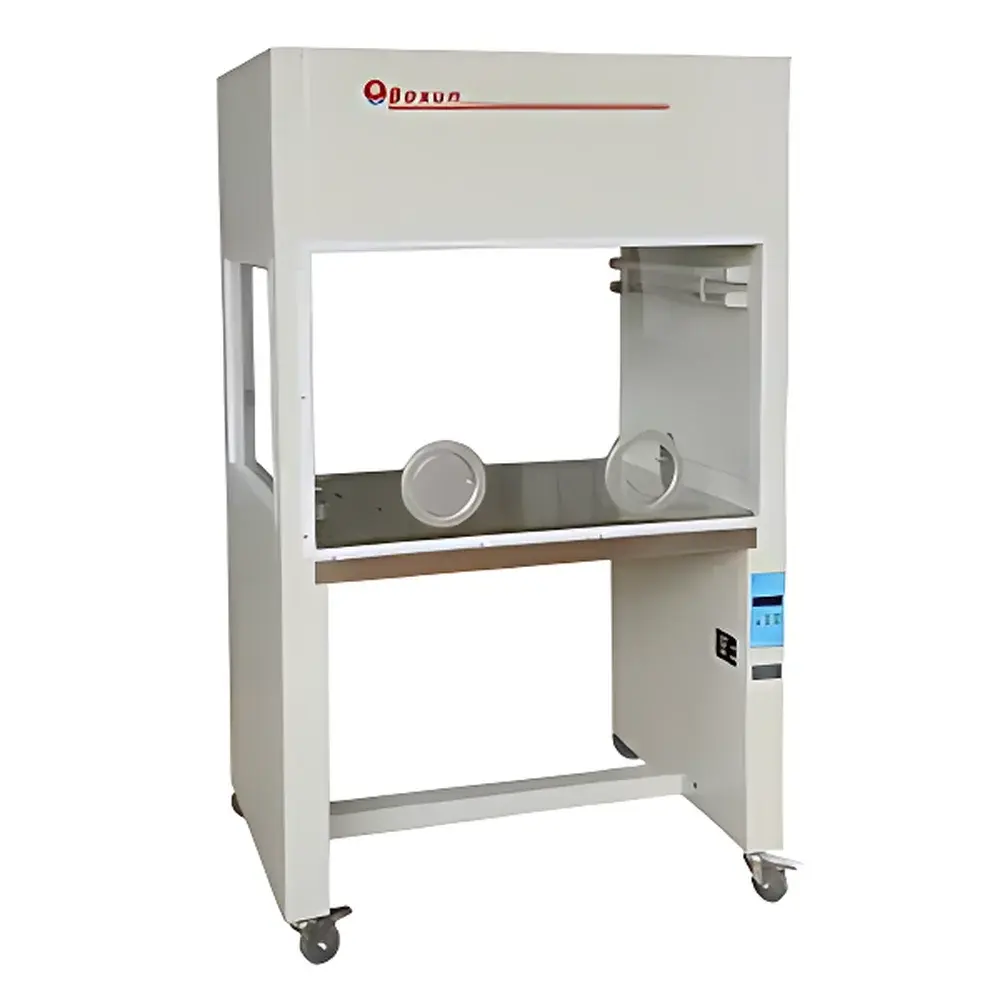
BOXUN SW-CJ-1FD Vertical Flow Clean Bench
| Brand | BOXUN |
|---|---|
| Origin | Shanghai, China |
| Manufacturer Type | Direct Manufacturer |
| Product Category | Domestic |
| Model | SW-CJ-1FD |
| Price Range | USD 700–1,400 (FOB) |
| Instrument Type | Vertical Flow Clean Bench |
| Cleanliness Class | ISO Class 5 (100-level, ≥99.99% filtration efficiency for particles ≥0.5 µm) |
| Noise Level | ≤67 dB(A) |
| User Capacity | Single-user, single-face configuration |
| Airflow Pattern | Vertical downward laminar flow |
| Working Surface Wind Speed | 0.3–0.6 m/s (adjustable in six discrete steps) |
| Vibration Amplitude (peak-to-peak) | ≤5 µm (X/Y/Z axes) |
| Illumination | ≥300 lux |
| Work Area Dimensions (W×D×H) | 870 × 700 × 520 mm |
| Overall Dimensions (W×D×H) | 990 × 724 × 1650 mm |
| HEPA Filter Specification | 820 × 615 × 50 mm (single unit) |
| Lighting | 20 W fluorescent lamp × 1 |
| UV Germicidal Lamp | 20 W × 1 (timer-controlled, 0–999 min) |
| Net Weight | 110 kg |
| Power Consumption | 0.15 kW |
| Electrical Supply | AC 220 V ±10%, 50/60 Hz |
Overview
The BOXUN SW-CJ-1FD Vertical Flow Clean Bench is an ISO Class 5-certified laminar flow workstation engineered to deliver a controlled, particle-free microenvironment for non-sterile but contamination-sensitive laboratory operations. Operating on the principle of vertical unidirectional airflow—generated by a high-efficiency centrifugal blower and conditioned through a dual-stage filtration system—the unit establishes a consistent downward laminar stream across the work surface. This airflow profile minimizes turbulent mixing, suppresses cross-contamination between samples and operators, and prevents ambient particulates from re-entering the working zone. Designed for applications where aseptic technique is required but full enclosure or positive-pressure isolator functionality is unnecessary, the SW-CJ-1FD serves as a foundational engineering control in biosafety Level 1 (BSL-1) and select BSL-2 workflows. Its architecture complies with core principles outlined in ISO 14644-1 (Cleanrooms and associated controlled environments) and aligns with Good Laboratory Practice (GLP) facility requirements for environmental monitoring and sample preparation.
Key Features
- Vertical laminar airflow system with six-step adjustable wind speed (0.3–0.6 m/s), enabling optimization for diverse procedural sensitivities and operator comfort.
- Dual-stage air filtration: pre-filter (medium-efficiency, G4 class) extends service life of the terminal HEPA filter (ISO 14644-1 H13 grade, ≥99.99% @ 0.5 µm), ensuring long-term performance stability and reduced maintenance frequency.
- Electrostatically coated cold-rolled steel housing and SUS304 brushed stainless steel work surface—corrosion-resistant, non-porous, and compatible with common laboratory disinfectants (e.g., 70% ethanol, diluted sodium hypochlorite).
- Integrated LCD controller with tactile membrane switches; independent, timer-enabled controls for UV germicidal irradiation (0–999 min) and task lighting ensure operational flexibility and safety compliance.
- Vertically oriented, quasi-enclosed work chamber with downward-flowing air curtain—effectively isolates the work area from room air infiltration while maintaining ergonomic access.
- Movable sash with auxiliary access door minimizes odor dispersion during volatile reagent handling and enhances personnel protection without compromising laminar integrity.
Sample Compatibility & Compliance
The SW-CJ-1FD supports open-vessel procedures involving microbial cultures, cell line passaging, media preparation, PCR setup, and analytical sample handling where external airborne contamination poses a critical risk. It is not intended for use with hazardous biological agents requiring containment (e.g., BSL-3 pathogens) or volatile organic compounds requiring exhaust ducting. The unit meets structural and performance benchmarks referenced in ISO 14644-1 (Class 5), ISO 14644-3 (test methods for cleanroom performance), and JIS B 9920 (Japanese standard for laminar flow clean benches). While not certified to NSF/ANSI 49 (which applies to biosafety cabinets), its design adheres to fundamental airflow velocity, uniformity, and particle count validation protocols used in GLP-compliant laboratories undergoing internal audit or regulatory inspection.
Software & Data Management
The SW-CJ-1FD operates via embedded hardware-based logic with no external software dependency. All operational parameters—including fan speed setting, UV exposure duration, and illumination status—are retained in non-volatile memory and displayed in real time on the integrated LCD panel. No data logging, remote monitoring, or network connectivity is provided, consistent with its role as a standalone engineering control rather than a digitally integrated instrument. For laboratories operating under FDA 21 CFR Part 11 or EU Annex 11 requirements, manual logbook entries documenting daily UV sterilization cycles, filter replacement dates, and periodic airflow verification (per ISO 14644-3 Annex B) are recommended to support traceability and audit readiness.
Applications
- Preparation of sterile culture media and reagents in microbiology and molecular biology labs.
- Handling of primary cell cultures and sensitive monoclonal antibody production intermediates.
- Environmental sampling preparation—including air, water, and surface swab processing—prior to microbial enumeration or identification.
- Quality control testing in pharmaceutical excipient manufacturing and medical device packaging validation.
- Calibration and setup of analytical instruments (e.g., HPLC autosamplers, mass spectrometer sample introduction systems) where dust or particulate interference must be eliminated.
- Electronics assembly and inspection of precision optical components in low-particulate R&D environments.
FAQ
Is the SW-CJ-1FD suitable for handling infectious agents?
No. This is a clean bench—not a biosafety cabinet—and provides personnel protection only against environmental particulates, not aerosolized biohazards.
What is the recommended HEPA filter replacement interval?
Typical service life is 12–18 months under continuous operation; however, actual interval depends on ambient air quality and pre-filter maintenance frequency. Pressure drop monitoring is advised.
Can this unit be connected to an external exhaust system?
No. It is a recirculating (non-ducted) vertical flow system. Exhaust ducting would compromise laminar flow dynamics and void warranty.
Does it comply with FDA or EU GMP requirements?
It supports GMP-aligned practices when validated per ISO 14644-3 and integrated into documented environmental control procedures—but is not itself GMP-certified.
Is calibration or certification included with purchase?
Factory-installed airflow and particle count verification is performed prior to shipment. On-site ISO 14644-3 commissioning (e.g., airflow uniformity, particle counting) must be conducted by qualified third-party service providers.



