
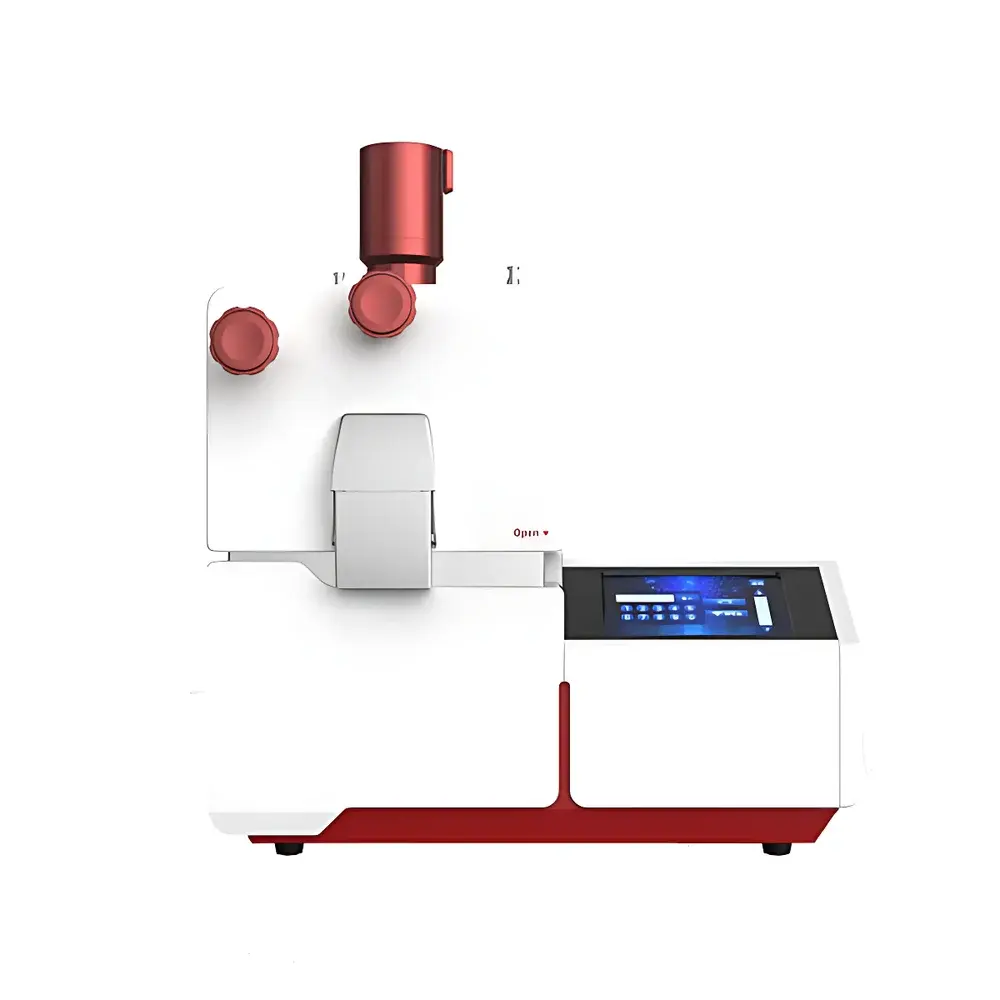
Ants Scientific Instruments AM200S Mortar Grinder
| Brand | Ants Scientific Instruments |
|---|---|
| Origin | Beijing, China |
| Manufacturer Type | Authorized Distributor |
| Product Origin | Domestic (China) |
| Model | AM200S |
| Instrument Type | Mortar Grinder |
| Sample Suitability | Hard, Brittle, Soft, and Paste-like Materials |
| Feed Size | ≤15 mm |
| Final Particle Size | ≤5 µm |
| Batch Volume | 10–200 mL |
| Operating Speed | 50–150 rpm |
| Grinding Time Range | 1–99 h 59 min 59 s (adjustable) |
| Intermittent & Pause Duration | 1–99 h 59 min 59 s (adjustable) |
| Cycle Count | 1–20 |
| Stored Methods | 10 presets |
| Load Monitoring | Real-time digital display |
| Temperature Monitoring | Integrated sensor with LCD readout |
| Pestle Pressure Calibration | Graduated scale + on-screen numeric feedback |
| Scraper Blade Pressure Adjustment | Manual knob control |
| Grinding Modes | Dry, Wet, Cryogenic (liquid nitrogen), Optional Heating Module |
| Grinding Set Materials | Hardened Steel, Stainless Steel, Tungsten Carbide, Agate, Alumina, Zirconia, Hard Porcelain |
| Sealed Grinding Chamber | Dust-tight design with safety interlock |
| Illuminated View Window | LED-lit observation port |
| Pestle–Mortar Interface | Eccentric rotational geometry enabling combined shear, compression, and attrition forces |
Overview
The Ants Scientific Instruments AM200S Mortar Grinder is an engineered laboratory grinding system that replicates the mechanical action of traditional manual mortar-and-pestle preparation while delivering precise, reproducible, and scalable particle size reduction. It operates on a dual-mode mechanical principle: eccentric rotation of the pestle within a stationary or counter-rotating mortar generates controlled compressive stress, shear strain, and attritional forces—ideal for achieving sub-micron homogeneity without excessive thermal degradation or amorphization. Unlike high-energy impact mills, the AM200S applies gradual, directional force through continuous orbital motion and adjustable axial loading—making it especially suitable for heat-sensitive, brittle, or heterogeneous samples where structural integrity and chemical stability must be preserved during comminution. Its modular architecture supports method development across regulatory-compliant workflows in pharmaceutical QA/QC, geological sample preparation, food authenticity testing, and advanced materials R&D.
Key Features
- Eccentric Dual-Force Grinding Mechanism: Combines controlled rotational torque with user-adjustable axial pressure (calibrated via engraved scale and real-time digital readout) to optimize energy transfer for each material class.
- Multi-Mode Processing Capability: Supports dry grinding, wet dispersion, cryogenic grinding (with liquid nitrogen compatibility), and optional heating module integration (up to 60 °C) for thermally assisted milling.
- Modular, Tool-Free Grinding Assembly: Quick-release mortars and pestles enable rapid material-specific changeover; seven certified material options—including zirconia, tungsten carbide, and agate—ensure chemical inertness and wear resistance.
- Real-Time Process Monitoring: Integrated load sensor and temperature probe feed data directly to the backlit LCD interface, allowing dynamic parameter adjustment and audit-ready logging.
- Sealed, Illuminated Chamber Design: Dust-tight grinding compartment with LED-lit observation window enables visual verification of sample flow dynamics and homogeneity without interrupting operation.
- Safety-Certified Operation: Interlocked door sensor halts rotation instantly upon chamber access; overload protection prevents motor stall under high-viscosity or oversized feed conditions.
- Programmable Method Storage: Ten independent protocol slots store time, speed, cycle count, pause intervals, and pressure settings—supporting GLP/GMP-aligned SOP execution.
Sample Compatibility & Compliance
The AM200S accommodates diverse physical states—including hard minerals (e.g., quartz, feldspar), brittle ceramics, soft biological tissues, fibrous plant matter, and viscous pastes—without requiring pre-drying or extensive pretreatment. Feed size limitation (≤15 mm) ensures consistent entry into the grinding zone, while final particle distributions consistently achieve ≤5 µm median diameter (D50) under optimized parameters. All contact surfaces comply with ISO 8573-1 (compressed air purity) and USP for material biocompatibility where applicable. The instrument meets IEC 61000-6-2 (immunity) and IEC 61000-6-4 (emission) standards; CE marking confirms conformity with EU Machinery Directive 2006/42/EC and Low Voltage Directive 2014/35/EU. For regulated environments, optional 21 CFR Part 11–compliant software add-ons provide electronic signatures, audit trails, and role-based access control.
Software & Data Management
While the AM200S operates autonomously via its embedded controller, optional PC connectivity (RS-232 or USB) enables synchronization with LIMS or ELN platforms. Raw process logs—including timestamped speed, load, temperature, elapsed time, and cycle phase—are exportable as CSV files for statistical process analysis (SPC) or trend reporting. Method recall functionality permits exact replication of historical runs, satisfying traceability requirements under ISO/IEC 17025 and ASTM E2500. All stored protocols are protected against unauthorized modification via password-protected administrator mode.
Applications
- Pharmaceutical: Pre-formulation studies, API micronization, excipient blending validation, dissolution testing sample prep.
- Agriculture & Food: Homogenization of grain, spices, seeds, and composite food matrices prior to elemental analysis (ICP-OES/MS) or mycotoxin screening.
- Geology & Mining: Preparation of rock, soil, and ore samples for XRF, XRD, and SEM-EDS analysis—minimizing preferred orientation artifacts.
- Materials Science: Dispersion of nanocomposites, ceramic precursors, and battery electrode materials without introducing metallic contamination.
- Clinical & Forensic Labs: Disruption of frozen tissue biopsies and forensic evidence (e.g., paint chips, polymer fragments) under cryogenic conditions.
FAQ
What particle size distribution can be expected from the AM200S?
Typical D50 values range from 1–5 µm depending on material hardness, moisture content, grinding time, and selected set material; narrow distributions are achievable using multi-stage protocols with intermediate sieving.
Is the AM200S compatible with regulated pharmaceutical workflows?
Yes—when paired with validated software modules, it supports 21 CFR Part 11 compliance, including electronic records, audit trails, and user authentication.
Can the instrument handle abrasive or corrosive samples?
Absolutely—the availability of tungsten carbide, zirconia, and alumina grinding sets ensures long-term performance with silicates, oxides, halides, and organic acids.
How is pestle pressure calibrated and verified?
Axial force is adjusted via a precision micrometer screw; pressure magnitude is displayed numerically on the LCD and cross-referenced against a factory-calibrated scale etched onto the pestle housing.
Does the AM200S support automated cleaning cycles?
No dedicated cleaning program exists, but the tool-free disassembly, smooth internal surfaces, and chemical-resistant materials facilitate manual solvent rinsing or ultrasonic bath decontamination per SOP.



