
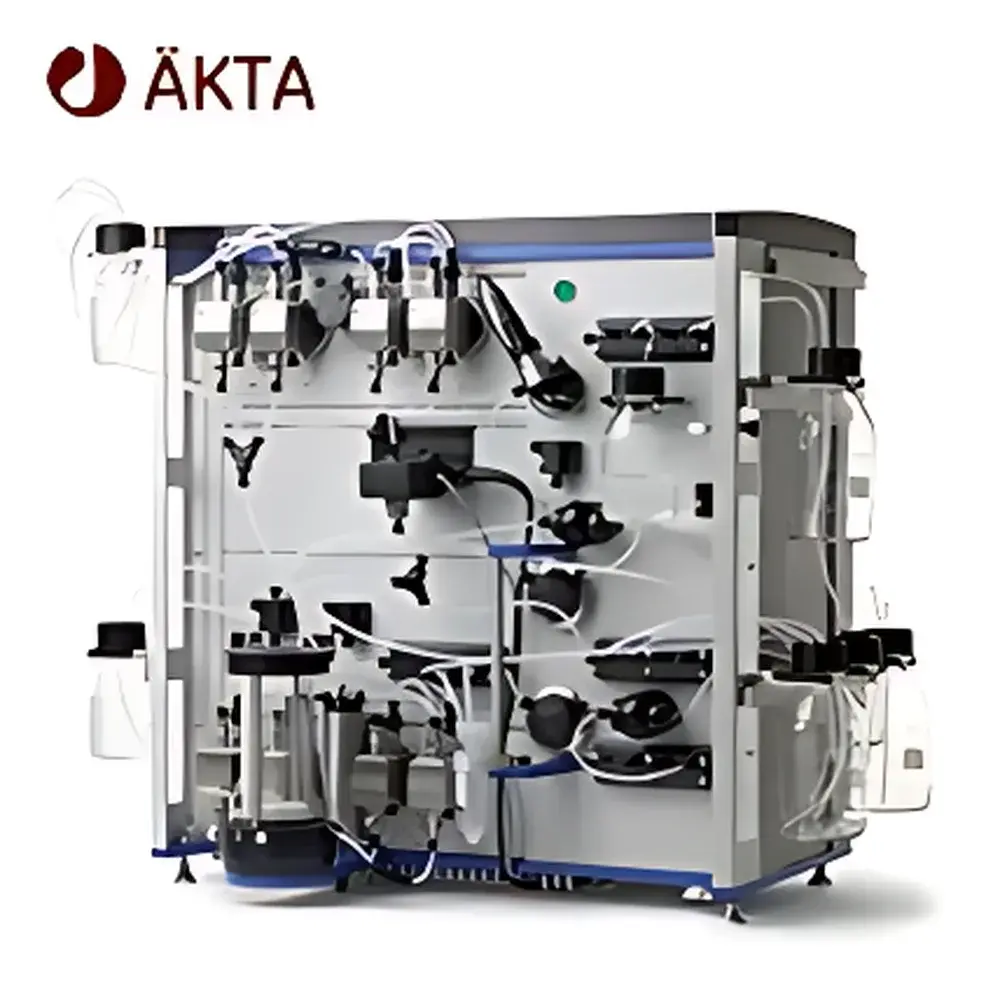
Cytiva AKTA crossflow Automated Tangential Flow Filtration System
| Brand | Cytiva |
|---|---|
| Origin | USA |
| Model | AKTA crossflow |
| Application Range | 25 mL – 50 L |
| Pump Flow Rate (Feed) | Up to 600 mL/min |
| Pump Flow Rate (Permeate/Retentate) | Up to 200 mL/min |
| Membrane Area Capacity | Up to 0.1 m² |
| Control Software | UNICORN™ v7.x or later |
| Compliance | FDA 21 CFR Part 11, USP <1211>, ISO 13485, GMP/GLP-ready |
| Sanitization | Validated NaOH (1 M) CIP, ≥6-log reduction in microbial challenge testing |
Overview
The Cytiva AKTA crossflow Automated Tangential Flow Filtration (TFF) System is an engineered platform for scalable, reproducible, and regulatory-compliant membrane-based separation in biopharmaceutical process development. Designed on the foundation of Cytiva’s industry-proven AKTA architecture, it applies tangential flow filtration principles—where feed stream flows parallel to the membrane surface—to minimize concentration polarization and fouling while preserving biomolecular integrity. Unlike batch dead-end filtration, AKTA crossflow enables continuous retentate recirculation, precise transmembrane pressure (TMP) control, and real-time flux monitoring—critical for optimizing ultrafiltration (UF), diafiltration (DF), microfiltration (MF), and cell harvesting operations. Its unique capability to operate down to 25 mL sample volume bridges the gap between early-stage discovery and clinical manufacturing, supporting linear scale-up from benchtop to pilot-scale processing without method requalification.
Key Features
- Automated, software-driven TFF operation with full process scripting, including feed loading, concentration, diafiltration, flush, and CIP sequences
- Four-piston peristaltic feed pump delivering pulse-free flow up to 600 mL/min; dual low-shear permeate and retentate pumps (up to 200 mL/min each)
- Integrated pressure sensors for real-time monitoring of feed pressure, retentate pressure, permeate pressure, and ΔP across the membrane
- Clean-in-place (CIP) compatibility with 1 M NaOH validated for ≥6-log microbial reduction per USP and ISO 13485 requirements
- Hygienic, sanitary-grade fluid path components—including EPDM diaphragm valves, self-rinsing pump heads, and minimal hold-up volume manifolds
- UNICORN™ software-controlled TMP regulation, constant-flux mode, feed flow modulation, and shear-sensitive parameter mapping (e.g., fiber bundle shear stress)
Sample Compatibility & Compliance
The AKTA crossflow accommodates a broad spectrum of bioprocess streams: clarified mammalian cell culture harvests, microbial lysates, viral vectors, mRNA-LNPs, and therapeutic proteins. It supports all major TFF formats—including cassette-style UF membranes (e.g., Pellicon® and Viresolve®), hollow-fiber modules (e.g., Start™ AXM and AXH series), and flat-sheet configurations—with total membrane area scalability from 150 cm² (3 × 50 cm² cassettes) up to 0.1 m². All wetted materials comply with USP Class VI and FDA-approved elastomer standards. The system meets ICH Q5A/Q5D requirements for product contact surfaces and is fully aligned with FDA 21 CFR Part 11 for electronic records and signatures—including full audit trail, user access control, and electronic signature validation. Process documentation adheres to ALCOA+ principles (Attributable, Legible, Contemporaneous, Original, Accurate, Complete, Consistent, Enduring, Available) required under GMP and GLP environments.
Software & Data Management
UNICORN™ software serves as the unified control and data management platform for both TFF and chromatography workflows. Version 7.x and later provide method editor modules with pre-validated cleaning protocols, scale-up/scale-down wizards, and automated data reduction tools for flux decline analysis, rejection coefficient calculation, and buffer exchange efficiency quantification. All raw sensor data—including pressure, flow, conductivity, pH, and UV absorbance (when integrated with optional detectors)—are time-stamped, encrypted, and stored in a relational database compliant with 21 CFR Part 11 Annex 11. OPC UA connectivity enables integration into higher-level MES/SCADA systems. Batch reports include full traceability of operator actions, parameter deviations, alarm logs, and electronic signatures—supporting inspection readiness for EMA, PMDA, and Health Canada audits.
Applications
- Early-stage process screening: rapid comparative evaluation of membrane chemistries, pore sizes, and operational modes (constant TMP vs. constant flux)
- Cell harvest and clarification: gentle separation of CHO, HEK293, or microbial cells using Start™ AXM hollow-fiber MF modules
- Protein concentration and buffer exchange: UF/DF of monoclonal antibodies, fusion proteins, and enzymes with minimal aggregation
- Viral vector purification: clarification and concentration of AAV and lentivirus preparations under low-shear conditions
- mRNA-LNP formulation support: sterile filtration-compatible TFF for nanoparticle size stabilization and formulation exchange
- Process characterization studies: DoE-driven optimization of TMP, crossflow velocity, and temperature for robustness assessment
FAQ
Can AKTA crossflow be used for both ultrafiltration and microfiltration?
Yes—it supports both UF (1–1000 kDa MWCO) and MF (0.1–0.45 µm pore size) membranes via interchangeable hardware modules and software-configurable control logic.
Is scale-up from 25 mL to production volumes linearly validated?
Yes—UNICORN™’s scale-up wizard maintains constant shear rate, Reynolds number, and TMP profile across volumes; Cytiva provides technical documentation supporting direct transfer to ÄKTA ready and ÄKTA pilot systems.
Does the system support integration with existing AKTA chromatography platforms?
Yes—via shared UNICORN™ runtime environment and OPC UA communication; single PC can orchestrate sequential TFF and chromatography steps within one method file.
What cleaning agents are qualified for use with AKTA crossflow?
1 M sodium hydroxide is fully validated; other agents—including phosphoric acid, citric acid, and isopropanol—may be used subject to material compatibility assessment and risk-based validation.
How is data integrity ensured during long-duration diafiltration runs?
UNICORN™ implements cyclic database journaling, redundant storage, and automatic recovery after power interruption—ensuring zero data loss and full continuity of electronic batch records.
Related Products




