
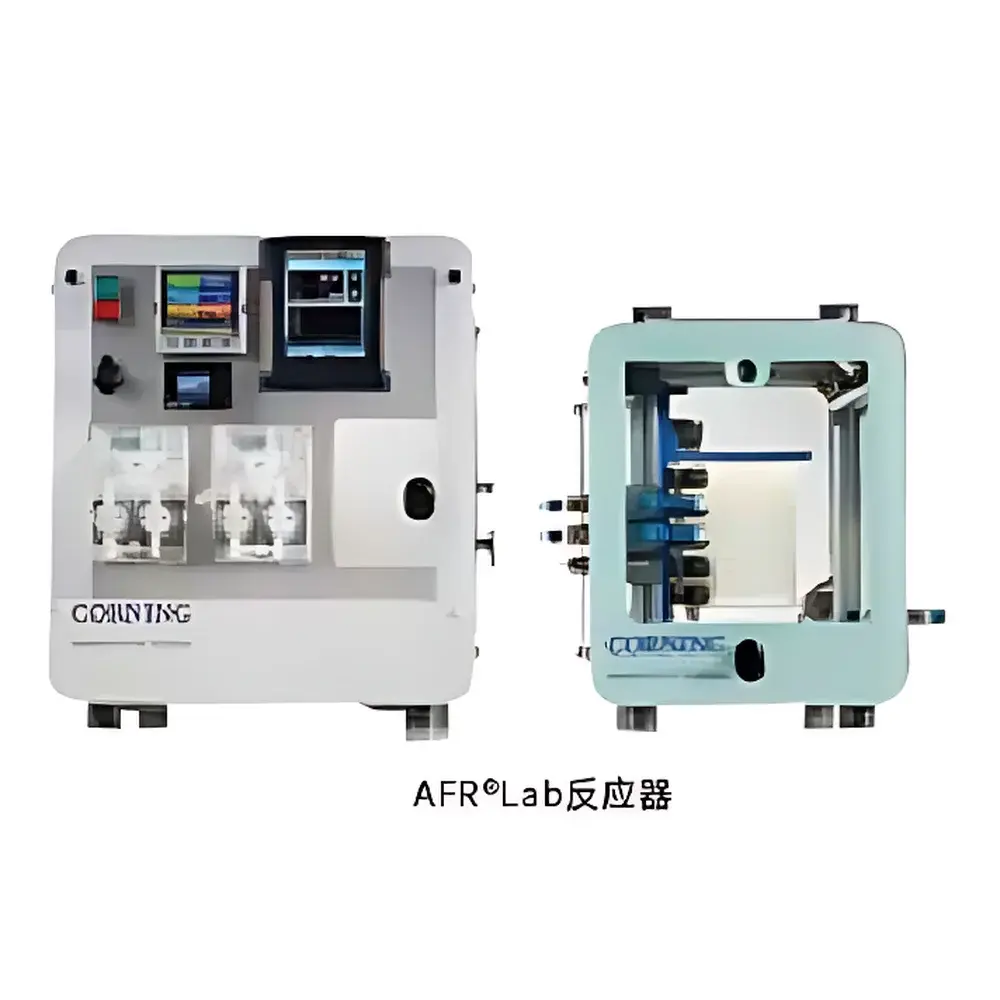
Corning AFR® Lab Reactor System
| Origin | USA |
|---|---|
| Manufacturer Type | Distributor |
| Origin Category | Imported |
| Model | AFR Lab |
| Quotation | Upon Request |
| Usable Volume | Medium-Scale |
| Construction Material | Specialty Glass / PFA / PETE / Perfluoroelastomer |
| Operating Pressure | High-Pressure (0–18 bar(g)) |
| Capacity | 2.7 mL per reactor module |
| Vacuum Capability | Not Specified |
Overview
The Corning AFR® Lab Reactor System is a benchtop continuous-flow microreactor platform engineered for safe, precise, and scalable chemical synthesis under controlled temperature and pressure conditions. Based on Corning’s proprietary Advanced-Flow Reactor (AFR®) technology, the system employs a monolithic glass microchannel architecture featuring the patented “heart-shaped” channel geometry — optimized to deliver high interfacial area, uniform residence time distribution, and exceptional heat and mass transfer performance. Unlike batch reactors, the AFR® Lab operates exclusively in continuous flow mode, enabling reproducible kinetic studies, rapid reaction screening, and direct process development from milligram to multigram scale. Its design supports operation across a broad thermal range (–40 °C to +200 °C) and up to 18 bar(g), making it suitable for exothermic, hydrogenation, nitrations, photochemical, and other high-risk transformations where thermal runaway or reagent accumulation must be rigorously avoided.
Key Features
- Modular reactor core with 2.7 mL internal volume per unit — minimizes reagent consumption while maintaining laminar-to-transitional flow regimes for high reproducibility
- Chemically inert fluidic path constructed entirely from specialty borosilicate glass, PFA, PETE, and perfluoroelastomer seals — zero metal contact ensures compatibility with strong acids, halogens, organolithiums, and corrosive catalysts
- Integrated temperature control via external chiller/heater circulator and built-in portable temperature controller — achieves sub-±0.5 °C stability across full operating range
- Multi-feed capability: one gas inlet and two or three independent liquid inlets, each equipped with precision syringe or HPLC pumps and real-time back-pressure regulation (BPR) to maintain constant system pressure and prevent vapor lock
- Plug-and-play architecture with digital data logging — all operational parameters (flow rates, temperature setpoints, pressure readings, valve states) are timestamped and exportable in CSV format for audit-ready traceability
- Ready-to-start configuration — pre-assembled, factory-tested modules require only connection to utilities and feedstock lines for immediate commissioning
Sample Compatibility & Compliance
The AFR® Lab accommodates homogeneous, heterogeneous, and multiphase (gas–liquid, liquid–liquid, solid-containing) reaction mixtures without clogging or fouling, thanks to its smooth-walled, non-tapered microchannels and absence of dead volumes. It complies with widely referenced laboratory safety standards including ASTM E2500 (Good Manufacturing Practice for Laboratory Equipment), ISO/IEC 17025 (for method validation support), and supports alignment with GLP and GMP documentation requirements through its integrated event logging and user-access-controlled parameter settings. While not intrinsically rated for Class I Div 1 environments, the system may be deployed in certified fume hoods or ventilated enclosures when handling volatile or toxic reagents.
Software & Data Management
The AFR® Lab does not rely on proprietary closed software; instead, it interfaces seamlessly with third-party pump controllers, temperature circulators, and pressure transmitters via analog (0–10 V, 4–20 mA) or digital (RS-232, Modbus RTU) protocols. All operational metadata — including timestamps, setpoint deviations, alarm triggers, and manual intervention logs — are stored locally on an embedded SD card and can be exported for integration into LIMS or ELN platforms. Audit trails meet FDA 21 CFR Part 11 readiness criteria when paired with validated user authentication workflows and electronic signature protocols implemented at the facility level.
Applications
- Rapid optimization of reaction parameters (temperature, residence time, stoichiometry, mixing intensity) for API intermediates and fine chemicals
- Safe execution of highly exothermic or explosive reactions (e.g., diazotizations, nitration, ozonolysis) via instantaneous heat removal and precise residence time control
- Photochemical synthesis using the optional AFR® Lab Photo Module — equipped with six independently addressable LED arrays (365, 385, 405, 420, 450, and 525 nm), delivering ≥100 mW/cm² irradiance with bilateral illumination and active liquid cooling for thermal management
- Gas-liquid hydrogenations and carbonylations with inline back-pressure regulation and dissolved gas quantification support
- Scale-down studies bridging discovery chemistry to pilot-scale AFR® systems — eliminating scale-up artifacts due to identical hydrodynamic and thermal characteristics across Corning’s AFR® platform family
FAQ
What is the maximum allowable operating pressure for the AFR® Lab system?
The system is rated for continuous operation up to 18 bar(g) at temperatures ≤150 °C; pressure rating decreases linearly above this temperature per Corning’s published derating curve.
Can the AFR® Lab be used for solid-handling reactions?
Yes — suspensions with particle sizes <25 µm and solids loading ≤5 wt% are compatible; optional ultrasonic-assisted feed modules are available for higher-load slurries.
Is the photochemical module compatible with non-standard wavelengths?
No — only the six factory-installed LED bands are supported; custom wavelength integration requires engineering consultation and mechanical redesign.
Does the system support automated reaction sequencing?
Not natively — but third-party sequence controllers (e.g., LabVIEW, Python-based OpenSCADA) can orchestrate multi-step protocols via analog/digital I/O interfaces.
How is calibration traceability maintained?
Temperature sensors are NIST-traceable; pressure transducers are calibrated annually per ISO 9001 procedures; flow verification is performed using gravimetric or bubble-trap methods per ASTM D3595.



