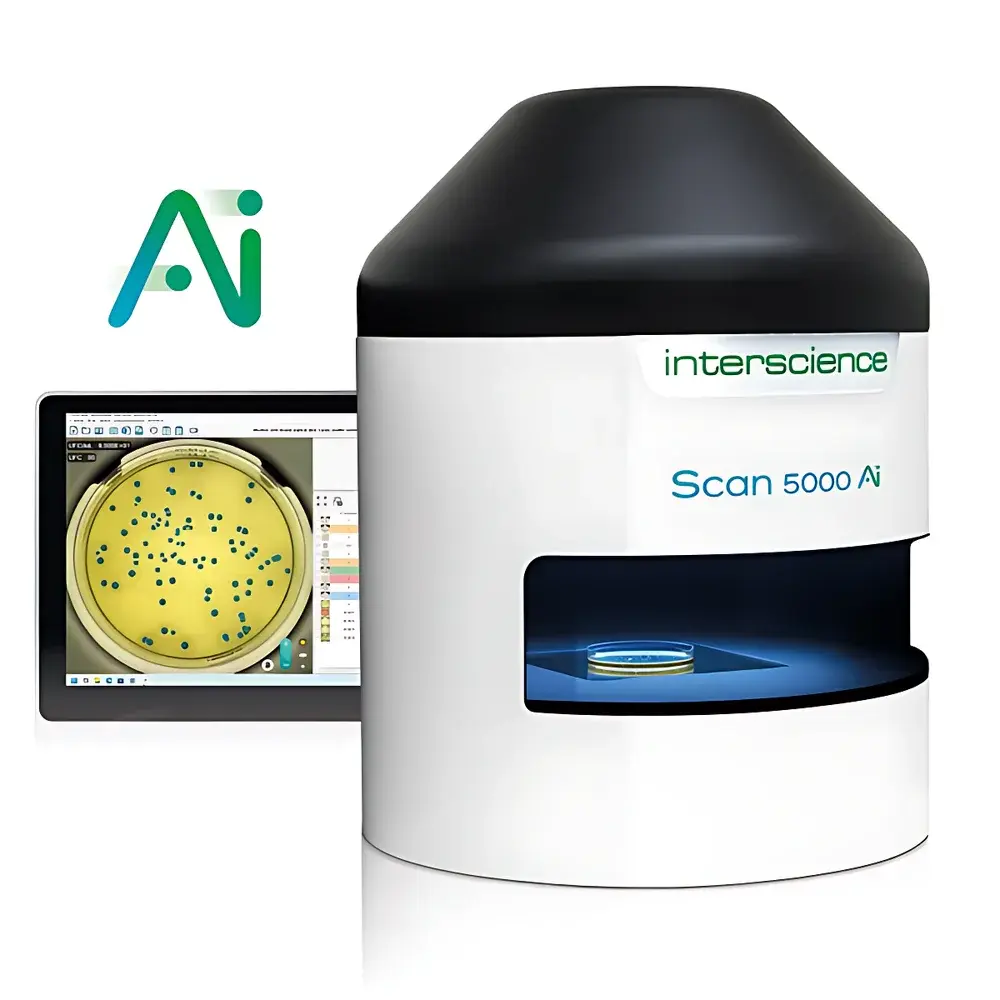
InterScience Scan 5000 Ai Automated AI-Powered Colony Counter and Zone-of-Inhibition Analyzer
| Brand | InterScience |
|---|---|
| Origin | France |
| Model | Scan 5000 Ai |
| Camera | 69 MP Ultra-HD CMOS Color Sensor with Japanese HD Zoom Lens |
| Illumination | Auto-Configurable 7-Mode LED Dome Lighting (Top/Bottom, White/Black Background) |
| Petri Dish Compatibility | Ø 55–150 mm circular & 120 mm square dishes |
| Colony Detection Limit | ≥ 0.03 mm diameter |
| Counting Speed | Up to 1000 colonies/sec |
| Zone Measurement Accuracy | ±0.1 mm |
| Zone Detection Time | 2–4 sec for up to 16 antibiotics |
| Standards Compliance | ISO 7218, AOAC 977.27, CLSI, EUCAST, CA-SFM (Human & Veterinary), FDA 21 CFR Part 11 |
| Software Languages | English, French, German, Spanish, Japanese, Chinese, Russian |
| Data Export Formats | CSV, Excel™, PDF, JPEG, PNG, BMP, SCA, BIO |
| System Requirements | Windows 10/11, Intel i7 (2.8 GHz+) or Xeon Gold, NVIDIA RTX 3060/4050+, 16 GB RAM, USB 3.0, 1920×1080+ display |
| Dimensions (W×D×H) | 46.4 × 46.4 × 63.1 cm |
| Net Weight | 25.15 kg |
| Warranty | 3 years (registration required) |
| Spare Parts Availability | 10 years |
Overview
The InterScience Scan 5000 Ai is an automated, AI-driven colony counter and zone-of-inhibition (ZOI) analyzer engineered for high-throughput, regulatory-compliant microbiological analysis in pharmaceutical QC, clinical microbiology, food safety, and contract testing laboratories. It operates on a dual-core optical and computational architecture: high-resolution color imaging combined with a proprietary deep learning inference engine trained on over one million expert-annotated microbial growth images across diverse media types, incubation conditions, and morphologies. Unlike rule-based image analysis systems, the Scan 5000 Ai employs convolutional neural networks (CNNs) fine-tuned for simultaneous detection, segmentation, classification (bacteria, yeasts, molds), and quantification of colonies—even under challenging conditions such as overlapping growth, low-contrast colonies on chromogenic media, or subtle edge artifacts from Petrifilm™ or Compact Dry™ substrates. Its ZOI module implements sub-pixel edge detection algorithms calibrated against reference standards (CLSI M02-A13, EUCAST v14.0), enabling reproducible measurement of inhibition zones around antibiotic discs, wells, or Oxford cups with ±0.1 mm resolution—critical for AST interpretive criteria alignment.
Key Features
- AI-powered colony detection and classification: Differentiates bacterial colonies, yeasts, and molds on standard and chromogenic agars—including selective/differential media—without manual threshold tuning.
- Full-dish coverage analysis: Processes 100% of the agar surface area on Ø 55–150 mm circular and 120 mm square Petri dishes, eliminating sampling bias inherent in partial-field instruments.
- Intelligent colony separation: Automatically resolves clustered or confluent colonies using adaptive watershed segmentation guided by morphology-aware confidence scoring.
- Multi-color discrimination: Detects up to four distinct colony colors simultaneously while excluding two user-defined background or artifact colors (e.g., condensation droplets, marker ink).
- Comprehensive ZOI analysis: Supports paper discs (multiple commercial brands), agar wells, and metal/plastic Oxford cups; auto-detects zones with optional manual correction and validation logging.
- Regulatory-grade data integrity: Enforces audit trails, electronic signatures, role-based access control (RBAC), and immutable session logs compliant with FDA 21 CFR Part 11 and EU Annex 11 requirements.
- Integrated traceability: Native bidirectional communication with LIMS/SIL via USB or DataLink Pro interface; all metadata—including sample ID, operator, timestamp, antibiotic name, organism ID, measured diameters, and interpretive category—is embedded in exported reports.
Sample Compatibility & Compliance
The Scan 5000 Ai accommodates a broad spectrum of microbiological sample formats: pour-plated, spread-plated, spiral-plated, and membrane-filtered samples—as well as commercial rapid methods including Petrifilm™, Compact Dry™, MC-Media Pads™, EasyPlate™, and ISO-standardized agar plates. Its illumination system dynamically selects optimal top/bottom, white/black background combinations to maximize contrast for translucent colonies on opaque media or pigmented colonies on chromogenic substrates. The instrument meets ISO 7218:2017 (microbiology of food and animal feeding stuffs), AOAC Official Method 977.27 (colony enumeration), and pharmacopoeial standards for antimicrobial susceptibility testing (USP , EP 2.6.12). All firmware and software revisions are validated per GAMP 5 principles, and the system supports full lifecycle documentation for GLP/GMP audits.
Software & Data Management
The ScanAi software suite provides a validated, multi-language (English, French, German, Spanish, Japanese, Chinese, Russian) desktop application running on Windows 10/11. It features a session-based workflow with automatic version-stamped archiving of raw images, processed overlays, count tables, ZOI measurements, and interpretive classifications per CLSI, EUCAST, or custom breakpoints. Data export options include CSV, Excel™, PDF (with embedded digital signatures), and image formats (JPEG, PNG, BMP). All modifications—whether adding/removing colonies, adjusting zone boundaries, or reclassifying organisms—are logged with operator ID, timestamp, reason code, and pre/post values. Integration with DataLink Pro enables seamless traceability from dilution and plating steps through final reporting, satisfying ALCOA+ (Attributable, Legible, Contemporaneous, Original, Accurate, Complete, Consistent, Enduring, Available) data integrity principles.
Applications
- Pharmaceutical microbiological quality control: Enumeration of bioburden in non-sterile products, environmental monitoring (EM) settle plates, and water testing per USP /.
- Clinical microbiology labs: Rapid AST reporting aligned with CLSI M100 or EUCAST guidelines for routine pathogen identification workflows.
- Food and beverage safety testing: Quantitative analysis of total viable counts (TVC), coliforms, E. coli, Staphylococcus aureus, and Listeria spp. on selective media.
- Academic and research microbiology: High-fidelity phenotypic screening of mutant libraries, biofilm assays, and antifungal susceptibility profiling.
- Contract research organizations (CROs): Fully auditable, LIMS-integrated reporting for GLP-compliant study deliverables.
FAQ
Does the Scan 5000 Ai require periodic recalibration?
No—its optical path and illumination geometry are factory-aligned and thermally stabilized. Routine verification is performed using included NIST-traceable calibration disks; no field recalibration is necessary.
Can the AI model be retrained with lab-specific isolates?
Yes—the software supports secure, offline model fine-tuning using anonymized, IRB-approved image sets; retraining preserves regulatory compliance when conducted under a documented validation protocol.
Is remote software update supported?
Firmware and software updates are delivered via encrypted USB media or authenticated network push; all changes undergo version-controlled release notes and impact assessment per change control SOPs.
What backup mechanisms ensure data continuity during power loss?
The system implements journaling file system logging and auto-saves session state every 3 seconds; unsaved work is recoverable post-reboot without data corruption.
How is user authentication managed for 21 CFR Part 11 compliance?
Authentication uses Windows Active Directory integration or local credential stores with password complexity enforcement, session timeout, and lockout policies; electronic signatures require dual approval for critical actions (e.g., report finalization).