
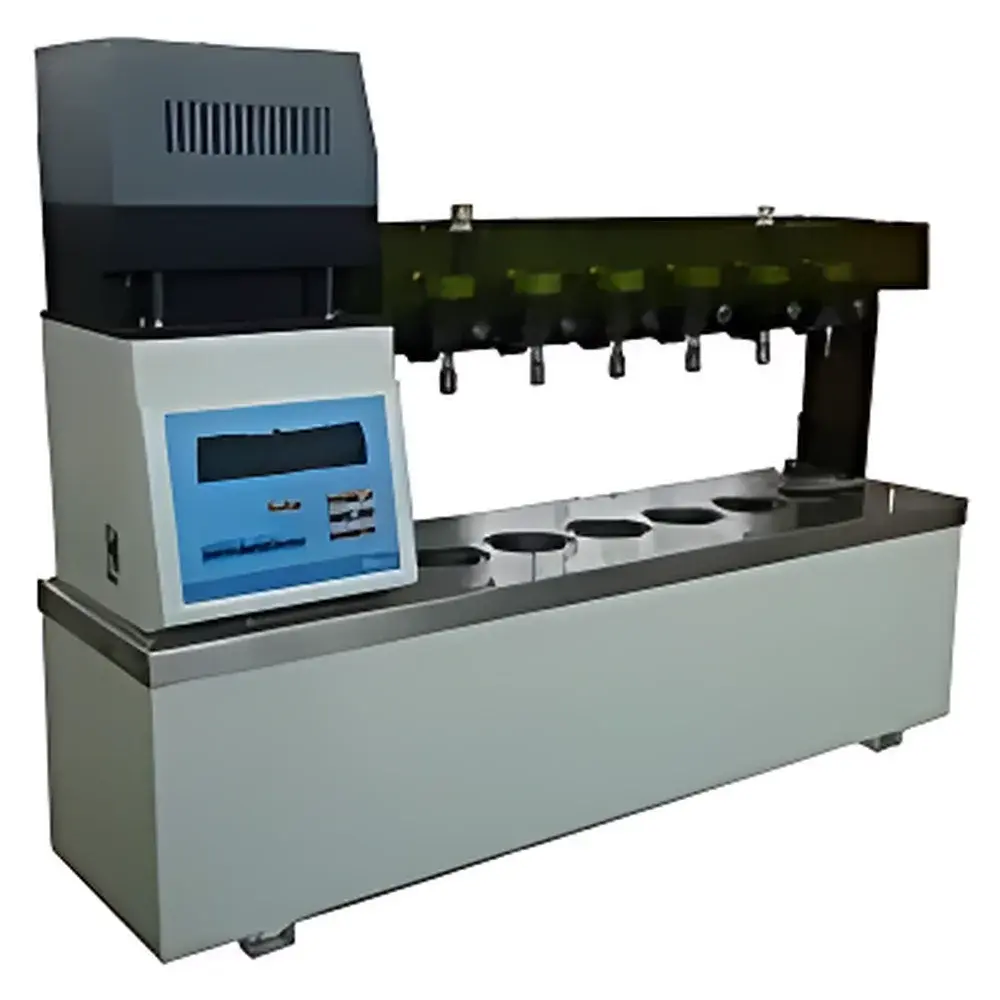
Shanghai Xufeng RLP-6 Automatic Liquid-Phase Rust Corrosion Tester for Petroleum Products
| Brand | Shanghai Xufeng |
|---|---|
| Origin | Shanghai, China |
| Model | RLP-6 |
| Temperature Control Range | 10°C to 80°C (standard test at 60 ± 1°C) |
| Temperature Accuracy | ±0.5°C |
| Sample Capacity | 6 positions |
| Bath Dimensions | 816 × 180 × 200 mm (W×D×H) |
| Overall Dimensions | 1000 × 260/340 × 720 mm (W×D×H) |
| Heating Power | 2000 W |
| Bath Stirring Motor | AC 220 V, 25 W |
| Sample Stirring Motor | DC 24 V, 50 W, 1500 ± 25 rpm |
| Beaker Volume | 400 mL |
| Pt100 Sensors | 6-channel independent temperature monitoring |
| Timer Function | 6 independent digital timers |
| Compliance | GB/T 11143–2008, ASTM D665 |
Overview
The Shanghai Xufeng RLP-6 Automatic Liquid-Phase Rust Corrosion Tester is an engineered solution for evaluating the rust-inhibiting performance of inhibited mineral oils under controlled aqueous conditions. Designed in strict accordance with GB/T 11143–2008 and ASTM D665, this instrument quantifies the ability of lubricants—including turbine oils, hydraulic fluids, circulating oils, and other water-immiscible petroleum products—to prevent corrosion on ferrous metal surfaces when exposed to water contamination. The test principle relies on standardized immersion of polished steel specimens (typically ASTM 1018 or equivalent) in a heated oil–water emulsion, followed by mechanical agitation to accelerate interfacial contact and promote electrochemical corrosion pathways. The RLP-6 replicates real-world operational stressors—elevated temperature, sustained agitation, and phase separation dynamics—enabling reproducible assessment of additive package efficacy and formulation stability.
Key Features
- Six independent test stations with fully decoupled temperature monitoring and timing control—each equipped with a Pt100 sensor embedded in the lid assembly for real-time bath temperature validation at the sample interface.
- High-fidelity rotational agitation system: six synchronized DC-driven stirrers operating at 1500 ± 25 rpm, each powered by a dedicated 50 W motor with integrated speed feedback and display.
- Thermally stable oil bath with precision PID-controlled heating (±0.5°C accuracy) across a 10–80°C range; default setpoint optimized for the 60 ± 1°C requirement of ASTM D665 and GB/T 11143.
- Modular stirring assembly design: individual stirrer units can be physically disengaged without tools—reducing mechanical load during partial-load operation and extending motor service life.
- Comprehensive self-diagnostic firmware: continuous monitoring of bath fluid level, heater continuity, Pt100 integrity, thermal excursion, and both bath and sample motor status—with audible alarm and on-screen fault codes per IEC 61508 functional safety conventions.
- Ergonomic maintenance access: stirrer shafts lift vertically from their alignment sleeves after simple removal of the circular retaining nut and beam cover—enabling rapid cleaning or replacement without disassembly of the main chassis.
Sample Compatibility & Compliance
The RLP-6 accommodates standard 400 mL glass beakers conforming to ASTM D665 dimensional specifications and supports test specimens fabricated from low-carbon steel (ASTM A1018, 25 mm × 12 mm × 1.5 mm), pre-polished to 600-grit finish and degreased prior to immersion. It is validated for use with turbine oils (ISO L-TGA/L-TGB), hydraulic oils (ISO L-HM/L-HV), and industrial circulating oils meeting API RP 1360 or ISO 8502-9 cleanliness thresholds. Instrument compliance extends to laboratory quality management frameworks: data logging meets GLP audit requirements; timer and temperature records are timestamped and non-editable in internal memory; and firmware architecture supports future integration with LIMS via RS-232 or optional Ethernet module (not included). While not certified to FDA 21 CFR Part 11 out-of-the-box, the system’s deterministic control logic and immutable event logging provide a foundation for validation under GMP-aligned protocols.
Software & Data Management
The RLP-6 employs an embedded microcontroller platform with a 4.3-inch TFT LCD interface supporting multilingual menu navigation (English default). All operational parameters—including target temperature, dwell time per station, stirrer enable/disable flags, and alarm thresholds—are configurable via tactile keypad input. Real-time metrics (actual bath temperature, stirrer RPM, elapsed time per channel) are displayed simultaneously with status icons indicating active alarms or maintenance prompts. Internal flash memory retains up to 100 complete test logs with full metadata: date/time stamp, operator ID field, ambient lab temperature, and final visual rust rating per ASTM D665 Annex A1 (e.g., “A”, “B”, “C”, or “D”). Export is supported via USB 2.0 port to CSV format for traceability and statistical process analysis (SPC) in external software such as Minitab or JMP.
Applications
- Quality assurance of rust-inhibited turbine oils prior to turbine commissioning or scheduled oil changes.
- Benchmarking comparative performance of additive packages during lubricant R&D.
- Root-cause analysis of field-reported rust formation in hydraulic systems subjected to moisture ingress.
- Validation of re-refined base oil compatibility with commercial inhibitor systems.
- Third-party certification testing for ISO 8502-3-compliant rust prevention claims in OEM lubricant specifications.
FAQ
What standards does the RLP-6 explicitly support?
The instrument is designed and factory-validated for GB/T 11143–2008 and ASTM D665, including all procedural requirements for specimen preparation, emulsion formation, agitation profile, and endpoint evaluation.
Can the RLP-6 operate with non-standard specimen geometries?
No—the test fixture geometry, beaker dimensions, and stirrer clearance are calibrated to ASTM D665 tolerances; deviation may invalidate results for regulatory submission.
Is remote monitoring or network connectivity available?
Standard configuration includes local display and USB data export; optional RS-232 or Ethernet modules are available upon request for SCADA or centralized lab network integration.
How often must the Pt100 sensors be calibrated?
Per ISO/IEC 17025 recommendations, annual calibration against a NIST-traceable reference bath is advised; drift verification should be performed before each test series using a secondary handheld thermometer.
Does the RLP-6 include test specimens or beakers?
No—steel specimens (ASTM A1018), 400 mL borosilicate beakers, and demineralized water must be sourced separately per ASTM D665 Section 6.1 and 6.2.






