
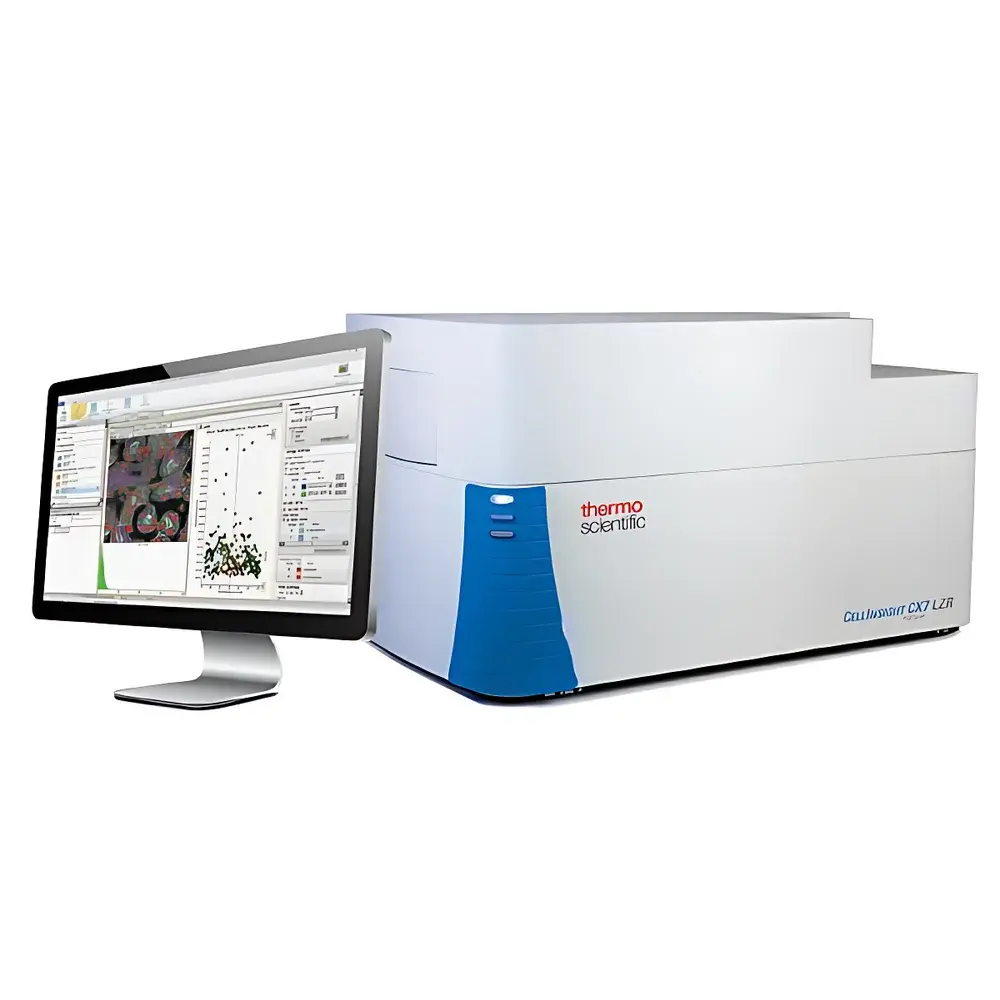
Thermo Scientific CellInsight CX7 LZR Laser Confocal High-Content Screening System
| Origin | USA |
|---|---|
| Manufacturer Type | Authorized Distributor |
| Origin Category | Imported |
| Model | CellInsight CX7 LZR |
| Price Range | USD 480,000 – 550,000 |
| Temperature Control Module | Optional |
| Humidity & CO₂/O₂ Control | Optional (via Live-Cell Chamber) |
| Imaging Throughput | Up to 1,000 fields per hour (dependent on objective, channel count, and z-stack depth) |
| Laser Excitation Wavelengths | 405, 488, 561, 640, 785 nm (5-line solid-state laser engine) |
| Pinhole Diameters | 40 µm and 70 µm (dual-spinning-disk confocal) |
| Detector | Cooled scientific-grade CCD camera (monochrome, >95% quantum efficiency at 500–700 nm) |
| Objective Compatibility | 2× to 60×, high-NA oil/water/glycerol immersion supported |
| Software Platform | HCS Studio v3.5+ (FDA 21 CFR Part 11 compliant audit trail, GLP/GMP-ready) |
Overview
The Thermo Scientific CellInsight CX7 LZR Laser Confocal High-Content Screening System is a fully integrated, automated platform engineered for quantitative, multi-parametric analysis of fixed and live cells at single-cell resolution. Built upon spinning-disk confocal microscopy principles, the system combines dual rotating pinhole disks (40 µm and 70 µm), a five-laser excitation engine (405/488/561/640/785 nm), and a thermoelectrically cooled scientific CCD detector to deliver optical sectioning with minimal phototoxicity and high signal-to-noise ratio. Unlike widefield systems, the CX7 LZR enables true 3D reconstruction of thick specimens—including spheroids, organoids, and tissue sections—while maintaining subcellular spatial fidelity. Its architecture supports both endpoint assays and longitudinal kinetic studies, making it suitable for applications ranging from target validation and mechanism-of-action profiling to phenotypic screening in drug discovery and translational research.
Key Features
- Dual spinning-disk confocal optics with selectable 40 µm and 70 µm pinholes—optimized for thin monolayers and thick 3D models without compromise in axial resolution or acquisition speed.
- Five-wavelength solid-state laser engine including 785 nm for near-infrared (NIR) fluorophore excitation—enabling up to 7-plex fluorescence detection when combined with LED-based widefield channels.
- Laser power modulation and adaptive exposure control—minimizing photobleaching and photodamage during time-lapse imaging of sensitive primary cells and stem cell derivatives.
- Integrated autofocus using laser-based reflection detection—ensuring consistent focus across multiwell plates, even with variable well-bottom thickness or meniscus effects.
- Modular live-cell environmental control unit (optional)—providing precise regulation of temperature (±0.2°C), CO₂ (0–20%), O₂ (0.1–21%), and humidity (>95% RH) for long-term dynamic imaging under physiologically relevant conditions.
- RGB + amber LED illumination module—supporting brightfield, phase contrast, and colorimetric immunohistochemistry (IHC) using conventional dyes such as hematoxylin & eosin (H&E), Masson’s trichrome, or DAB.
Sample Compatibility & Compliance
The CellInsight CX7 LZR accommodates standard microplate formats (6–1536-well), chambered coverslips, glass-bottom dishes, and histological slides. It supports diverse biological samples: adherent and suspension cell lines, primary neurons, iPSC-derived cardiomyocytes, tumor spheroids, and formalin-fixed paraffin-embedded (FFPE) tissue sections. All hardware and software components comply with ISO 13485 design controls for in vitro diagnostic (IVD) development workflows. The HCS Studio software includes full 21 CFR Part 11 compliance features—including electronic signatures, user-level access control, immutable audit trails, and version-controlled protocol management—meeting GLP, GCP, and early-phase GMP requirements for preclinical assay development.
Software & Data Management
HCS Studio Cell Analysis Software serves as the unified interface for acquisition, segmentation, feature extraction, and statistical modeling. Its drag-and-drop workflow builder enables rapid assay method deployment without scripting. The software performs real-time image processing—including background subtraction, deconvolution (optional), nuclear/cytoplasmic/membrane segmentation, and subcellular object classification—using validated machine-learning classifiers trained on >50,000 annotated cellular phenotypes. Raw data (TIFF/OME-TIFF), processed feature tables (CSV/Excel), and interactive heatmaps are stored in a structured project hierarchy with metadata tagging (e.g., plate map, treatment condition, timepoint). Export options include direct integration with third-party platforms such as KNIME, Python (via REST API), and commercial LIMS systems.
Applications
The platform supports standardized and custom assay development across multiple therapeutic areas. Validated application modules include: mitotic index quantification via phospho-histone H3 staining; apoptosis profiling using caspase-3 activation and Annexin V/PI co-staining; neurite outgrowth and branching analysis in iPSC-derived neuronal cultures; mitochondrial membrane potential assessment with TMRM or JC-1; lysosomal pH mapping with LysoTracker dyes; and hypoxia response monitoring via HIF-1α nuclear translocation. In oncology research, it facilitates tumor spheroid invasion assays, immune cell–tumor cell interaction scoring, and checkpoint inhibitor efficacy evaluation using PD-L1/PD-1 co-localization metrics. For biologics development, the system enables antibody internalization kinetics, Fc receptor engagement profiling, and ADCC/CDC functional readouts.
FAQ
Does the CX7 LZR support spectral unmixing for highly multiplexed experiments?
No—the system relies on sequential acquisition with discrete filter sets rather than spectral imaging. However, its 5-laser + 4-LED architecture supports up to 9-color detection through optimized emission filter wheels and computational crosstalk correction.
Can I run FDA-regulated clinical trial assays on this platform?
Yes—when deployed with HCS Studio in 21 CFR Part 11 mode and validated according to your organization’s SOPs, the system meets regulatory expectations for assay documentation, traceability, and data integrity in IND-enabling studies.
Is remote operation and monitoring supported?
Yes—HCS Studio includes secure web-based dashboard access for real-time status tracking, queue management, and alarm notifications. IT administrators may configure role-based permissions and integrate with enterprise SSO infrastructure.
What maintenance is required for the laser subsystem?
Solid-state lasers are rated for >20,000 hours of operation with no consumables. Annual calibration by Thermo Fisher Field Service Engineers is recommended to maintain alignment accuracy and photometric stability.
How does the CX7 LZR compare to point-scanning confocal systems in throughput?
Spinning-disk architecture delivers ~5–10× faster volumetric acquisition than scanning confocals for equivalent resolution—critical for screening-scale experiments where z-stack depth exceeds 20 planes per field.




