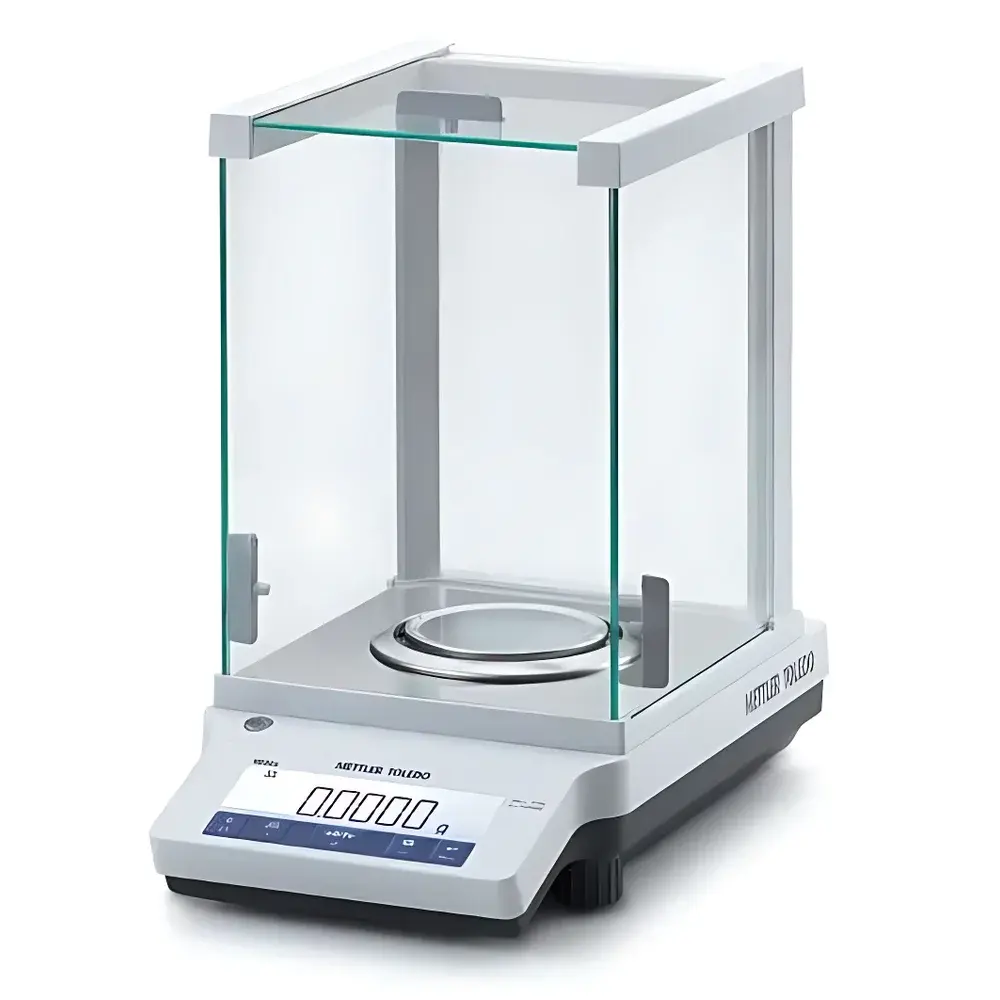
METTLER TOLEDO ME Series Analytical and Precision Balances
| Brand | METTLER TOLEDO |
|---|---|
| Origin | Switzerland |
| Product Line | ME Series |
| Instrument Type | Analytical Balance / Precision Balance |
| Maximum Capacity | 20–100 g (model-dependent) |
| Readability | 0.0001 g (0.1 mg) to 0.1 g (model-dependent) |
| Repeatability | ≤ 0.0001 g (for 0.1 mg models) |
| Linearity Error | ≤ 0.0002 g (for 0.1 mg models) |
| Pan Dimensions | 90 mm to 180 × 180 mm (model-dependent) |
| Calibration | Internal automatic calibration (integrated motor-driven mass) |
| Compliance | ISO/IEC 17025, GLP, GMP, USP <41>, ASTM E898, FDA 21 CFR Part 11 (with optional software) |
Overview
The METTLER TOLEDO ME Series Analytical and Precision Balances are engineered for laboratories requiring consistent accuracy, operational robustness, and regulatory traceability in routine weighing tasks. Built upon METTLER TOLEDO’s decades of metrological expertise, the ME Series employs electromagnetic force compensation (EMFC) technology — a high-stability transduction principle that delivers exceptional linearity, minimal drift, and long-term repeatability across environmental fluctuations. Each balance features a rigid metal frame with reinforced housing designed to withstand mechanical overload and incidental impacts, ensuring structural integrity during daily use in QC labs, academic research facilities, and production environments. The series encompasses dual-purpose models: analytical balances (0.1 mg readability) for pharmacopeial assay, titration endpoint verification, and reference standard preparation; and precision balances (1–100 mg readability) for bulk material dosing, formulation checks, and intermediate process control. All units comply with international weighing standards including OIML R76, ISO 9001, and ISO/IEC 17025 requirements for measurement uncertainty evaluation.
Key Features
- Internal automatic calibration system with motor-driven internal weight — activated manually or scheduled via time-based triggers to maintain metrological stability without operator intervention.
- SmartOperation interface: five tactile, capacitive-touch–like keys enabling one-touch access to built-in applications including percentage weighing, density determination, parts counting, animal weighing, and formulation mode.
- High-contrast backlit LCD display with oversized digits (up to 20 mm height) optimized for legibility under variable ambient lighting, including low-light or glove-operated conditions.
- Ultra-fast stabilization time — as low as 1.5 seconds for most 0.1 mg models — reducing throughput bottlenecks in high-volume sample processing workflows.
- Energy-efficient design: power consumption reduced by up to 50% versus prior-generation NewClassic platforms, supporting sustainability goals without compromising performance or warm-up stability.
- Dust- and splash-resistant enclosure (IP42-rated), compatible with routine cleaning using ethanol or isopropanol — critical for regulated pharmaceutical and food testing labs adhering to hygiene protocols.
Sample Compatibility & Compliance
The ME Series accommodates diverse sample types — from volatile solvents and hygroscopic powders to dense metallic alloys and viscous suspensions — via configurable draft shield options (sold separately) and adjustable leveling feet with integrated bubble level. All models support GLP/GMP-compliant documentation through embedded time/date stamping on every weighing event, calibration log, and adjustment record. Data output conforms to RS232 and USB interfaces, enabling seamless integration with LIMS or ELN systems. When paired with METTLER TOLEDO LabX® software (optional), the balances meet full 21 CFR Part 11 requirements, including electronic signatures, audit trails, user-level permissions, and secure data archiving. Regulatory alignment extends to USP repeatability criteria, ASTM E898 for balance verification, and ISO 14413 for uncertainty estimation in analytical weighing.
Software & Data Management
While standalone operation requires no external software, the ME Series supports bidirectional communication with METTLER TOLEDO’s LabX® software suite for centralized instrument management, method deployment, and automated report generation. Raw weighing data — including tare values, net weights, timestamps, operator IDs, and calibration history — can be exported in CSV, PDF, or XML formats. Optional Bluetooth or Ethernet connectivity modules enable wireless integration into networked lab infrastructures. All firmware updates are delivered via METTLER TOLEDO’s validated update protocol, maintaining configuration integrity and version control traceability per ISO/IEC 17025 clause 5.9.
Applications
- Pharmaceutical quality control: active pharmaceutical ingredient (API) assay, excipient blending verification, and dissolution tablet weight uniformity testing per USP .
- Academic and industrial research: gravimetric analysis, catalyst loading quantification, and stoichiometric reagent preparation.
- Food and beverage testing: moisture content determination (via loss-on-drying), nutritional labeling compliance, and allergen cross-contamination checks.
- Chemical manufacturing: batch reconciliation, raw material receipt inspection, and in-process concentration monitoring.
- Environmental labs: filter weighing for particulate matter (PM2.5/PM10) analysis per EPA Method 201A and ISO 12103-1.
FAQ
What is the difference between analytical and precision balances in the ME Series?
Analytical models (e.g., ME54, ME104) offer 0.1 mg readability and are intended for applications demanding high resolution and low uncertainty, such as reference standard preparation. Precision models (e.g., ME1002, ME2002) provide 1–100 mg readability and are optimized for higher capacity and ruggedized use in production or warehouse settings.
Does the ME Series support external calibration with traceable weights?
Yes — all models include external calibration capability using Class E2 or better certified weights, with calibration data stored internally alongside internal calibration records for full metrological traceability.
Can the ME balance be connected to a laboratory information management system (LIMS)?
Yes — via RS232, USB, or optional Ethernet module, with ASCII or MODBUS RTU protocols supported. LabX software provides certified LIMS integration templates for major vendors including Thermo Fisher SampleManager and LabWare.
Is the internal calibration weight certified and recalibratable?
The internal mass is factory-certified and sealed; it does not require user recalibration. Its performance is verified during annual service by METTLER TOLEDO-certified technicians using NIST-traceable standards.
How is compliance with ISO/IEC 17025 addressed in daily operation?
The ME Series enables documented evidence generation: automatic timestamping, operator ID logging (when used with optional keypad), calibration history export, and uncertainty calculation support via built-in repeatability and linearity data — all essential for accredited testing laboratories.