
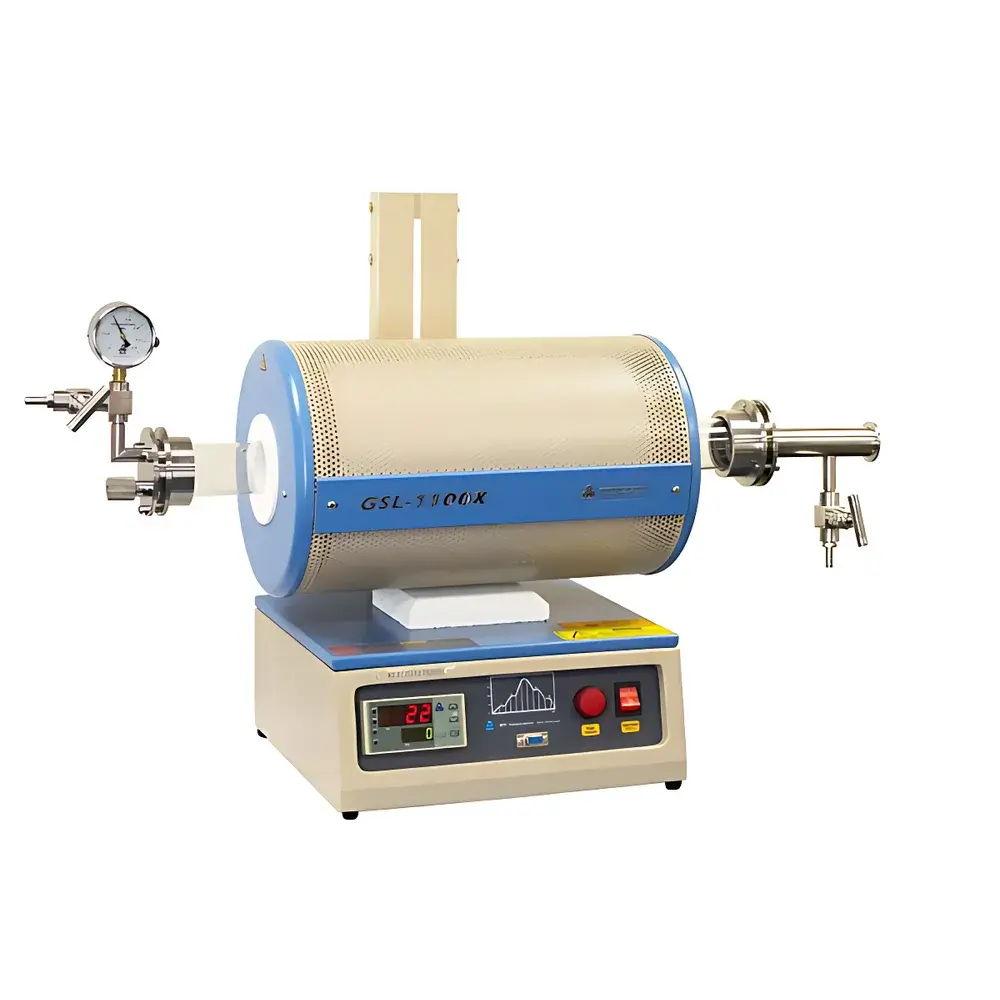
KEJING GSL-1100X-S Multi-Station Vacuum/Atmosphere Tube Furnace
| Brand | KEJING |
|---|---|
| Origin | Anhui, China |
| Model | GSL-1100X-S |
| Maximum Temperature | 1100 °C (≤2 h) |
| Operating Temperature Range | Up to 1000 °C continuous |
| Temperature Control Accuracy | ±1 °C |
| Heating Rate | 20 °C/min (to max temperature) |
| Power Rating | 1.2 kW (10 A @ 220 V AC, 50 Hz) |
| Heating Element | Molybdenum-doped Fe-Cr-Al alloy resistance wire with zirconia coating |
| Tube Dimensions | Φ25 mm × 600 mm and Φ50 mm × 600 mm (quartz) |
| Hot Zone Length | 300 mm |
| Uniform Temperature Zone | 80 mm |
| Controller | 30-segment programmable PID with auto-tuning, K-type thermocouple (Omega), over-temperature & thermocouple break alarms |
| Vacuum Compatibility | With optional KF-25 or VCR double-ferrule fittings |
| Certification | CE certified |
Overview
The KEJING GSL-1100X-S Multi-Station Vacuum/Atmosphere Tube Furnace is a precision-engineered laboratory furnace designed for controlled thermal processing of small-volume samples under vacuum, inert, reducing, or reactive gas atmospheres. Based on resistive heating via molybdenum-doped Fe-Cr-Al alloy elements and optimized thermal insulation using high-purity mullite plugs and US-sourced 1750 °C-rated alumina reflective coating, the furnace delivers stable, repeatable thermal profiles across its 300 mm heating zone. Its dual-tube configuration (Φ25 mm and Φ50 mm quartz tubes, both 600 mm long) supports parallel or sequential sample processing—enabling comparative studies, process optimization, or multi-condition screening in materials synthesis, thin-film deposition (e.g., CVD, VLS growth), annealing, and post-processing of ceramics, catalysts, and battery electrode materials. The furnace operates within a validated continuous duty range up to 1000 °C, with short-term excursions to 1100 °C permitted for ≤2 hours per cycle. Its vertical/horizontal mounting flexibility accommodates diverse experimental geometries—including quenching setups—and integrates seamlessly into glovebox or vacuum manifold environments.
Key Features
- Multi-station tube configuration supporting simultaneous or independent thermal treatment of samples in Φ25 mm and Φ50 mm quartz tubes
- 30-segment programmable PID temperature controller with auto-tuning, real-time ramp/soak profiling, and data logging capability
- High-fidelity thermal regulation: ±1 °C control accuracy maintained across the 80 mm uniform temperature zone
- Dual sealing interface options: standard stainless-steel flange with O-ring seal; optional hinge-type flange or corrosion-resistant VCR/KF-25 fittings for ultra-high purity or high-vacuum applications
- Integrated safety architecture: over-temperature cutoff, thermocouple failure detection, and pressure monitoring compatibility (max safe internal pressure: 0.02 MPa)
- Thermally optimized chamber: interior coated with high-emissivity alumina ceramic for enhanced radiant efficiency and extended service life
- Modular gas/vacuum interface: configurable inlet/outlet ports support mass flow controllers (MFCs), vacuum pumps, and residual gas analyzers (RGAs)
Sample Compatibility & Compliance
The GSL-1100X-S is compatible with standard quartz, alumina, and fused silica tubes rated for ≤1100 °C. For prolonged operation above 1000 °C, quartz tube usage is restricted to atmospheric or near-atmospheric pressure conditions to prevent devitrification and mechanical failure. The furnace meets CE marking requirements and conforms to IEC 61000-6-3 (EMC) and IEC 61000-6-4 standards. All electrical components exceeding 24 V are independently certified to UL 61010-1, CSA C22.2 No. 61010-1, and MET requirements. When equipped with optional digital vacuum gauges and calibrated thermocouples, the system supports GLP-compliant thermal validation per ASTM E2882–22 (Standard Guide for Thermal Analysis of Materials). Pressure and gas-flow interlocks may be integrated to satisfy ISO 14644–1 cleanroom environmental controls or OSHA 1910.1200 hazard communication protocols.
Software & Data Management
The embedded controller provides local operational control via intuitive membrane keypad and LCD display. Optional RS485/USB interface enables remote monitoring and script-based thermal protocol execution using KEJING’s proprietary LabFurnace Control Suite (Windows-compatible). Software features include real-time temperature curve overlay, alarm event timestamping, CSV export of time-temperature-pressure logs, and audit trail generation compliant with FDA 21 CFR Part 11 when paired with user-defined electronic signatures and role-based access control. Data integrity is preserved through non-volatile memory backup and cyclic redundancy check (CRC) verification on all stored programs and historical records.
Applications
- Chemical vapor deposition (CVD) and vapor–liquid–solid (VLS) nanowire synthesis
- Controlled-atmosphere annealing of metal oxides, perovskites, and solid-state electrolytes
- Thermal reduction of metal precursors under H₂/N₂ mixtures
- Carbonization and pyrolysis of polymer-derived ceramics
- Calibration and qualification of thermocouples and reference materials (per ASTM E230/E220)
- Inert-gas sintering of battery cathode composites (e.g., NMC, LFP)
- Pre-oxidation treatments for high-temperature superalloys and refractory metals
FAQ
What is the maximum safe operating pressure inside the quartz tube?
The internal pressure must not exceed 0.02 MPa (2 bar absolute) at any time. For temperatures above 1000 °C, the tube must be maintained at ambient pressure (i.e., vented to atmosphere or backfilled to ~101 kPa) to prevent quartz deformation or rupture.
Can this furnace be used for hydrogen annealing?
Yes—provided VCR double-ferrule fittings, leak-tested stainless-steel gas lines, and appropriate hydrogen sensors are employed. Hydrogen flow rate must remain below 200 SCCM to avoid thermal shock to the quartz tube.
Is temperature uniformity data available for validation?
KEJING provides traceable temperature mapping reports (per ASTM E220) upon request. Users are advised to perform in-situ calibration using NIST-traceable armored thermocouples for application-critical processes.
Does the furnace support automated vacuum cycling?
Not natively—but the KF-25 port and analog vacuum gauge output enable integration with external PLCs or vacuum sequencers for programmable evacuation/purge cycles.
What maintenance is required for long-term reliability?
Annual inspection of furnace insulation integrity, thermocouple calibration, O-ring replacement, and visual assessment of heating element oxidation state are recommended. Quartz tubes should be inspected for haze, cracks, or crystallization before each high-temperature run.



