
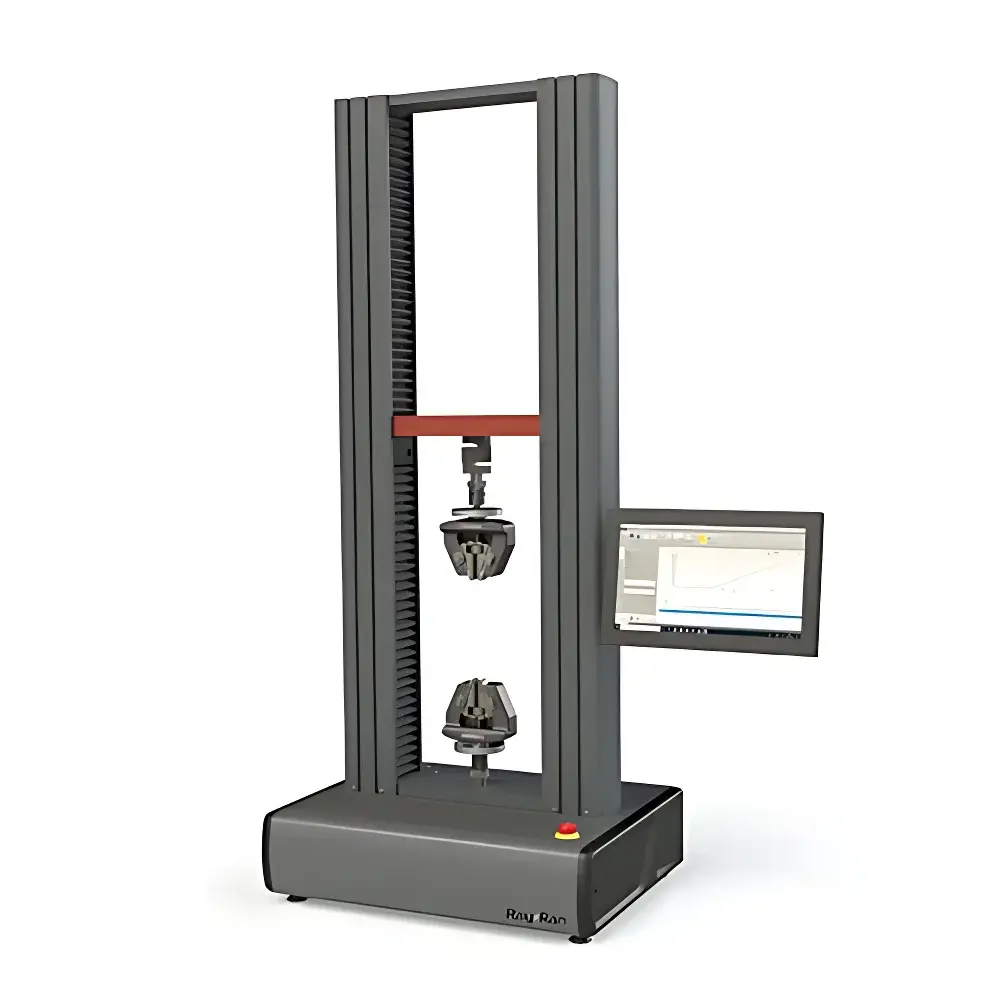
Ray-Ran X350 Dual-Column Universal Testing Machine
| Brand | Ray-Ran |
|---|---|
| Origin | United Kingdom |
| Model | X350 |
| Load Capacity | 5 kN / 10 kN / 20 kN |
| Load Accuracy | ±0.5% of reading down to 0.1% of sensor full scale |
| Effective Test Stroke | 1100 mm |
| Vertical Clearance | 1275 mm |
| Position Resolution | 1 µm |
| Minimum Speed | 0.00001 mm/min |
| Maximum Speed | 2000 mm/min |
| Speed Accuracy | ±0.1% at full speed under steady-state conditions |
| Crosshead Stiffness | 50 kN/mm |
| Data Acquisition Rate | 500 Hz (optional 1000 Hz) |
| PC Interface | Ethernet (USB via adapter optional) |
| Frame Type | Dual-column, bench-mounted (floor cabinet optional) |
| Weight | 120 kg |
| Operating Temperature | −10 °C to +40 °C |
| Power Consumption | 0.45 kW |
| Overload Protection | Up to 800% of sensor capacity |
| Motor Type | Brushless AC servo motor with 4,000,000 steps/revolution positioning resolution |
| I/O Channels | 6 digital I/O for extensometers, micrometers, calipers, balances, etc. |
| Additional Features | Self-cleaning preloaded ball screws |
Overview
The Ray-Ran X350 Dual-Column Universal Testing Machine is an ISO 17025-aligned electromechanical system engineered for high-fidelity mechanical property characterization across research laboratories, quality control environments, and contract testing facilities. Based on closed-loop digital servo control architecture, the X350 implements precise force–displacement–time data acquisition through a robust dual-column frame designed to ASTM E4, ISO 7500-1, and EN 10002-2 compliance requirements. Its core measurement principle relies on high-stability load cell transduction combined with sub-micron position feedback from optical encoders integrated into the brushless servo drive train. The system supports static and quasi-static tensile, compressive, flexural, shear, peel, and puncture testing of metallic, polymeric, composite, elastomeric, and biomedical specimens — delivering traceable, repeatable results under GLP and GMP-aligned workflows.
Key Features
- Triple-range interchangeable load cells (5 kN, 10 kN, 20 kN), each certified to ±0.5% accuracy down to 0.1% of full-scale capacity, with automatic sensor recognition and embedded calibration parameter storage;
- Dual-column structural frame with 50 kN/mm axial stiffness, fabricated from precision-machined steel extrusions and fitted with T-slotted crossheads for rapid accessory mounting;
- Preloaded, self-cleaning ball screw actuation system with sealed, lifetime-lubricated end bearings — eliminating maintenance intervals and ensuring long-term positional fidelity;
- Brushless AC servo motor delivering 4,000,000 microsteps per revolution, enabling position resolution of 1 µm and velocity control from 0.00001 mm/min to 2000 mm/min (±0.1% stability at maximum speed);
- Integrated 6-channel digital I/O interface supporting contact and non-contact extensometers (including video and laser types), thickness gauges, environmental chambers, and auxiliary weighing systems;
- Telescoping bellows enclosure protecting the ball screw assembly against particulate ingress during abrasive or high-debris testing;
- Onboard software calibration verification utility enabling real-time validation of force and displacement linearity without external metrology equipment;
- 800% overcapacity tolerance on load sensors — safeguarding transducer integrity during accidental overload events;
- High-speed data acquisition at up to 1000 Hz (standard 500 Hz) synchronized across up to four analog input channels, compliant with ASTM E139 and ISO 6892-1 timing requirements.
Sample Compatibility & Compliance
The X350 accommodates specimens ranging from thin films (<0.05 mm) to structural composites (up to 1200 mm in length), with standardized grips and fixtures meeting ISO 527, ASTM D638, D790, D143, D3044, and EN ISO 178 test method geometries. Optional pneumatic, hydraulic, wedge, and custom-designed grips ensure secure clamping without slippage or premature failure. All force and displacement measurements are traceable to UKAS-accredited standards. The machine’s firmware and control architecture support audit-ready operation under FDA 21 CFR Part 11 when paired with validated software packages — including electronic signatures, change logs, and user access controls. Environmental chamber integration enables testing across −70 °C to +300 °C per ISO 6721 and ASTM D696 protocols.
Software & Data Management
Control and analysis are performed via Ray-Ran’s Windows-based UniTest software — a modular platform supporting method-driven test sequencing, real-time curve overlay, multi-specimen batch processing, and automated report generation in PDF, Excel, and XML formats. Raw data streams are stored in vendor-neutral ASCII or HDF5 containers, preserving timestamped metadata (user ID, calibration ID, environmental conditions, fixture configuration). Software modules include advanced modulus calculation (tangent, secant, chord), yield point detection (0.2% offset, maximum slope), fracture energy integration, and creep/stress relaxation modeling. Audit trails record all parameter modifications, calibration events, and export actions — satisfying GLP documentation requirements and internal QA review cycles.
Applications
- Tensile strength, elongation at break, and Young’s modulus determination for thermoplastics, thermosets, and biopolymers per ISO 527 and ASTM D638;
- Compressive yield stress and deformation behavior of foams, ceramics, and pharmaceutical tablets (USP <1217>);
- Flexural modulus and bending strength of laminates and fiber-reinforced composites (ASTM D790, ISO 178);
- Peel adhesion and tack performance of pressure-sensitive adhesives (PSA) per ASTM D903 and FINAT FTM 1;
- Shear strength of bonded joints, welds, and encapsulated electronics (ASTM D1002, ISO 4587);
- Mechanical fatigue pre-screening using programmable load cycling with variable amplitude and dwell control;
- Validation of material substitution in medical device components (ISO 10993-12) and packaging integrity (ASTM F88, F1140).
FAQ
What load cell options are available for the X350, and how is calibration managed?
The X350 supports factory-calibrated 5 kN, 10 kN, and 20 kN load cells. Each sensor contains EEPROM-stored calibration coefficients; automatic detection occurs at power-up. Calibration verification can be performed in situ using the built-in software utility.
Is the X350 compatible with third-party extensometers?
Yes — the 6-channel digital I/O interface accepts TTL, LVDT, and analog voltage outputs from external extensometers, provided signal conditioning matches the specified input range (±10 V, 16-bit resolution).
Can the system operate unattended overnight?
Yes — the X350 supports scheduled test sequences with automatic shutdown, data archiving, and email notification upon completion. All safety interlocks remain active during autonomous operation.
Does the machine meet international metrological standards for accreditation?
The X350 complies with ISO 7500-1 Class 0.5 for force measurement and ISO 9513 Class 0.5 for displacement, making it suitable for UKAS, DAkkS, and A2LA-accredited laboratories.
What is the recommended maintenance schedule?
No routine lubrication or mechanical adjustment is required. Annual verification of load cell linearity and crosshead alignment is advised, using NIST-traceable reference standards.



