
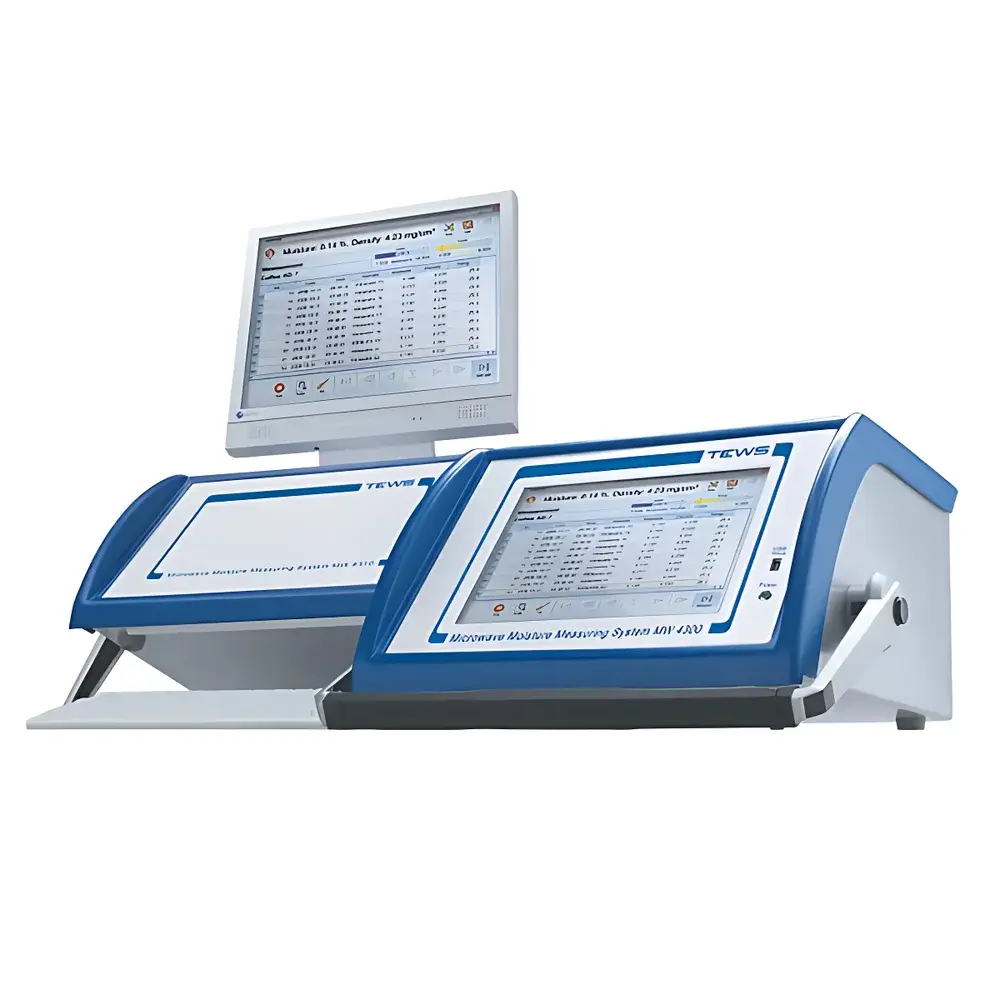
TEWS MW 4300 / MW 4310 Microwave Moisture and Bulk Density Analyzer
| Brand | TEWS |
|---|---|
| Origin | Germany |
| Model | MW 4300 / MW 4310 |
| Power Supply | 110–230 V AC, 50–60 Hz |
| Power Consumption | 60 VA |
| Operating Temperature | 0–45 °C |
| Data Interfaces | 2× RS-232 (COM + Service), 1× Ethernet, 3× USB, 1× Analog Input (0/4–20 mA for optional IR sensor), 1× Pt100 temperature sensor input, PS/2 mouse & keyboard + VGA display support |
| Measurement Time | Millisecond-scale |
| Internal Data Storage | 6,000 measurements |
| External Server Storage | Unlimited |
| Display | MW 4300 — integrated 10.4" (26.4 cm) LCD color touchscreen |
| Sample Volume Range | 1–2000 mL |
| Max. Sensor Units Supported | 2 (lab-grade microwave sensors) |
| Calibration Profiles | Up to 200 product-specific calibration curves |
| Software | Pre-installed TEWS Moisture View© |
Overview
The TEWS MW 4300 and MW 4310 are laboratory-grade microwave-based analyzers engineered for simultaneous, non-destructive determination of moisture content and bulk density in solid, granular, and powdered materials. Unlike thermal or chemical methods, these instruments employ high-frequency electromagnetic wave interaction (typically at 2.45 GHz) with polar molecules—primarily water—to quantify dielectric permittivity and loss factor. This physical principle enables direct, real-time correlation between microwave signal attenuation/phase shift and volumetric water concentration, independent of sample composition heterogeneity or surface morphology. The system operates on a transmission/reflection measurement architecture optimized for reproducible cavity-free sensing, eliminating the need for sample preparation, drying, grinding, weighing, or reagent use. Measurements are completed within seconds, with results—including moisture (% w/w), bulk density (g/cm³), and derived parameters such as porosity or compaction index—computed and timestamped automatically. Both models comply with fundamental metrological requirements for laboratory instrumentation under ISO/IEC 17025-accredited environments when used with traceable calibration standards.
Key Features
- Non-invasive, non-thermal measurement principle preserving sample integrity—samples remain chemically unaltered and physically recoverable post-analysis.
- Millisecond-scale acquisition cycle enabling high-throughput screening of batch samples in QC/QA workflows.
- Dual-mode operation: standalone (MW 4300) with integrated 10.4″ capacitive touchscreen interface, or PC-integrated (MW 4310) via VGA, USB, and Ethernet for centralized lab network deployment.
- Flexible sensor integration: supports up to two TEWS-certified laboratory microwave sensors, each configurable for specific volume ranges (1–2000 mL) and material classes (e.g., polymers, pharmaceutical granules, food powders, mineral ores).
- Comprehensive I/O architecture: dual RS-232 ports for legacy device interoperability, Ethernet for TCP/IP-based remote monitoring, three USB ports for peripheral expansion (e.g., barcode scanners, external storage), analog input for hybrid sensing (e.g., IR-based surface moisture cross-validation), and Pt100 input for ambient temperature compensation.
- Embedded data governance: internal storage for 6,000 full measurement records with metadata (date, time, operator ID, sensor ID, calibration profile used); exportable via USB or network to LIMS or ELN systems.
Sample Compatibility & Compliance
The MW 4300/MW 4310 accommodates a broad spectrum of non-metallic, low-conductivity materials including but not limited to pharmaceutical excipients, catalyst pellets, agricultural grains, ceramic powders, plastic resins, and battery electrode coatings. Metallic fillers, highly conductive slurries, or samples with excessive salt content may require empirical validation due to microwave shielding effects. Instrument design adheres to EN 61326-1 (EMC for laboratory equipment) and EN 61010-1 (safety requirements for electrical equipment). While not intrinsically rated for hazardous areas, it is suitable for general laboratory use under ISO 9001, ISO 13485 (medical device manufacturing), and USP guidance for alternative moisture assay methods—provided method validation per ICH Q2(R2) is performed. Audit trails, user access levels, and electronic signature support are implemented in TEWS Moisture View© to facilitate compliance with FDA 21 CFR Part 11 and EU Annex 11 for regulated environments.
Software & Data Management
Pre-installed TEWS Moisture View© provides a deterministic, deterministic GUI for instrument configuration, calibration management, real-time sensor visualization, and statistical reporting. The software supports creation and validation of up to 200 product-specific calibration curves using reference methods (e.g., Karl Fischer titration, loss-on-drying). All measurement sessions generate structured CSV/Excel-compatible logs with timestamps, environmental readings (via Pt100), and raw microwave signal parameters (S11/S21). Trend analysis, histogram generation, SPC charting (X-bar/R), and deviation alerts are available natively. Data export protocols include FTP, SMB/CIFS, and OPC UA for seamless integration into MES or SAP QM modules. Remote firmware updates and diagnostic logging are accessible via secure HTTPS interface.
Applications
- Pharmaceutical: Quantification of residual moisture in lyophilized APIs and tablet granulations without thermal degradation risk—critical for stability-indicating assays.
- Food & Agriculture: Rapid verification of moisture specifications in cereal blends, dairy powders, and roasted coffee beans prior to packaging.
- Materials Science: In-process monitoring of green body density in ceramic injection molding feedstocks.
- Chemical Manufacturing: Batch release testing of silica gels, molecular sieves, and zeolite catalysts where conventional LOD introduces bias from volatile co-solvents.
- Recycling & Mining: On-site moisture correction for mass-to-volume conversion of crushed ore or shredded polymer flakes during feedstock characterization.
FAQ
How does microwave moisture measurement differ from traditional oven-drying or Karl Fischer methods?
Microwave analysis relies on dielectric response rather than mass loss or chemical reaction, delivering results in seconds without sample destruction, heating artifacts, or reagent consumption.
Can the MW 4300/MW 4310 be validated for GMP-regulated environments?
Yes—when deployed with documented IQ/OQ/PQ protocols, calibrated against NIST-traceable standards, and operated under TEWS Moisture View© with audit trail enabled, it meets core requirements of FDA 21 CFR Part 11 and EU GMP Annex 11.
What sample volume ranges are supported, and how is sensor selection determined?
From 1 mL (micro-vial configurations) to 2000 mL (bulk container mode); sensor choice depends on material density, particle size distribution, and required precision—application engineering support is available from TEWS regional technical centers.
Is temperature compensation automatic during measurement?
Yes—the integrated Pt100 input continuously feeds ambient temperature data to the algorithm, correcting for thermal drift in dielectric constant estimation.
Does the system support automated calibration verification?
TEWS Moisture View© includes scheduled auto-check routines using certified reference standards; deviation thresholds trigger configurable notifications and lockout of measurement mode until corrective action is logged.




