
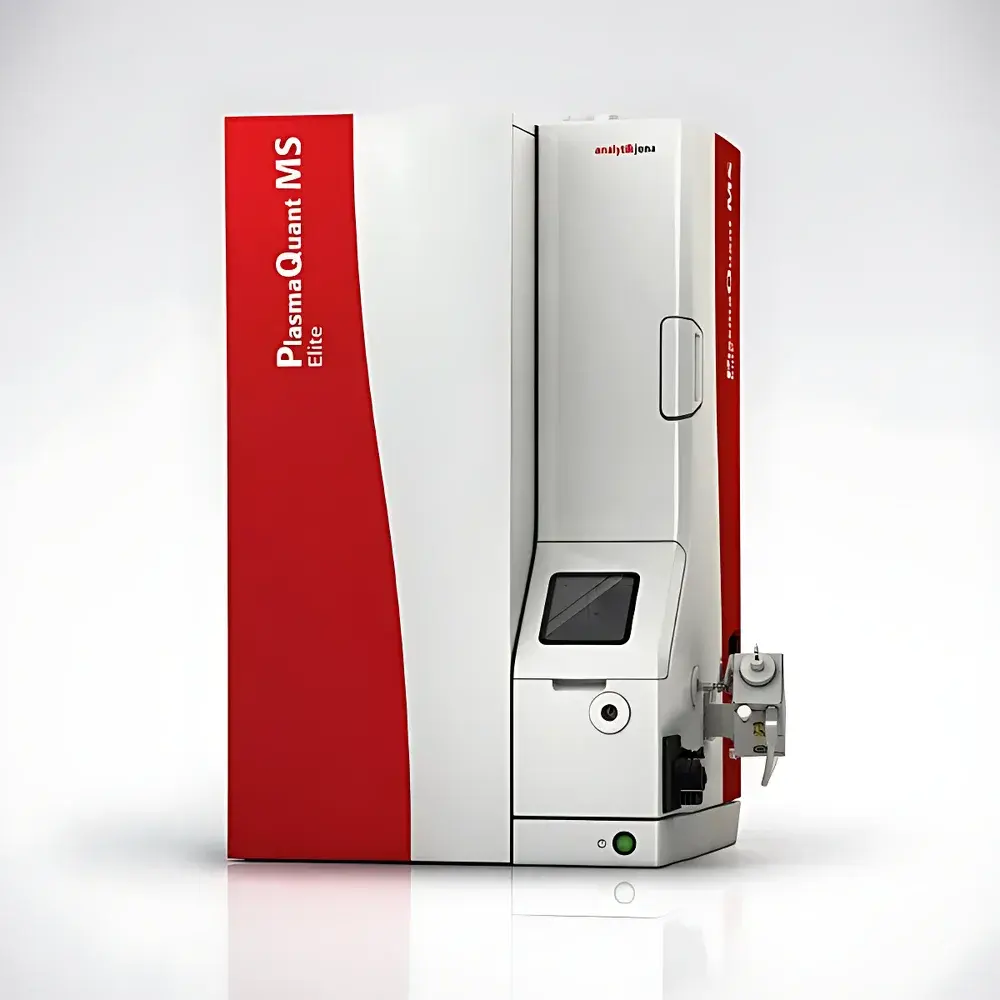
Analytik Jena PlasmaQuant MS Inductively Coupled Plasma Mass Spectrometer (ICP-MS)
| Brand | Analytik Jena |
|---|---|
| Origin | Germany |
| Instrument Type | Quadrupole ICP-MS |
| Model | PlasmaQuant MS |
| Application Domain | Laboratory-based elemental and isotopic analysis |
| Regulatory Compliance | Designed for GLP/GMP environments |
| Gas Consumption | <9 L/min Ar plasma gas |
| Oxide Rate (CeO⁺/Ce⁺) | ≤1.8% |
| Double-Charge Rate (Ba²⁺/Ba⁺) | ≤2% |
| Detection Limit Performance | 7Li ≥100 Mcps/ppm, 115In ≥500 Mcps/ppm, 238U ≥500 Mcps/ppm |
| Dynamic Range | 0.1–10¹⁰ cps (11-decade linear range in pulse-counting mode) |
| Quadrupole Drive Frequency | 3.0 MHz |
| Mass Scan Speed | 5115 amu/s |
| Minimum Dwell Time | 50 µs |
| iCRC Collision/Reaction Cell | Dual-gas (He/H₂) configurable, with BOOST technology for sensitivity preservation |
Overview
The Analytik Jena PlasmaQuant MS is a high-performance quadrupole inductively coupled plasma mass spectrometer engineered for ultra-trace elemental quantification, high-precision isotope ratio measurement, and single-particle nanoparticle analysis (down to <10 nm). It operates on the fundamental principle of ionization in a robust, water-cooled RF plasma (27.12 MHz), followed by mass separation via a high-resolution quadrupole mass filter and detection using an advanced all-digital detector (ADD11). The instrument integrates proprietary technologies—including ReflexION 3D ion optics, iCRC collision/reaction cell, BOOST interference mitigation, and Nitrox plasma modification—to deliver exceptional sensitivity, stability, and operational efficiency across diverse sample matrices, from ultrapure standards to high-TDS seawater and organic solvents.
Key Features
- ReflexION Ion Optics: A parabolic electrostatic field enables true 90° ion beam reflection and three-dimensional focusing at the quadrupole entrance—maximizing ion transmission across the full mass range while excluding photons, neutrals, and particulates to achieve sub-0.5 cps background noise.
- iCRC Integrated Collision/Reaction Cell: Configurable with helium or hydrogen gas for efficient removal of polyatomic interferences (e.g., ArO⁺ on 56Fe, ArAr⁺ on 80Se); BOOST technology maintains analyte sensitivity during reactive gas operation.
- Nitrox Plasma Modification Module: Fully automated MFC-controlled online addition of nitrogen and oxygen to enhance ionization efficiency for hard-to-ionize elements (e.g., As, Se) in organic matrices and suppress carbon-based interferences.
- Aerosol Dilution Technology: Enables direct analysis of high-total-dissolved-solids (TDS) samples such as seawater or brines without offline dilution, preserving accuracy and reducing contamination risk.
- HD Quadrupole with 3.0 MHz Drive Frequency: Delivers high mass resolution (M/ΔM > 300), abundance sensitivity of 2.3 × 10⁻⁸ (at m–1 for ²³⁸U), and scan speeds up to 5115 amu/s—critical for transient signal analysis (e.g., LA-ICP-MS, single-nanoparticle detection).
- ADD11 All-Digital Detector: Provides 11-decade linear dynamic range (0.1–10¹⁰ cps) in pulse-counting mode, enabling simultaneous quantification of major, minor, and ultra-trace elements in a single run; validated lifetime ≥10 years under routine NIST 1643e analysis (300 samples/day, 20 days/month).
Sample Compatibility & Compliance
The PlasmaQuant MS accommodates aqueous solutions, digested environmental/biological matrices, laser-ablation aerosols, and directly nebulized organic solvents (e.g., kerosene, diesel) when paired with Nitrox. Its plasma robustness—supported by adjustable RF power (300–1600 W), low oxide (<1.8% CeO⁺/Ce⁺) and double-charge (<2% Ba²⁺/Ba⁺) rates, and <9 L/min argon consumption—ensures stable operation with complex, high-salt, or high-carbon content samples. The system meets essential requirements for ISO/IEC 17025-accredited laboratories and supports audit-ready data integrity through optional 21 CFR Part 11–compliant software modules. It is routinely deployed in applications aligned with ASTM D5191, EPA Method 6020B, and USP / for elemental impurities.
Software & Data Management
Controlled via the intuitive PlasmaQuant Software Suite, the instrument supports method development, real-time interference monitoring, automatic tuning, and comprehensive reporting. The software architecture supports traceable audit trails, electronic signatures, and secure user-role management—enabling compliance with GLP and GMP documentation standards. Data export formats include .csv, .xlsx, and .cdf (NetCDF), facilitating integration with LIMS and statistical analysis platforms. Optional add-ons provide isotope ratio calculation (with internal/external standardization), nanoparticle size distribution modeling, and LA time-resolved quantification.
Applications
- Ultra-trace metal analysis in semiconductor-grade chemicals (sub-ppq detection limits)
- Isotopic fingerprinting in geochemical and nuclear forensics studies
- Single-particle ICP-MS (spICP-MS) for nanomaterial characterization (size, number concentration, dissolution kinetics)
- Direct organic sample analysis in petrochemical QA/QC (e.g., S, V, Ni, Fe in fuels)
- High-TDS environmental monitoring (seawater, brine, wastewater)
- Elemental impurity testing per ICH Q3D and USP guidelines in pharmaceuticals
- Multi-element bio-monitoring in clinical and nutritional research
FAQ
What regulatory standards does the PlasmaQuant MS support?
It is designed for use in ISO/IEC 17025, GLP, and GMP environments, with optional software features compliant with FDA 21 CFR Part 11 for electronic records and signatures.
Can the PlasmaQuant MS analyze organic solvents directly?
Yes—when equipped with the Nitrox module, it enables robust, interference-minimized analysis of hydrocarbon-based samples without prior digestion or matrix separation.
How does the iCRC cell differ from conventional collision cells?
iCRC uses dual-gas (He/H₂) selection with BOOST technology to preserve analyte transmission while eliminating polyatomic interferences—eliminating the need for kinetic energy discrimination or hardware reconfiguration between methods.
What is the typical maintenance interval for the ADD11 detector?
Under standard operating conditions (e.g., daily analysis of NIST 1643e), the detector is rated for ≥10 years of service life without replacement or recalibration.
Is the PlasmaQuant MS suitable for laser ablation applications?
Yes—the combination of high scan speed (5115 amu/s), short dwell time (50 µs), and stable transient signal response makes it ideal for LA-ICP-MS coupling with excimer or Nd:YAG lasers.
Related Products





