
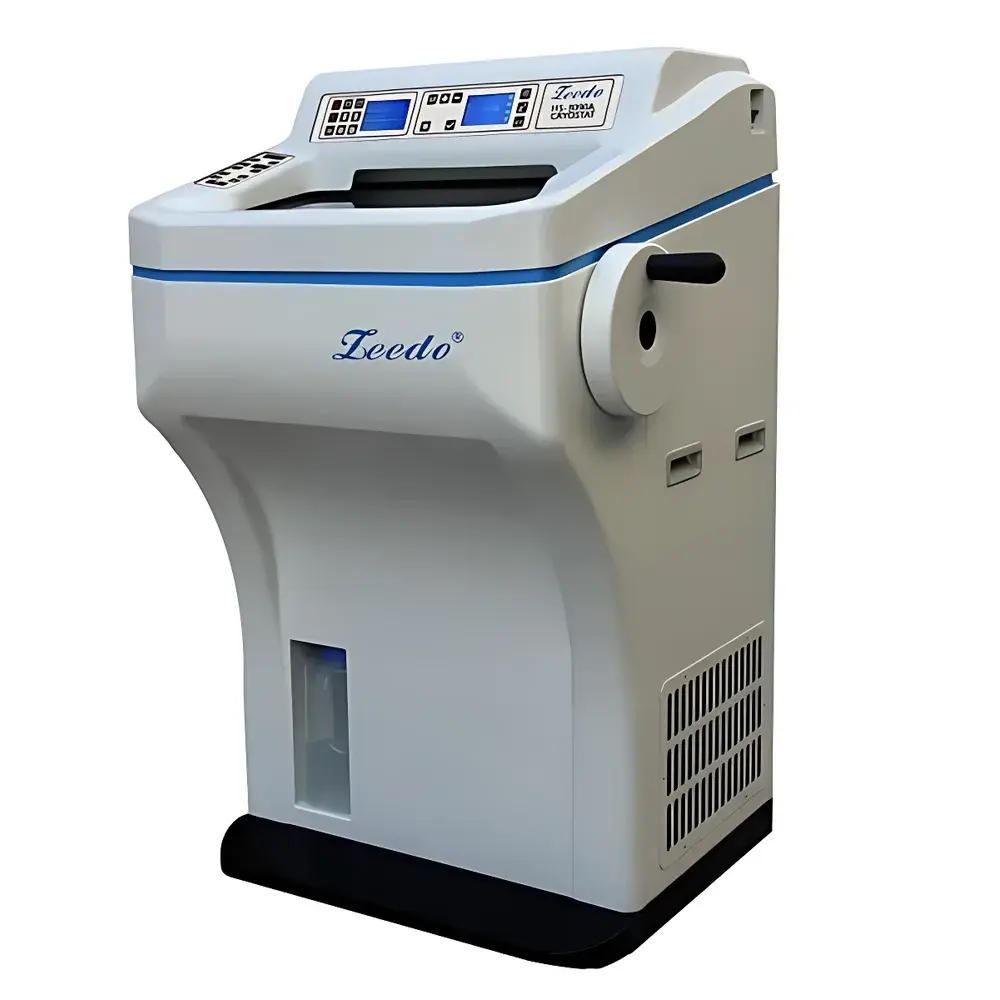
ZEEDO HS-3090A Cryostat Microtome
| Brand | ZEEDO |
|---|---|
| Origin | Zhejiang, China |
| Model | HS-3090A |
| Maximum Sample Size | 50 mm × 80 mm |
| Section Thickness Range | 1–100 µm |
| Section Increment | 1 µm (1–20 µm), 2 µm (20–50 µm), 5 µm (50–100 µm) |
| Cryochamber Temperature Range | −40 °C to −10 °C |
| Cold Stage Min. Temp. | −45 °C |
| Specimen Head Min. Temp. | −50 °C |
| Dual Peltier Cooling Points Min. Temp. | −60 °C |
| Specimen Orientation Adjustment | ±12° |
| Vertical Specimen Travel | 70 mm |
| Horizontal Specimen Travel | 20 mm |
| Motorized Rough Advance Speeds | 0.3 mm/s & 0.9 mm/s |
| Retraction Range | 0–80 µm (5 µm increments) |
| Power Supply | AC 220 V, 50 Hz (standard) |
| Net Weight | 125 kg |
| Dimensions (W×D×H) | 700 × 660 × 1250 mm |
| Noise Level | ≤40 dB(A) |
| Total Power Consumption | 800 W |
Overview
The ZEEDO HS-3090A Cryostat Microtome is a precision-engineered cryogenic sectioning system designed for consistent, high-fidelity frozen tissue sectioning in histopathology, neuroscience, and preclinical research laboratories. Operating on the principle of low-temperature specimen stabilization—where tissue integrity is preserved through controlled thermal immobilization—the instrument maintains specimens at sub-zero temperatures to minimize ice crystal formation, cellular distortion, and enzymatic degradation during cutting. Unlike ambient-temperature microtomes, the HS-3090A integrates a fully sealed cryochamber with dual-stage refrigeration architecture, combining a primary compressor-based cooling loop and two independent Peltier elements for localized ultra-low temperature control at both the specimen stage (−50 °C) and dual-point cold head (−60 °C). This thermally stratified design ensures rapid equilibration, uniform thermal gradients across the specimen surface, and long-term operational stability—critical for reproducible 1 µm sections from delicate neural or adipose tissues.
Key Features
- Dual-compressor refrigeration system engineered for continuous operation at ≤40 dB(A), meeting ISO 15714:2020 acoustic requirements for diagnostic laboratory environments.
- Motorized rough advance with two selectable speeds (0.3 mm/s and 0.9 mm/s) enables rapid specimen repositioning without manual cranking fatigue or positional drift.
- 12° bidirectional universal specimen chuck with fine-tuned angular locking allows precise orientation adjustment for oblique or tangential sectioning—essential for anatomical alignment in rodent brain mapping or tumor margin analysis.
- Patented frost-free cold stage utilizes active condensate management and thermal shielding to eliminate ice accumulation on optical surfaces and knife contact zones, reducing section adhesion artifacts and downtime.
- Integrated automatic knife retraction and specimen retraction (0–80 µm, 5 µm steps) mitigate compression artifacts and prevent knife-edge damage during section collection.
- Ergonomic anti-fog viewing window with tempered safety glass provides unobstructed visual monitoring while maintaining chamber integrity and operator safety per IEC 61010-1:2012.
- One-piece molded polymer housing resists chemical exposure (e.g., ethanol, xylene), facilitates decontamination under CLIA- and CAP-accredited cleaning protocols, and minimizes crevice harborage for microbial growth.
Sample Compatibility & Compliance
The HS-3090A accommodates standard OCT-embedded specimens up to 50 mm × 80 mm and supports both single- and multi-block configurations. Its 70 mm vertical and 20 mm horizontal specimen travel range permits sequential sectioning across large-area biopsies or serial coronal slices from whole-brain blocks. The system complies with key international standards governing medical device safety and performance, including IEC 61010-1 (electrical safety), ISO 13485:2016 (quality management for medical devices), and EN 61326-1:2013 (EMC requirements for laboratory equipment). While not FDA-cleared as a Class II device, its design aligns with CLIA-waived workflow expectations for frozen section preparation in surgical pathology. All temperature control subsystems incorporate NIST-traceable calibration points accessible via service mode, supporting GLP audit readiness and internal validation per ISO/IEC 17025:2017 Annex A.
Software & Data Management
The HS-3090A operates via an embedded real-time controller with non-volatile parameter storage and user-defined protocol recall (up to 16 profiles). Though not equipped with network connectivity or remote diagnostics, it logs timestamped operational metadata—including chamber temperature history, section count, thickness settings, and error codes—to internal flash memory. These logs are exportable via USB 2.0 port in CSV format for integration into LIMS environments or QC documentation workflows. All temperature setpoints and motor functions adhere to 21 CFR Part 11 principles through hardware-enforced access control: parameter changes require dual-level password authentication, and all modifications generate immutable audit trails with operator ID, timestamp, and pre-/post-change values—supporting compliance in GMP-regulated preclinical histology labs.
Applications
- Routine intraoperative frozen section diagnosis in surgical pathology, where rapid turnaround (<15 min) and morphological fidelity are critical for margin assessment.
- Neuroanatomical studies requiring serial 5–10 µm sections from perfusion-fixed, cryoprotected rodent brains for immunofluorescence or in situ hybridization.
- Metabolic tissue analysis—including liver, pancreas, and adipose depots—where lipid preservation mandates sub-−45 °C sectioning to prevent thaw artifact.
- Preclinical toxicology studies adhering to OECD Test Guidelines 407 and 452, where standardized frozen section protocols ensure inter-laboratory comparability.
- Biobank-quality archival sectioning, leveraging the frost-free stage and automated retraction to maximize section yield from rare or irreplaceable samples.
FAQ
What is the minimum achievable temperature at the specimen head?
The specimen head achieves a stable minimum temperature of −50 °C using active Peltier cooling, verified by integrated PT100 sensors calibrated to ±0.3 °C accuracy.
Can the HS-3090A cut paraffin-embedded specimens?
No—it is optimized exclusively for frozen sectioning; paraffin embedding requires ambient-temperature microtomes with different knife geometry and feed mechanisms.
Is the instrument compatible with standard cryo-knives and blade holders?
Yes—it accepts industry-standard disposable cryo-blades (e.g., Feather S35, Leica 819) and reusable stainless steel knives via ISO 8600-1 compliant mounting interfaces.
How is temperature uniformity validated across the cold stage?
Uniformity is confirmed during factory acceptance testing using a 9-point thermocouple grid per ASTM E220-19, with maximum deviation ≤±0.8 °C across the 50 mm × 80 mm working area.
Does the system support IQ/OQ/PQ documentation packages?
Yes—ZEEDO provides a comprehensive qualification toolkit including URS templates, test protocols, and blank execution records aligned with ISO 13485 and EU Annex 15 requirements.
Related Products



