
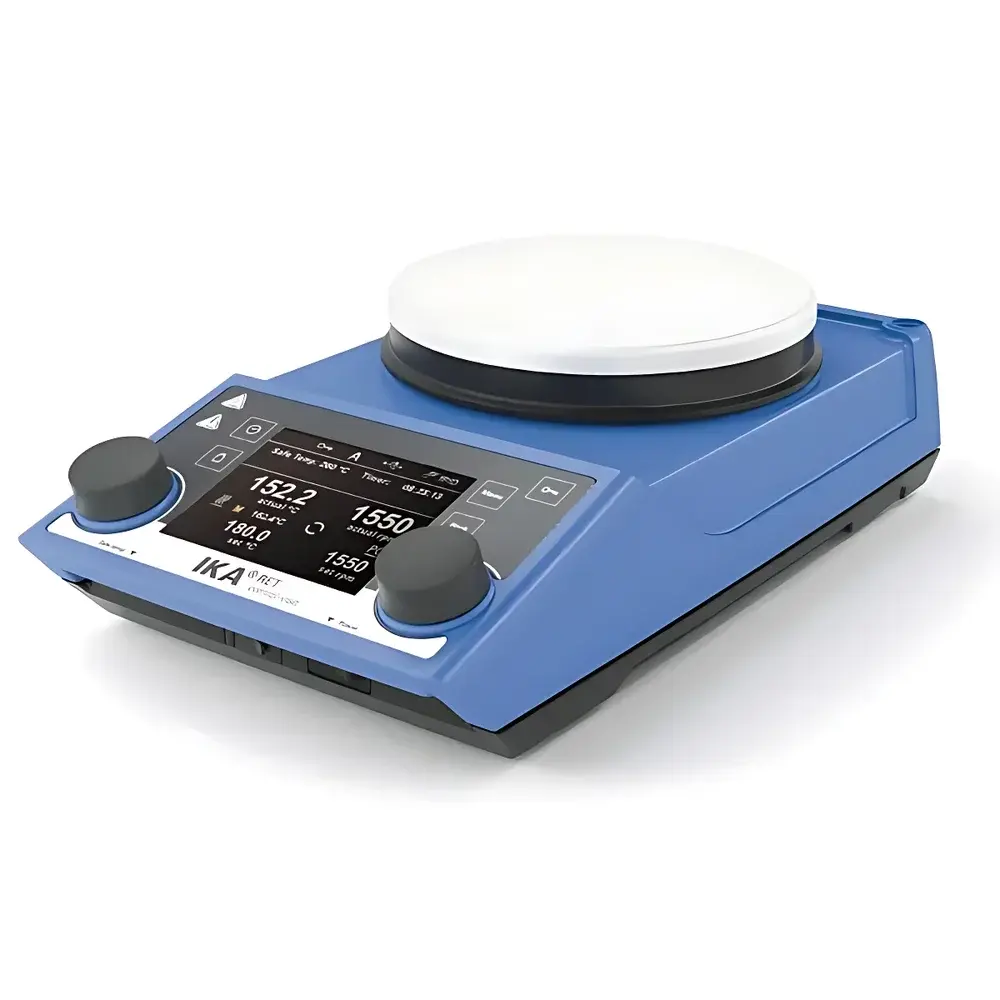
IKA RET control-visc white Advanced Heating Magnetic Stirrer with Integrated Precision Balance and Dual-Temperature Control
| Brand | IKA |
|---|---|
| Origin | Germany |
| Model | RET control-visc white |
| Motor Output Power | 9 W |
| Max. Stirring Volume (H2O) | 20 L |
| Speed Range | 50–1700 rpm |
| Speed Setting Accuracy | ±10 rpm |
| Stirrer Bar Length Compatibility | 20–80 mm |
| Heating Plate Material | Enamel-Coated Ceramic |
| Heating Plate Diameter | Ø135 mm |
| Heating Power | 600 W |
| Heating Temperature Range | Ambient + Self-Heating (up to +28 K) to 340 °C |
| Temp. Setting Range | 0–340 °C |
| Temp. Setting Resolution | 0.1 K |
| External Temperature Sensor Interface | PT100/PT1000 (dual-input) |
| Media Temp. Accuracy (e.g., 1 L M50 silicone oil in H1500) | ±0.1 K |
| Media Heating Rate | 7 K/min |
| Max. Media Temp. | 270 °C |
| Safety Overtemperature Range | 50–380 °C |
| Integrated Balance Capacity | 10–5000 g |
| Balance Accuracy | ±(0.3% + 2) g |
| Balance Resolution | 1 g |
| pH Measurement Support | Yes (BNC female socket) |
| Display | Full-color TFT screen with multilingual UI |
| Timer & Countdown Function | Yes |
| Intermittent Mode | Yes |
| Viscosity Trend Monitoring | Yes |
| Stirrer Bar Detection (Jump Detection) | Yes |
| Graphical Data Plotting | Yes |
| Programmable Protocols | Yes |
| Media Detection Sensor (Error Code 5) | Yes |
| Lock Key Function | Yes |
| Post-Shutdown Temperature Hold Display | Yes (until plate <50 °C) |
| Enclosure Protection Rating | IP42 (per DIN EN 60529) |
| Communication Interfaces | RS232, USB (for remote control, data export, firmware updates) |
| Input Voltage | 220–240 V AC, 50/60 Hz |
| Total Instrument Power Consumption | 650 W |
| Dimensions (W×H×D) | 160 × 270 × 85 mm |
| Weight | 2.7 kg |
| Operating Ambient | 5–40 °C, ≤80% RH |
Overview
The IKA RET control-visc white is a high-integration laboratory heating magnetic stirrer engineered for precision process control in R&D, quality assurance, and regulated production environments. It combines three core functionalities—magnetic stirring, programmable surface heating, and real-time mass monitoring—within a single compact platform. Its measurement architecture is based on permanent-magnet synchronous drive technology for stable torque delivery across the full speed range (50–1700 rpm), coupled with PID-controlled ceramic heating elements capable of reaching 340 °C on the enamel-coated plate. The system supports dual-temperature regulation via optional PT100/PT1000 probes: one embedded in the heating plate and another immersed directly in the reaction medium, enabling closed-loop control of both thermal interface and bulk sample temperature. This architecture meets fundamental requirements for thermally sensitive syntheses, dissolution testing, and viscosity-dependent kinetic studies where thermal drift or mechanical inconsistency would compromise reproducibility.
Key Features
- Integrated high-resolution balance (10–5000 g, ±0.3% + 2 g accuracy) eliminates need for external weighing stations during reagent addition or endpoint titration workflows.
- Dual-channel temperature control with independent setpoints for plate and medium—enabling precise simulation of thermal gradients or validation of heat transfer efficiency.
- TFT color display with intuitive multilingual interface (English, German, French, Spanish, Chinese, Japanese) and context-sensitive soft keys for rapid parameter navigation.
- Real-time viscosity trend monitoring via torque feedback analysis—detects rheological transitions (e.g., gelation, polymerization onset, precipitation) without external viscometers.
- Stirrer bar jump detection and automatic speed correction prevent vortex collapse or splashing during low-viscosity or high-speed operations.
- Programmable intermittent mode, countdown timer, and multi-step protocols support standardized test methods such as USP <701> (Dissolution) or ASTM D2196 (Rheology of Paints).
- Lock key function prevents accidental modification of critical parameters during unattended operation—essential for GLP/GMP-compliant labs.
- IP42-rated enclosure ensures dust resistance and protection against vertically falling droplets, supporting long-term reliability in shared lab spaces.
Sample Compatibility & Compliance
The RET control-visc white accommodates standard glass and stainless-steel vessels up to 20 L volume (water-equivalent), with compatibility confirmed for borosilicate glass (DIN ISO 3585), PTFE-coated reactors, and jacketed flasks. Its heating plate’s enamel-ceramic surface resists chemical attack from common solvents (e.g., acetone, ethanol, dilute acids/bases) and maintains dimensional stability at sustained temperatures up to 340 °C. For regulatory compliance, the instrument supports audit-trail-ready operation when connected via RS232 or USB to validated LIMS or ELN systems. Firmware logging includes timestamped records of setpoint changes, error codes (e.g., Error 5 = media sensor fault), safety limit activations, and balance calibration events—facilitating FDA 21 CFR Part 11 alignment when paired with appropriate electronic signature controls. All electrical design conforms to IEC 61010-1 and EMC directive 2014/30/EU.
Software & Data Management
Data acquisition and remote operation are enabled through IKA’s proprietary Labworldsoft software (v5.0+), compatible with Windows 10/11. The software provides real-time plotting of temperature, speed, torque, weight, and pH (via BNC input) on synchronized axes, with export options to CSV, PDF, or XML formats. Each data point carries embedded metadata—including operator ID, method name, instrument serial number, and environmental conditions (if logged via optional sensors). Firmware updates are performed exclusively over USB, with checksum verification and rollback capability. All communication channels support configurable baud rates (RS232) and descriptor-based enumeration (USB HID class), ensuring interoperability with third-party SCADA or MES platforms under ISA-95 frameworks.
Applications
- Controlled synthesis of nanomaterials requiring precise thermal ramping and in-situ mass tracking of precipitant addition.
- Dissolution testing per USP <711>, where simultaneous monitoring of medium temperature, stirring rate, and dissolved solid mass improves correlation with bioavailability models.
- Viscosity profiling of polymer solutions during crosslinking reactions—leveraging torque-derived trend curves to identify gel points.
- pH-stat titrations in enzymatic assays, using the BNC interface for real-time electrode feedback and automated reagent dosing based on weight gain.
- Method development for ASTM D445 (kinematic viscosity) sample conditioning, where consistent bath temperature and agitation minimize shear history effects.
- Teaching laboratories performing calorimetry experiments—utilizing the integrated balance and dual-temperature inputs to calculate enthalpy changes via mass-normalized energy balance.
FAQ
Does the RET control-visc white support GLP-compliant data integrity?
Yes—when used with Labworldsoft and configured with user authentication, electronic signatures, and immutable audit logs, it satisfies core ALCOA+ principles for traceability and data reliability.
Can the balance be calibrated internally without external weights?
No—external calibration weights meeting ISO/IEC 17025 traceability standards are required for initial and periodic verification.
Is the PT1000 probe compatible with all IKA temperature modules?
Only with instruments explicitly specifying dual-input PT100/PT1000 support; the RET control-visc white accepts both probe types interchangeably via auto-detection.
What happens if the heating plate exceeds the safety temperature limit?
The system immediately cuts power to the heater, displays the active safety limit value, and retains the error in non-volatile memory until cleared by authorized personnel.
How frequently should the stirrer bar detection algorithm be validated?
Validation is recommended before each critical batch run using standardized bar lengths (e.g., 40 mm and 60 mm) under identical viscosity and speed conditions.



