
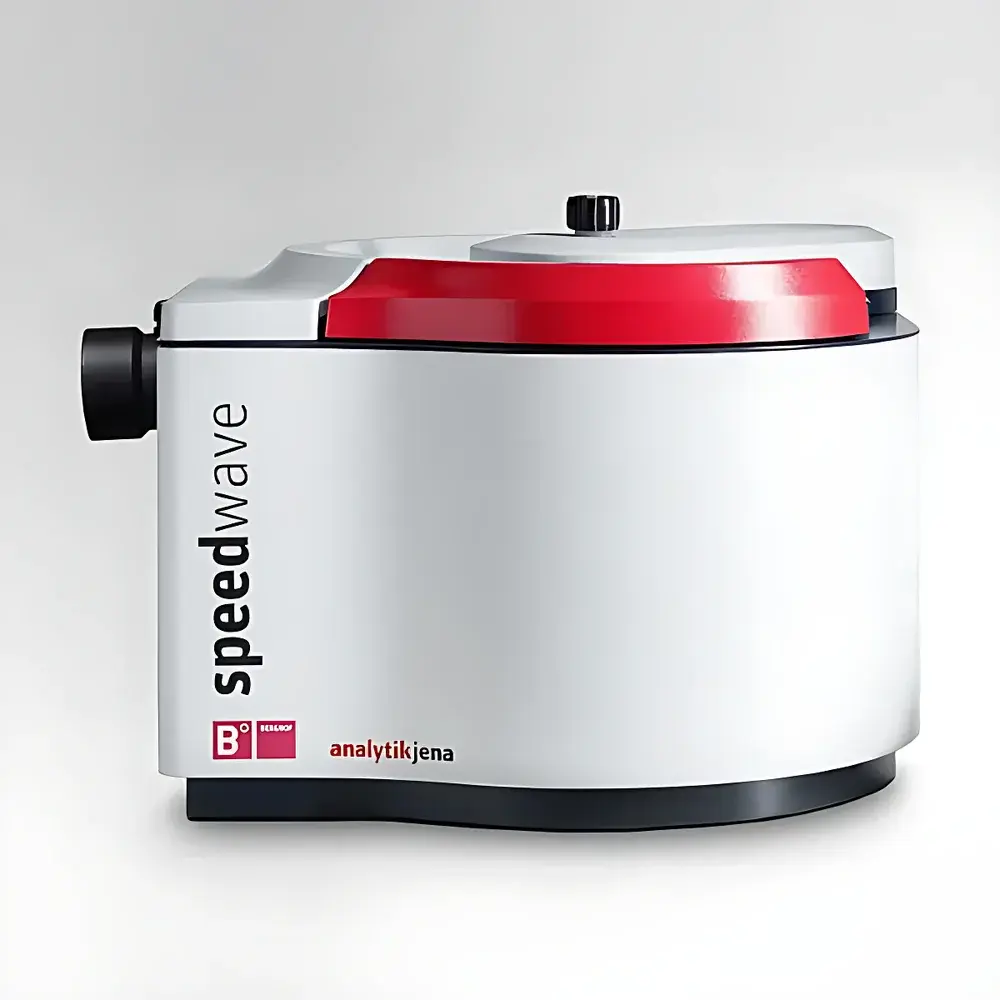
Analytik Jena SPEEDwave XPERT Microwave Digestion System
| Brand | Analytik Jena |
|---|---|
| Origin | Germany |
| Model | SPEEDwave XPERT |
| Cavity Class | Civil-grade (non-industrial) |
| Max Temperature | 260 °C |
| Max Pressure | 100 bar |
| Vessel Volume Options | 40–100 mL |
| Vessel Material | High-purity TFM-PTFE |
| Pressure Monitoring | Optical Pressure Control (OPC), non-contact, per-vessel |
| Temperature Monitoring | Direct Infrared Control (DIRC), optical, per-vessel |
| Safety Features | Electrically actuated rotary lid with auto-locking, integrated gas absorption module, continuous cavity ventilation, rupture disc–equipped vessel caps, pressure-relief on opening |
| Compliance | Designed for GLP/GMP-aligned workflows |
Overview
The Analytik Jena SPEEDwave XPERT Microwave Digestion System is a high-reliability, closed-vessel microwave-assisted sample preparation platform engineered for routine and research-grade laboratories requiring trace-level elemental analysis. It operates on the principle of controlled microwave energy absorption by polar molecules—primarily water and nitric acid—to rapidly elevate temperature and pressure within sealed digestion vessels, enabling complete mineralization of organic matrices and dissolution of inorganic compounds. Unlike open-vessel or hot-block systems, the SPEEDwave XPERT delivers accelerated reaction kinetics while maintaining strict containment of volatile analytes (e.g., As, Hg, Se) and corrosive fumes. Its architecture integrates real-time, non-contact optical sensing at the vessel level—ensuring that each sample’s thermal and mechanical state is independently monitored and regulated. This eliminates reliance on single-point reference sensors and mitigates risks associated with heterogeneous sample composition, variable mass loading, or matrix-dependent exothermic behavior.
Key Features
- Per-vessel optical monitoring: Optical Pressure Control (OPC) and Direct Infrared Control (DIRC) provide independent, contactless measurement of pressure and temperature inside every digestion vessel—no thermocouples or pressure transducers inserted into the reaction medium.
- Patented safety-integrated vessel design: TFM-PTFE vessels rated to 260 °C and 100 bar feature engineered rupture discs, pressure-actuated venting upon lid opening, and modular construction permitting tool-free assembly/disassembly.
- Top-access rotary lid with electric actuation: Ergonomic overhead access enables intuitive vessel loading/unloading without bending or twisting; motorized locking ensures consistent sealing torque and repeatable pressure integrity.
- Active cavity management: Continuous forced-air ventilation maintains uniform thermal distribution across the cylindrical cavity, minimizing hot-spot formation and reducing risk of arcing or uneven digestion.
- Integrated off-gas treatment: Built-in chemical absorption module neutralizes NOx, Cl2, and HF vapors generated during aggressive acid digestions (e.g., HNO3/HF/HCl mixtures), eliminating need for external scrubbers.
- Touchscreen control interface: Android-based OS with gesture-responsive UI supports method storage, stepwise ramp/hold programming, and real-time graphical display of all vessel-specific parameters.
Sample Compatibility & Compliance
The SPEEDwave XPERT accommodates diverse sample types—including biological tissues, soils, polymers, foodstuffs, clinical specimens, and geological materials—across a broad range of acid chemistries (e.g., HNO3, HCl, HF, H2O2, and aqua regia). Vessels are available in four standardized volumes (40, 60, 80, and 100 mL), with optional inserts for low-volume or high-sensitivity applications (e.g., <100 µL serum digests). All vessel components comply with USP and ISO 10993-5 for extractables testing. The system is validated for use in environments governed by ISO/IEC 17025, ASTM D5681, EPA Methods 3050B/3051A/3052, and EN 13656. When operated with optional Audit Trail and Electronic Signature modules, it meets documentation requirements under FDA 21 CFR Part 11 and supports GLP/GMP audit readiness.
Software & Data Management
Control software provides full method lifecycle management: creation, validation, execution, and export. Each run logs timestamped, vessel-specific pressure/temperature profiles, microwave power output, and event markers (e.g., pressure relief, program abort, lid actuation). Data exports conform to ASTM E1447-compliant CSV and PDF formats. Optional LIMS integration via OPC UA enables bidirectional communication with laboratory information management systems. All user actions—including method edits, parameter overrides, and calibration entries—are recorded in an immutable audit trail with operator ID, timestamp, and reason-for-change fields—fully traceable for regulatory review.
Applications
- Preparation of samples for ICP-OES and ICP-MS analysis in environmental monitoring (soil leachates, wastewater sludge, airborne particulates)
- Routine digestion of pharmaceutical excipients and active ingredients prior to heavy metal testing per ICH Q3D
- Mineralization of plant and animal tissues for nutritional profiling and toxicological screening
- Dissolution of ceramic, alloy, and catalyst materials for metallurgical QA/QC
- High-throughput digestion of clinical specimens (urine, blood, biopsy tissue) in clinical chemistry and forensic toxicology labs
FAQ
What distinguishes OPC and DIRC from conventional sensor technologies?
OPC uses stress-induced birefringence in a fused silica ring to optically infer internal pressure—eliminating mechanical drift and corrosion issues common with piezoresistive transducers. DIRC employs narrow-band infrared detection focused directly on the vessel cap surface, avoiding emissivity errors associated with external IR sensors.
Can the system handle hydrofluoric acid (HF) digestions safely?
Yes—TFM-PTFE vessels and PFA-coated internal cavity surfaces are chemically inert to HF up to 260 °C; the integrated absorption module contains Ca(OH)2-impregnated media specifically formulated for HF capture.
Is method transfer possible between different SPEEDwave platforms?
Method files (.swm) created on SPEEDwave XPERT are backward-compatible with SPEEDwave FOUR and forward-compatible with newer firmware releases—ensuring consistency across instrument generations.
How is calibration verified for optical sensors?
OPC and DIRC subsystems undergo factory calibration against NIST-traceable pressure standards and blackbody radiators; users may perform field verification using certified reference materials (e.g., SRM 2783) with known decomposition onset temperatures.
Does the system support unattended overnight operation?
Yes—programmed runs include automatic cooldown, pressure equalization, and end-of-run alerts; however, post-digestion vessel handling must be performed manually after confirmation of safe internal conditions.



