
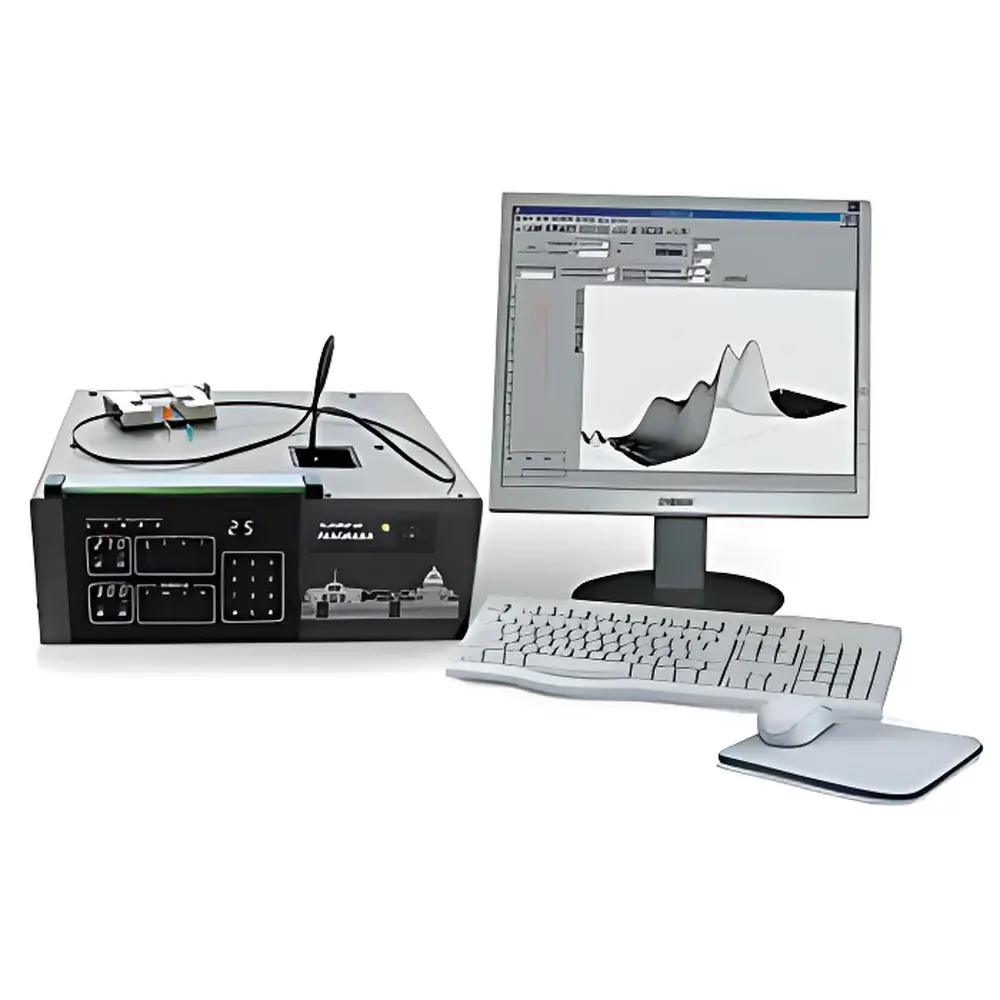
LUMEX Fluorat-02-Panaroma Molecular Fluorescence Spectrometer
| Brand | LUMEX |
|---|---|
| Origin | Russia |
| Model | Fluorat-02-Panaroma |
| Wavelength Range (Excitation) | 210–840 nm |
| Wavelength Range (Emission) | 210–690 nm (up to 840 nm optional) |
| Spectral Resolution | <8 nm (15 nm optional) |
| Wavelength Accuracy | <3 nm |
| Signal-to-Noise Ratio | >100 (up to 200) |
| Slit Width (Spectral Bandpass) | 1.5 nm |
| Sensitivity | >200:1 |
| Detector | PMT |
| Light Source | Pulsed Xenon Lamp |
| Cuvette Volume | 0.01–3 mL |
| Dimensions | 400 × 355 × 150 mm |
| Weight | 13 kg |
| Power Supply | 110/220 V, 50/60 Hz, 60 W |
Overview
The LUMEX Fluorat-02-Panaroma is a high-performance molecular fluorescence spectrometer engineered for precision quantitative and qualitative analysis of fluorescent compounds across research, environmental monitoring, clinical diagnostics, and industrial quality control applications. Based on the principle of photoluminescence spectroscopy, the instrument measures emission intensity as a function of excitation and emission wavelength—enabling acquisition of excitation spectra, emission spectra, synchronous scans, and three-dimensional (3D) contour plots. Its dual-monochromator architecture—comprising independently programmable excitation and emission monochromators—eliminates stray light interference and enables high spectral fidelity, particularly critical in the UV region (210–250 nm), where conventional filter-based systems suffer from poor isolation and signal degradation. The pulsed xenon lamp provides broad-spectrum, stable, and intense excitation across the full 210–840 nm range without filament aging or intensity drift, ensuring long-term measurement reproducibility.
Key Features
- Dual independent monochromators with real-time editable scan parameters—supporting synchronous, asynchronous, and 2D spectral mapping modes.
- Pulsed xenon lamp source delivering uniform spectral irradiance and eliminating thermal baseline drift during extended kinetic measurements.
- Patented optical path design optimized for ultraviolet sensitivity, achieving >200:1 signal-to-noise ratio even at sub-250 nm excitation wavelengths.
- Configurable slit width (1.5 nm fixed) and optional resolution settings (<8 nm standard, 15 nm optional) for balancing throughput and spectral discrimination.
- Integrated reference and transmission channels for real-time background correction and photometric calibration.
- Modular compatibility with HPLC systems—operating as a programmable fluorescence detector with on-the-fly wavelength tuning and peak spectral identification.
- Compact benchtop footprint (400 × 355 × 150 mm) and low power consumption (60 W), suitable for regulated laboratory environments with limited space and infrastructure.
Sample Compatibility & Compliance
The Fluorat-02-Panaroma accommodates standard quartz cuvettes (10 mm pathlength) with volumes ranging from 0.01 mL (micro-volume inserts) to 3 mL (standard Q10 cell). It supports aqueous, organic, and mixed-phase samples—including suspended particles, colloids, and biological suspensions—without requiring derivatization. The system complies with core analytical standards relevant to fluorescence quantification, including ISO 8536-7 (fluorescence assay validation), ASTM D5176 (fluorescent hydrocarbon detection in water), and USP (fluorescence intensity measurement protocols). Its hardware architecture and firmware support audit-trail-enabled operation under GLP and GMP frameworks, with timestamped metadata logging for all acquisition events, parameter changes, and calibration actions.
Software & Data Management
Instrument control, data acquisition, and post-processing are managed via LUMEX’s proprietary FluoroSoft v5.x software suite—designed for Windows OS and compliant with FDA 21 CFR Part 11 requirements for electronic records and signatures. The software provides full scripting capability (Tcl/Tk-based macros) for automated multi-step assays, kinetic series, and method transfer between instruments. All spectral datasets are stored in vendor-neutral .spc format with embedded metadata (wavelength calibration coefficients, lamp usage hours, detector gain settings). Export options include CSV, ASCII, and JCAMP-DX for third-party chemometric tools (e.g., MATLAB, Unscrambler, SIMCA). Batch processing modules enable comparative analysis across sample sets, including peak integration, ratio calculations (e.g., F430/F680 for chlorophyll-a quantification), and spectral deconvolution using constrained non-negative least squares (NNLS).
Applications
- Environmental Monitoring: Quantification of petroleum hydrocarbons in surface waters using native fluorescence; tracking biodegradation kinetics of oil contaminants; mapping chlorophyll-a distribution via in vivo phytoplankton fluorescence.
- Life Sciences: Time-resolved phosphorescence lifetime measurement; characterization of fluorescent probes (e.g., FITC, TRITC, quantum dots); protein conformational studies via intrinsic tryptophan fluorescence.
- Clinical & Diagnostic Research: Detection of bacterial/viral biomarkers labeled with fluorescent tags; PCR product verification via intercalating dyes; metabolic activity profiling in cell cultures.
- Materials Science: Purity assessment of phosphors and luminescent powders; spectral fingerprinting of security inks and banknote substrates; defect analysis in OLED precursor films.
- Geochemical & Forensic Analysis: Hydrogeological tracer studies using fluorescent dye tagging; forensic document examination via ink spectral differentiation; mineral identification through rare-earth element luminescence.
FAQ
What is the maximum emission wavelength capability with the optional configuration?
The standard emission range extends to 690 nm; an optional extended-range detector module supports measurements up to 840 nm for near-infrared fluorophores.
Does the instrument support time-resolved fluorescence measurements?
Yes—the pulsed xenon lamp and gated PMT detection enable decay curve acquisition with temporal resolution down to 10 ns, supporting mono- and bi-exponential lifetime fitting.
Can the Fluorat-02-Panaroma be integrated into an automated liquid handling workflow?
It features RS-232 and USB 2.0 interfaces with SCPI-compliant command set, enabling direct integration with robotic autosamplers and LIMS platforms via LabVIEW or Python APIs.
Is spectral calibration traceable to NIST standards?
Factory calibration uses NIST-traceable holmium oxide and didymium filters; users may perform recalibration using supplied reference standards with documented uncertainty budgets.
What maintenance is required for the xenon lamp and optical components?
The lamp has a rated lifetime of ≥1×10⁹ pulses; no routine alignment is needed due to rigid monochromator mounting. Optical surfaces are sealed and require only periodic dust removal with nitrogen purge.




