
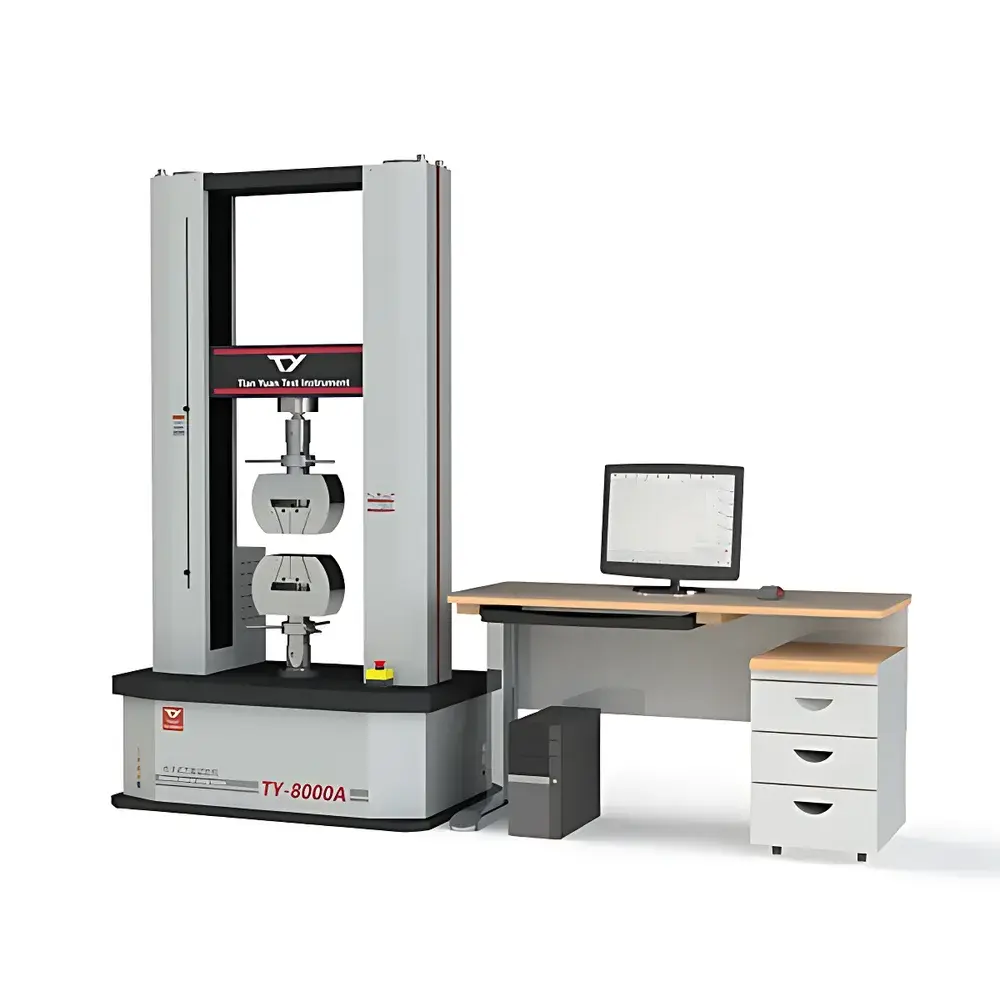
TianYuan TY8000 Universal Testing Machine for Reinforcing Steel
| Brand | TianYuan |
|---|---|
| Origin | Jiangsu, China |
| Manufacturer Type | Direct Manufacturer |
| Country of Origin | China |
| Model | TY8000 |
| Price Range | USD 14,000 – 42,000 (FOB) |
| Instrument Type | Electromechanical Universal Testing Machine |
| Max Load Capacity | 10–300 kN (configurable) |
| Effective Test Width | 500 mm |
| Effective Tensile Travel | 600 / 800 mm |
| Test Speed Range | 0.001–1000 mm/min |
| Speed Accuracy | ±1% of indicated value |
| Load Resolution | ±1/250,000 full scale (constant across entire range) |
| Displacement Accuracy | ±0.5% of indicated value |
| Strain/Deformation Accuracy | ±0.5% of indicated value |
| Crosshead Movement | Dual-speed (fast/slow) with jog control |
| Safety Protection | Electronic limit switches, overload protection at 110% of rated capacity |
| Return Mode | Manual high-speed or automatic post-test return |
| Dimensions (W×D×H) | 1000 × 680 × 2450 mm |
| Weight | 1250 kg |
Overview
The TianYuan TY8000 Universal Testing Machine is an electromechanical static testing system engineered for high-precision mechanical characterization of reinforcing steel bars, structural alloys, concrete reinforcement meshes, and related construction materials. Based on servo-controlled electromechanical actuation and closed-loop load/displacement feedback, the system complies with fundamental principles defined in ISO 6892-1 (tensile testing of metallic materials), ASTM E8/E8M, ASTM A615/A615M (specifications for deformed steel bars), and EN 10080. It delivers traceable force measurement within ±1% speed accuracy and ±0.5% displacement/strain fidelity—critical for certification-grade testing in QA/QC laboratories, precast concrete plants, and third-party inspection agencies operating under ISO/IEC 17025 requirements.
Key Features
- Modular load frame architecture supporting configurable capacities from 10 kN to 300 kN, optimized for rebar diameters ranging from Ø6 mm to Ø40 mm per ASTM A615 Class 60/75 and ISO 15630-1 compliance.
- High-resolution load cell with 1/250,000 internal resolution—maintained uniformly across the full measurement range without auto-ranging or stepwise calibration shifts.
- Dual-mode crosshead drive: precision low-speed positioning (0.001 mm/min) for creep and yield point detection, plus rapid return (up to 1000 mm/min) for throughput optimization.
- Integrated electronic safety interlocks including programmable upper/lower travel limits, hardware-based overload cutoff (110% FS), and emergency stop with mechanical brake engagement.
- Stiffness-optimized C-frame design (1250 kg mass, 2450 mm height) minimizing deflection-induced error during high-force compression tests on grouted couplers or anchor assemblies.
- Real-time Windows-based control interface with synchronized multi-channel data acquisition (load, displacement, extensometer input optional) at up to 1 kHz sampling rate.
Sample Compatibility & Compliance
The TY8000 accommodates standard rebar specimens per ASTM A370, ISO 6892-1 Annex B (machined and as-received bar geometries), and GB/T 228.1–2021. Grip systems include wedge-action pneumatic clamps (for Ø12–Ø32 mm smooth/deformed bars) and custom split-collar fixtures for embedded anchor pull-out testing. All test routines support audit-ready reporting aligned with ISO/IEC 17025 clause 7.8 (reporting results) and GLP-compliant metadata tagging—including operator ID, environmental conditions (optional sensor integration), calibration certificate traceability, and instrument firmware version logging. The system supports export of raw ASCII data and XML-formatted reports compatible with LIMS environments.
Software & Data Management
TYTest Pro v4.x software provides full IEC 62591 (FDT/DTM) compliant device integration and meets FDA 21 CFR Part 11 requirements for electronic records and signatures when configured with user role management, audit trail logging, and digital certificate authentication. Curve manipulation tools include real-time overlay of multiple specimens, derivative-based yield strength determination (0.2% offset, ISO 6892-1 Method A), modulus calculation via linear regression on initial slope, and automated fracture energy integration (area under stress–strain curve). Data export supports CSV, PDF (with embedded signature fields), and .tdms formats for NI DIAdem interoperability. All test configurations are saved as reusable method templates with version-controlled revision history.
Applications
- Tensile property verification of hot-rolled deformed steel bars (ASTM A615, BS 4449, JIS G3112)
- Yield strength, ultimate tensile strength, elongation at break, and reduction of area measurement per ISO 6892-1
- Compression testing of grouted splice sleeves and headed anchor assemblies (ASTM A1034)
- Bending and rebend testing per ASTM A615 Section 9 and ISO 15630-1 Clause 8
- Low-cycle fatigue evaluation (1–100 cycles) of seismic reinforcement under controlled strain amplitude
- Quality conformance testing for prefabricated reinforced concrete elements prior to site installation
FAQ
Does the TY8000 comply with ASTM E4 calibration standards for force verification?
Yes—the load cell and controller are calibrated per ASTM E4 using NIST-traceable deadweight standards, with as-found/as-left documentation provided with each annual recalibration.
Can the system be integrated into a centralized laboratory network with centralized data archiving?
Yes—TYTest Pro supports OPC UA server configuration for seamless connection to enterprise SCADA or LIMS platforms; database logging can be directed to SQL Server or PostgreSQL instances.
Is extensometer support available for true strain measurement during necking or post-yield deformation?
Yes—both clip-on and non-contact video extensometers (via optional DIC module) are supported, with automatic switching between crosshead and extensometer displacement channels per ISO 6892-1 Annex C.
What maintenance intervals are recommended for long-term accuracy retention?
Biannual mechanical inspection (guide rail lubrication, belt tension verification) and annual full metrological recalibration are advised; all procedures follow ISO 17025-mandated uncertainty budgeting protocols.



