
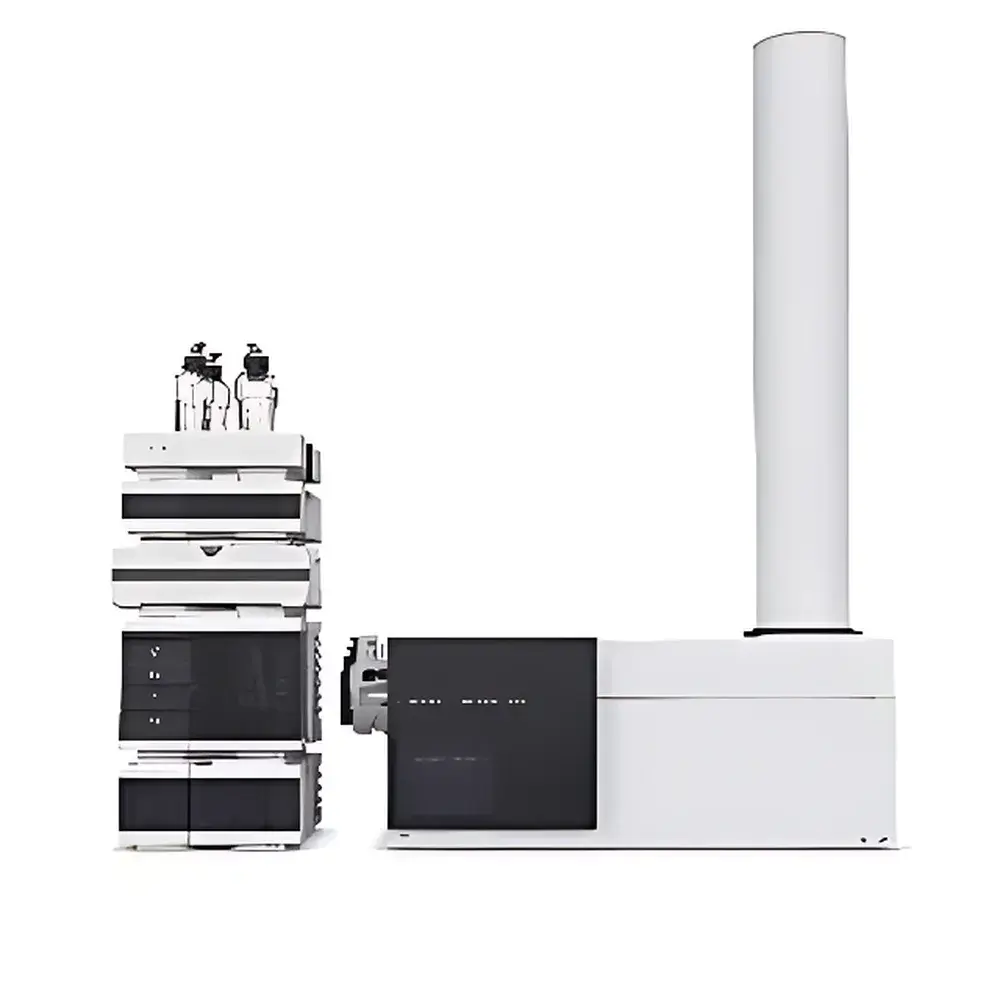
Agilent 6545XT AdvanceBio Q-TOF LC/MS System
| Brand | Agilent Technologies |
|---|---|
| Origin | Singapore |
| Manufacturer | Agilent Technologies |
| Origin Category | Imported |
| Model | 6545XT |
| Instrument Type | Quadrupole-Time-of-Flight (Q-TOF) |
| MS Sensitivity (Positive Ion, S/N RMS) | >500:1 @ 1 pg reserpine on-column |
| MS Mass Accuracy (Positive/Negative Ion) | <0.8 ppm RMS |
| MS Acquisition Rate | 50 spectra/sec |
| MS/MS Sensitivity (Positive Ion, S/N RMS) | >1500:1 @ 1 pg reserpine on-column |
| MS/MS Mass Accuracy (Positive/Negative Ion) | <2 ppm RMS |
| MS/MS Acquisition Rate | 30 spectra/sec |
| TOF Mass Resolution (FWHM) | >50,000 @ m/z 2722, independent of acquisition rate |
| TOF Mass Range | m/z 20–30,000 |
| Quadrupole Isolation Range | m/z 20–4,000 |
| Quadrupole Resolution (FWHM) | 1.3 Da (auto-tuned) |
| Polarity Switching Duty Cycle | 1.5 s |
| Internal Calibration Stability | <1 ppm / 3 °C |
| Dynamic Range within Single Spectrum | 5 orders of magnitude |
| Ion Sources | Dual AJS-ESI, APCI, ESI/APCI multimode, GC/APCI, NanoESI |
Overview
The Agilent 6545XT AdvanceBio Q-TOF LC/MS System is a high-performance quadrupole-time-of-flight mass spectrometer engineered for comprehensive characterization of biopharmaceuticals across multiple molecular weight domains—from intact proteins to peptides and post-translational modifications (PTMs). Leveraging orthogonal acceleration time-of-flight (oa-TOF) technology with reflectron-based flight path design, the system delivers sub-part-per-million mass accuracy, high-resolution isotopic fine structure resolution, and exceptional sensitivity in both full-scan and data-dependent MS/MS modes. Its integrated UHPLC compatibility—paired with Agilent AdvanceBio chromatographic columns—enables robust separation of complex biological matrices under high-pressure, low-dwell-time conditions. Designed specifically for regulated biotherapeutic development workflows, the 6545XT meets the analytical rigor required for comparability studies, biosimilarity assessment, and quality-by-design (QbD) implementation in accordance with ICH Q5, Q5A(R2), and ICH Q6B guidelines.
Key Features
- SWARM™ Auto-Tuning: Fully automated instrument optimization that dynamically adjusts TOF voltage gradients, collision energy, and quadrupole transmission parameters based on sample complexity and acquisition mode—eliminating manual tuning while maintaining consistent performance across batch runs.
- AdvanceBio Intact Protein Workflow: Enables high-fidelity top-down analysis of monoclonal antibodies (mAbs) and fusion proteins with sub-nanogram detection limits and mass accuracy ≤10 ppm for glycosylated species—validated for regulatory submissions under FDA 21 CFR Part 11 and EU Annex 11 compliance frameworks.
- Iterative MS/MS Acquisition: Combines intelligent precursor selection with real-time spectral deconvolution to maximize sequence coverage of enzymatically digested peptides, supporting confident PTM localization (e.g., phosphorylation, oxidation, deamidation) without pre-defined inclusion lists.
- Vacuum-Free Maintenance Architecture: Capillary inlet plate valve allows rapid source cleaning and ion optics inspection without venting the TOF vacuum chamber—reducing downtime by up to 70% compared to conventional Q-TOF platforms.
- Dual AJS Electrospray Ionization Source: Delivers stable, low-noise ion current over extended run times (>1,000 injections per column), with seamless polarity switching in ≤1.5 seconds—critical for simultaneous positive/negative mode screening of acidic and basic analytes.
- High-Fidelity Mass Resolution: Achieves >50,000 FWHM resolution at m/z 2722 independent of scan speed, enabling baseline separation of isotopic peaks for charge-state deconvolution of heterogeneous glycoforms and antibody-drug conjugates (ADCs).
Sample Compatibility & Compliance
The 6545XT supports diverse sample types including recombinant mAbs, ADCs, bispecifics, viral vectors, and host-cell protein (HCP) digests. It complies with GLP/GMP laboratory requirements through built-in audit trail functionality in MassHunter software, electronic signature support, and secure user-role management. All calibration and performance verification procedures align with ASTM E2927-21 (Standard Practice for Performance Verification of High-Resolution Mass Spectrometers) and ISO/IEC 17025:2017 accreditation criteria. The system’s mass accuracy and resolution stability are validated per USP for intact mass analysis and USP for peptide mapping applications.
Software & Data Management
Data acquisition and processing are fully integrated within the Agilent MassHunter platform, featuring BioConfirm for automated intact protein deconvolution and variant identification, Vista for comparative analysis of higher-order structure changes, and Flux for label-free quantitation of PTM site occupancy. Classifier and Lipid Annotator extend functionality to glycomics and lipidomics profiling. All software modules support raw data archiving in open-format .d directories, metadata tagging via controlled vocabularies (e.g., PSI-MI, MIAPE), and export to LIMS-compatible XML or CSV schemas. Audit trails record every parameter change, calibration event, and report generation—fully traceable for FDA inspection readiness.
Applications
- Intact mass analysis of therapeutic proteins with glycoform resolution
- Peptide mapping and sequence confirmation of biosimilars
- Comprehensive PTM profiling (glycosylation, oxidation, C-terminal lysine clipping, N-terminal pyroglutamate formation)
- Host cell protein (HCP) identification and quantification in purified drug substance
- Antibody-drug conjugate (ADC) drug-to-antibody ratio (DAR) determination
- Comparability assessments across manufacturing process changes
- Stability-indicating assays for forced degradation studies
FAQ
What is the maximum mass range supported for intact protein analysis?
The system operates from m/z 20 to 30,000, enabling full-spectrum acquisition of intact IgG molecules (≈150 kDa) with charge states up to +100, provided sufficient signal-to-noise and appropriate deconvolution settings.
Does the 6545XT support integration with MOBILion or e-MSion ExD platforms?
Yes—the instrument features standardized API interfaces and vendor-neutral data exchange protocols (e.g., mzML 1.1.0) compatible with external ion mobility and electron-based dissociation (ExD) modules for enhanced structural characterization.
How frequently must the TOF analyzer be calibrated?
Internal lock-mass calibration using infused reference compounds ensures long-term mass stability; routine daily calibration is recommended, but extended intervals (e.g., weekly) are feasible when operating under controlled environmental conditions (<±3 °C temperature variation).
Is method transfer possible between Agilent Q-TOF systems?
Method portability is ensured across the 6545XT, 6550, and 6546 platforms via MassHunter Method Transfer Assistant, preserving retention time alignment, collision energy ramp profiles, and acquisition timing parameters without manual re-optimization.
Can the system operate in both targeted and untargeted modes simultaneously?
While not true parallel acquisition, the 6545XT supports scheduled, data-dependent acquisition (DDA) with dynamic exclusion and inclusion lists—enabling hybrid workflows that combine targeted quantitation of known variants with discovery-oriented screening of novel modifications within the same run.






