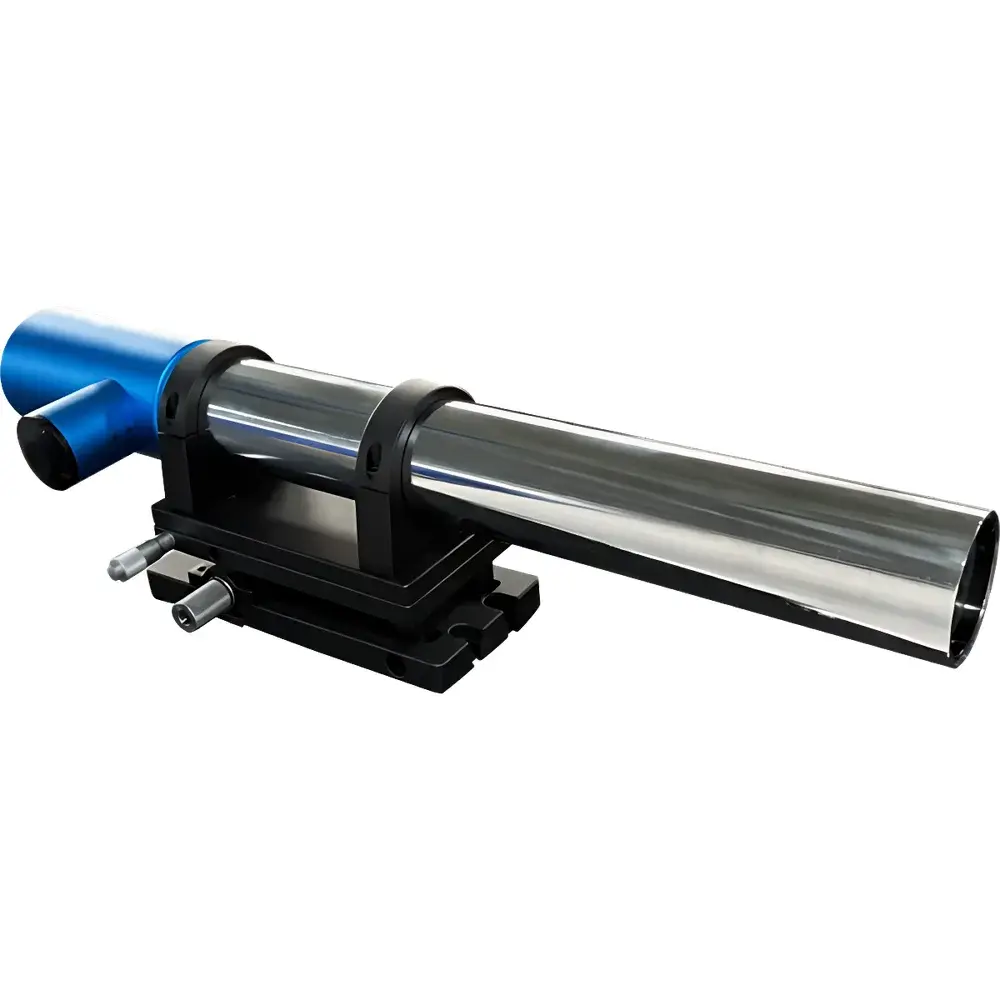
YANRUN MC030-LD400/68/0.3 Auto-Collimator
| Brand | YANRUN |
|---|---|
| Origin | Shanghai, China |
| Manufacturer Type | Manufacturer |
| Model | MC030-LD400/68/0.3 |
| Dimensions | 480 × 125 × 115 mm |
| Focal Length | 400 mm |
| Clear Aperture | 68 mm |
| Light Source | High-Stability Semiconductor LED |
| Measurement Range | 0–50 m |
| Detector | High-Resolution Photodetector Array |
| Angular Resolution | Adjustable down to 0.0001″ (arc second) |
| Field of View (X/Y) | 1700″ × 1350″ (arc seconds) |
| Accuracy (Center) | ±0.3″ for ±100″ range |
| Frequency Response | ≤30 Hz (typ.) |
| Interface | USB 2.0 |
| OS Compatibility | Windows 7 or later (64-bit) |
Overview
The YANRUN MC030-LD400/68/0.3 is a high-precision electro-optical auto-collimator engineered for non-contact angular metrology in industrial metrology labs, precision assembly facilities, and optical alignment environments. It operates on the fundamental principle of optical autocollimation: a collimated beam—generated by projecting a reticle located at the focal plane of a 400 mm focal-length objective lens—is reflected back from a planar mirror surface. Any angular deviation (α) of the mirror results in a linear displacement (ΔS) of the returned reticle image on a co-focal photodetector array, where ΔS = 2f·tan(2α) ≈ 4fα (for small angles in radians). This first-order linear relationship enables traceable, high-reproducibility angular measurement with sub-arcsecond resolution. The instrument’s 68 mm clear aperture supports stable beam propagation over distances up to 50 meters, while its semiconductor LED light source ensures long-term radiometric stability and eliminates thermal drift associated with filament-based illumination.
Key Features
- Simultaneous dual-axis (X and Y) angular measurement with real-time digital display and automatic error calculation
- Electronic eyepiece technology replaces manual visual alignment, eliminating parallax and observer-induced bias
- High-resolution photodetector array optimized for centroid-based sub-pixel displacement analysis
- Adjustable angular resolution: 0.1″, 0.01″, 0.001″, or 0.0001″ (arc second), configurable per application requirement
- Modular design supporting interchangeable accessories—including rotary stages, prisms, retroreflectors, and target mounts—for extended functionality
- Multi-language UI (English, Chinese, Russian, Korean) compliant with international lab deployment standards
- USB 2.0 interface enabling direct integration into automated metrology workstations and QC data acquisition systems
- Patented mechanical-optical architecture (Chinese Utility Model Patent No. referenced) ensuring thermal and mechanical stability during prolonged operation
Sample Compatibility & Compliance
The MC030-LD400/68/0.3 is compatible with any optically flat reflective surface meeting standard surface quality requirements (e.g., λ/10 or better PV flatness, low scatter finish). It is routinely deployed in environments governed by ISO 10360 (coordinate measuring machine acceptance testing), ISO 230-1 (machine tool geometric accuracy), and ASTM E2922 (standard practice for angular measurement using autocollimators). While not certified to FDA 21 CFR Part 11, its data export protocol (CSV/Excel) supports GLP/GMP-aligned documentation workflows when paired with validated laboratory information management systems (LIMS). All measurements are traceable to NIM (National Institute of Metrology, China) angular standards via internal calibration routines and optional external reference artifact verification.
Software & Data Management
Bundled Windows-native software provides real-time waveform visualization, statistical process control (SPC) charting, and batch measurement logging. Raw angular displacement data (X/Y in arc seconds) is timestamped and stored with metadata including operator ID, environmental conditions (optional sensor input), and calibration status. Export formats include native .xls/.xlsx for compatibility with enterprise QA databases and CSV for third-party analysis tools (e.g., MATLAB, Python pandas). Audit trails record all parameter changes, calibration events, and report generation actions—supporting internal quality audits and regulatory review requirements. Software architecture adheres to IEC 62304 Class B safety principles for medical device-adjacent applications.
Applications
- Precision alignment of CNC machine tool spindles, guideways, and rotary tables
- Verification of straightness, flatness, perpendicularity, and parallelism per ISO 1101 geometric tolerancing
- Dynamic angular stability assessment of air-bearing rotation stages used in semiconductor lithography equipment
- Optical bench alignment in laser cavity construction, interferometer setup, and telescope collimation
- Structural deformation monitoring in aerospace component testing (e.g., wing spar twist under load)
- Calibration of angle encoders, inclinometers, and other angular transducers
- Physics education and research labs requiring quantitative validation of reflection laws and small-angle approximation models
FAQ
What is the maximum working distance supported by the MC030-LD400/68/0.3?
The instrument maintains specified angular accuracy up to 50 meters when used with a high-quality plane mirror (surface flatness ≤ λ/10) and under ambient lighting conditions below 500 lux.
Does the system support external trigger synchronization?
Yes—via TTL-compatible input on the USB interface adapter, enabling synchronized acquisition with motion controllers or vibration shakers.
Can measurement data be integrated into a factory MES or SCADA system?
Direct integration is achieved through COM/ActiveX API support in the host software; custom OPC UA or MQTT gateways can be implemented via DLL interface.
Is NIST-traceable calibration available?
Factory calibration is traceable to NIM (China); optional third-party NIST-traceable calibration certificates are available upon request with documented uncertainty budgets.
How often does the system require recalibration?
Annual recalibration is recommended under ISO/IEC 17025 guidelines; however, daily verification using the included reference mirror is advised before critical measurements.