
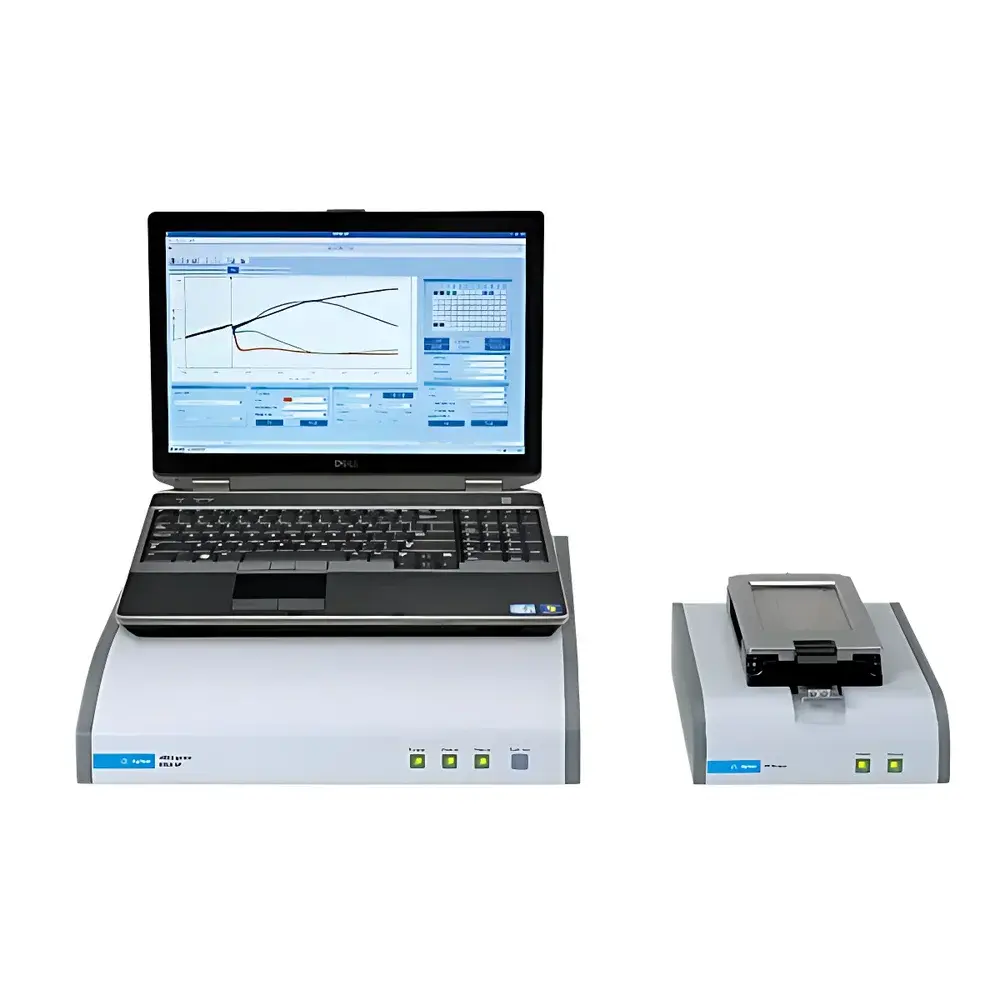
Agilent xCELLigence RTCA SP Real-Time, Label-Free Cell Analysis System
| Brand | Agilent Technologies |
|---|---|
| Origin | Zhejiang, China |
| Manufacturer Type | Original Equipment Manufacturer (OEM) |
| Regional Classification | Domestic (China-made) |
| Model | RTCA SP (1 × 96-well E-Plate) |
| Pricing | Available upon Request |
Overview
The Agilent xCELLigence RTCA SP Real-Time, Label-Free Cell Analysis System is an impedance-based, non-invasive biosensor platform engineered for continuous, quantitative monitoring of adherent mammalian cell behavior under physiologically relevant conditions. Operating inside standard CO2 incubators, the instrument measures dynamic changes in electrical impedance across microgold electrodes integrated into the bottom surface of specialized E-Plates (96-well format). As cells attach, spread, proliferate, migrate, or undergo morphological or functional changes—including cytotoxicity, barrier integrity loss, immune-mediated lysis, or GPCR activation—they modulate ion current flow between electrodes. This modulation is quantified as the dimensionless Cell Index (CI), a real-time, kinetic parameter reflecting collective cellular events without requiring dyes, labels, or endpoint assays. The system delivers sub-minute temporal resolution over experimental durations ranging from seconds to days, enabling high-fidelity longitudinal profiling of cell health, viability, adhesion strength, and functional responses—all while preserving native cell physiology.
Key Features
- Real-time, label-free monitoring via gold microelectrode impedance sensing—no transfection, staining, or fixation required
- Single 96-well E-Plate support (RTCA SP configuration) optimized for medium-throughput assay development and validation
- Integrated incubator-compatible hardware design: sensor module resides inside the CO2 incubator; control unit and data acquisition station remain external
- Cell Index (CI) as a standardized, unitless output metric—enabling cross-experiment normalization and comparative analysis
- High reproducibility enabled by consistent electrode geometry, calibrated signal processing, and temperature-stabilized measurement protocols
- Automated data acquisition with configurable sampling intervals (as low as 15 seconds) and built-in environmental monitoring (temperature, CO2, humidity)
Sample Compatibility & Compliance
The RTCA SP supports a broad range of adherent human and animal cell lines—including primary cells, stem cells, and co-cultures—provided they exhibit measurable impedance shifts upon attachment and functional modulation. Applications include cytotoxicity screening (e.g., IC50, KT50), TEER (Transepithelial/Transendothelial Electrical Resistance) assessment, viral cytopathic effect (CPE) kinetics, NK/T-cell mediated killing, and GPCR ligand profiling. All assays are performed under standard cell culture conditions (37 °C, 5% CO2, humidified atmosphere). The system complies with Good Laboratory Practice (GLP) principles and meets FDA 21 CFR Part 11 requirements for electronic records and signatures, including audit trail logging, user access controls, and data integrity safeguards. It is designated for research use only (RUO); not intended for diagnostic or clinical applications.
Software & Data Management
RTCA Software Pro serves as the central interface for instrument control, real-time visualization, and offline analysis. It provides synchronized multi-plate tracking, automated CI curve fitting, kinetic parameter extraction (e.g., lag time, doubling time, slope at inflection points), and customizable reporting templates. Data export is supported in CSV, Excel, and XML formats for integration with LIMS or statistical platforms (e.g., GraphPad Prism, R). The software implements role-based user authentication, electronic signature workflows, and immutable audit trails—fully aligned with regulatory expectations for data traceability in preclinical and translational research environments. Raw impedance values and derived CI metrics are stored in a relational database with version-controlled backups.
Applications
- Quantitative cytotoxicity and compound screening (dose–response kinetics, mechanism-of-action studies)
- Immuno-oncology assays: real-time monitoring of CAR-T or NK cell–mediated tumor cell lysis
- Barrier function analysis: TEER dynamics in endothelial or epithelial monolayers (e.g., BBB, gut, lung models)
- Virology: time-resolved characterization of virus-induced cytopathic effects and antiviral drug efficacy
- Cell adhesion and migration studies under pharmacological or genetic perturbation
- G-protein coupled receptor (GPCR) signaling: label-free detection of downstream morphological responses to agonists/antagonists
- Stem cell differentiation kinetics and quality control during biomanufacturing processes
FAQ
What is the fundamental measurement principle of the xCELLigence RTCA SP?
It employs real-time electrical impedance sensing across integrated microgold electrodes on E-Plate surfaces to detect changes in ion current caused by adherent cell morphology, density, and adhesion strength.
Can the RTCA SP accommodate other plate formats besides 96-well E-Plates?
No—the RTCA SP is specifically designed for single 96-well E-Plate operation. Other formats (e.g., 16-well, 384-well) require compatible RTCA MP or DP instruments.
Is calibration required before each experiment?
Yes—each E-Plate undergoes an automated background impedance calibration prior to cell seeding to establish baseline reference values.
How does the system ensure data integrity in regulated environments?
Through FDA 21 CFR Part 11–compliant features including electronic signatures, time-stamped audit trails, user permission hierarchies, and encrypted database storage.
Are E-Plates reusable?
No—E-Plates are single-use, sterile, tissue-culture-treated consumables with integrated electrodes; reuse compromises measurement fidelity and sterility.
Does the RTCA SP support co-culture or 3D spheroid assays?
While primarily optimized for 2D monolayers, validated protocols exist for certain co-cultures and spheroid adhesion assays—though sensitivity may vary depending on model complexity and electrode coverage.




