
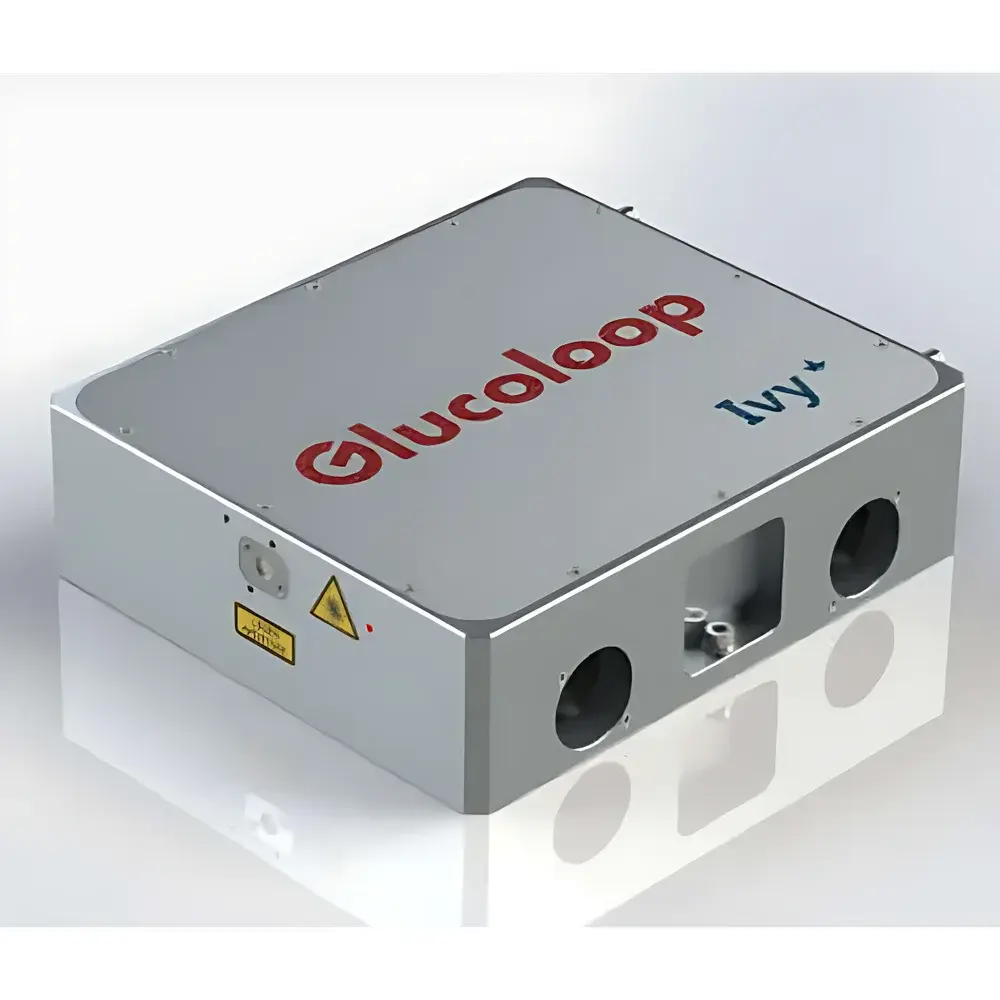
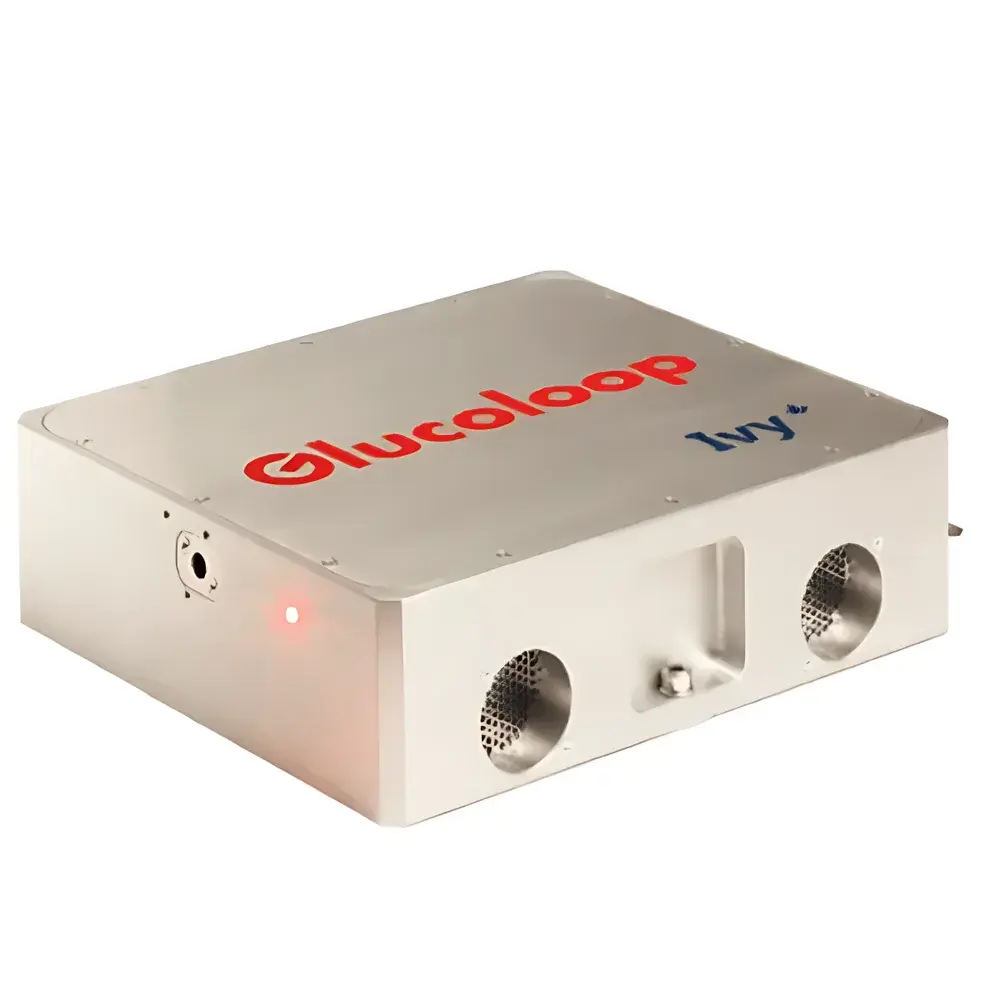
Glucoloop Ivy Integrated Mid-Infrared (MIR) Nanosecond Laser
| Brand | Glucoloop |
|---|---|
| Origin | Switzerland |
| Model | Ivy |
| Output Wavelength | ~2800 nm |
| Pulse Duration | < 3 ns |
| Pulse Energy | >25 µJ |
| Repetition Rate | <1.5 kHz |
| Peak Power | >9 kW |
| Average Power | >37.5 mW |
| Beam Quality (M²) | <1.1 |
| Polarization Extinction Ratio (PER) | >20 dB (vertical) |
| Cooling | Forced Air |
| Warm-up Time | <10 min |
| Operating Temperature | 15–35 °C |
| Storage Temperature | −20–55 °C |
| Electrical Input | 24 VDC/4 A or 90–264 VAC, 47–63 Hz |
| Dimensions | 260 × 230 × 72 mm³ |
| Weight | 6 kg |
| Mounting | Top-entry, 3-point low-stress through-hole |
| Trigger Options | Internal clock (master mode) or external TTL (slave mode) |
Overview
The Glucoloop Ivy is an integrated mid-infrared (MIR) nanosecond pulsed laser engineered for precision material interaction in the molecular fingerprint region (~2800 nm), where strong fundamental vibrational absorption bands of O–H, N–H, and C–H bonds reside. Unlike conventional thermal ablation sources, the Ivy leverages ultrafast (<3 ns) pulse delivery to selectively excite hydroxyl (–OH) vibrational modes on timescales significantly shorter than thermal diffusion—enabling non-thermal, high-fidelity modification of water-rich biological tissues, polymers, and hydrated thin films. Its monolithic, alignment-free architecture eliminates optical realignment drift and supports continuous 24/7 operation under laboratory or industrial QC environments. Designed and assembled in Zurich, Switzerland, the Ivy complies with IEC 60825-1:2014 (laser safety) and meets EMC requirements per EN 61326-1 for scientific instrumentation.
Key Features
- Monolithic MIR source: Fully integrated cavity, pump diode, and output optics in a single robust housing—no user-accessible alignment required.
- Nanosecond temporal fidelity: <3 ns pulse width ensures minimal heat accumulation and sub-micron spatial confinement during photoacoustic or photothermal transduction.
- Dual triggering architecture: Operates in master mode (internal oscillator with TTL-synced photodiode trigger output) or slave mode (external TTL input with <10 ns jitter).
- Flexible thermal management: Factory-configurable forced-air cooling; optional water-cooling interface available for extended duty cycles in high-ambient environments.
- Turnkey deployment: Pre-characterized beam profile (M² 20 dB PER), and factory-calibrated pulse energy monitoring enable rapid integration into OEM platforms or custom optical benches.
- Compact footprint & mechanical stability: 260 × 230 × 72 mm³ chassis with top-entry 3-point low-stress mounting minimizes vibration coupling and supports rigid integration into vacuum chambers or metrology-grade stages.
Sample Compatibility & Compliance
The Ivy is optimized for interaction with materials exhibiting strong mid-IR absorption above 2500 cm⁻¹—particularly hydrated biomaterials (e.g., corneal tissue, hydrogels), polymer films (e.g., PVA, chitosan), and semiconductor passivation layers containing OH/NH terminations. Its wavelength position avoids atmospheric water vapor absorption lines, ensuring stable free-space propagation over distances up to 2 m without purging. The system conforms to ISO 13485-aligned manufacturing controls (applied during final assembly in Zurich), and its electrical design satisfies UL 61010-1 and CE marking requirements for laboratory equipment. For regulated applications—including GLP-compliant environmental sensing or GMP-aligned semiconductor process development—the Ivy supports optional audit-trail-capable firmware logging (via RS-232/USB-C) and cleanroom-rated enclosure variants (ISO Class 5 compatible).
Software & Data Management
The Ivy operates autonomously without host PC dependency but includes a bidirectional UART interface (3.3 V logic, configurable baud rate) for remote parameter control (repetition rate, burst mode enable/disable) and real-time status reporting (pulse count, diode temperature, internal photodiode signal amplitude). Optional Glucoloop Control Suite (Windows/Linux/macOS) provides GUI-based waveform visualization, automated stability trending (RMS pulse energy deviation over 72 h), and CSV export compliant with ASTM E2917-22 (standard practice for laser performance data reporting). All firmware updates are digitally signed and validated prior to installation, satisfying FDA 21 CFR Part 11 requirements for electronic records when used in regulated quality systems.
Applications
- Mid-IR photothermal microscopy: Enables label-free, diffraction-unlimited imaging of lipid droplets and protein aggregates via pump-probe thermal lens detection at 2800 nm.
- High-resolution time-of-flight mass spectrometry (TOF-MS): Serves as a soft desorption source for intact biomolecule analysis—minimizing fragmentation through resonant vibrational excitation rather than thermal decomposition.
- Selective thin-film delamination: Used in microelectronics for stress-free lift-off of polyimide or SU-8 layers from silicon wafers without substrate damage.
- Photonic integrated circuit trimming: Precise refractive index modification in chalcogenide waveguides via controlled MIR-induced structural relaxation.
- Environmental trace gas sensing: Functions as a seed source for difference-frequency generation (DFG) systems targeting CH₄, CO, or NH₃ absorption features between 2.5–4.0 µm.
FAQ
Is the Ivy laser certified for use in Class 1000 cleanrooms?
Yes—optional cleanroom-compatible enclosures meet ISO 14644-1 Class 5 particulate limits and include static-dissipative housings and filtered air intake paths.
Can the Ivy be fiber-coupled without compromising beam quality?
Yes—factory-integrated single-mode ZBLAN fiber coupling (NA = 0.22) maintains M² <1.3 at the output facet; coupling efficiency exceeds 75% with AR-coated termination.
What is the long-term pulse energy stability under continuous operation?
Typical RMS fluctuation is ≤1.8% over 30 days (measured at 1 kHz, 25 °C ambient), verified per ISO 21254-1 Annex B accelerated aging protocol.
Does the system support burst-mode operation?
Yes—firmware v2.3+ enables user-defined burst trains (1–16 pulses) with inter-pulse spacing adjustable from 100 ns to 10 ms.
Are calibration certificates traceable to NIST or PTB standards?
All出厂 pulse energy calibrations are performed using a PTB-traceable pyroelectric sensor (Ophir PE50BF-DIF-C) and documented in the Certificate of Conformance shipped with each unit.




