
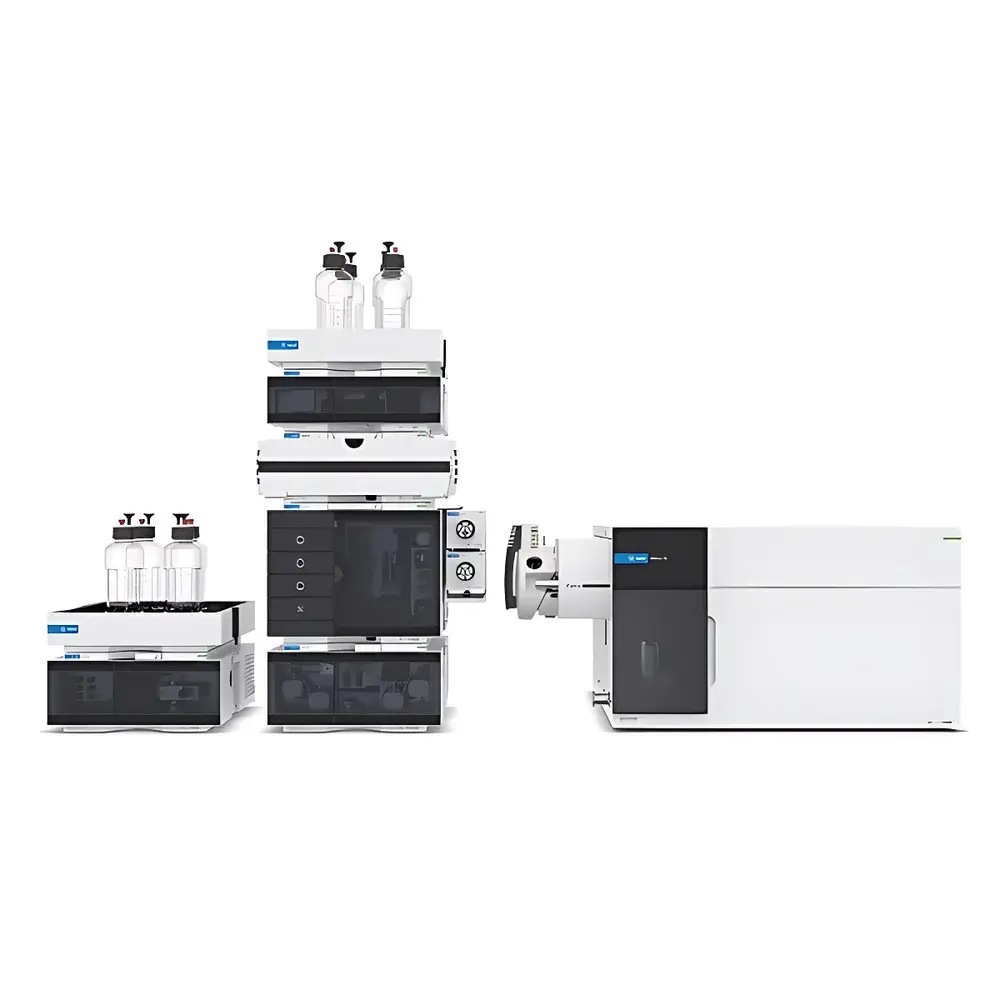
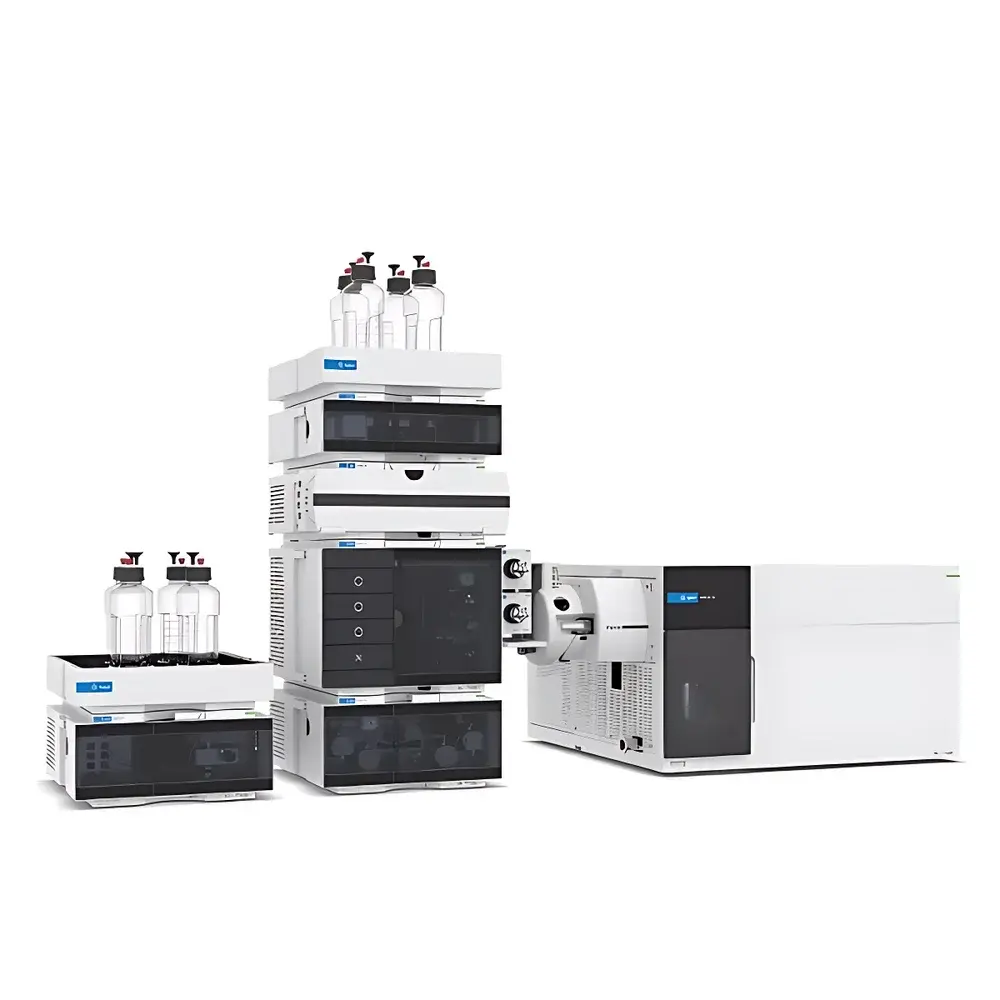
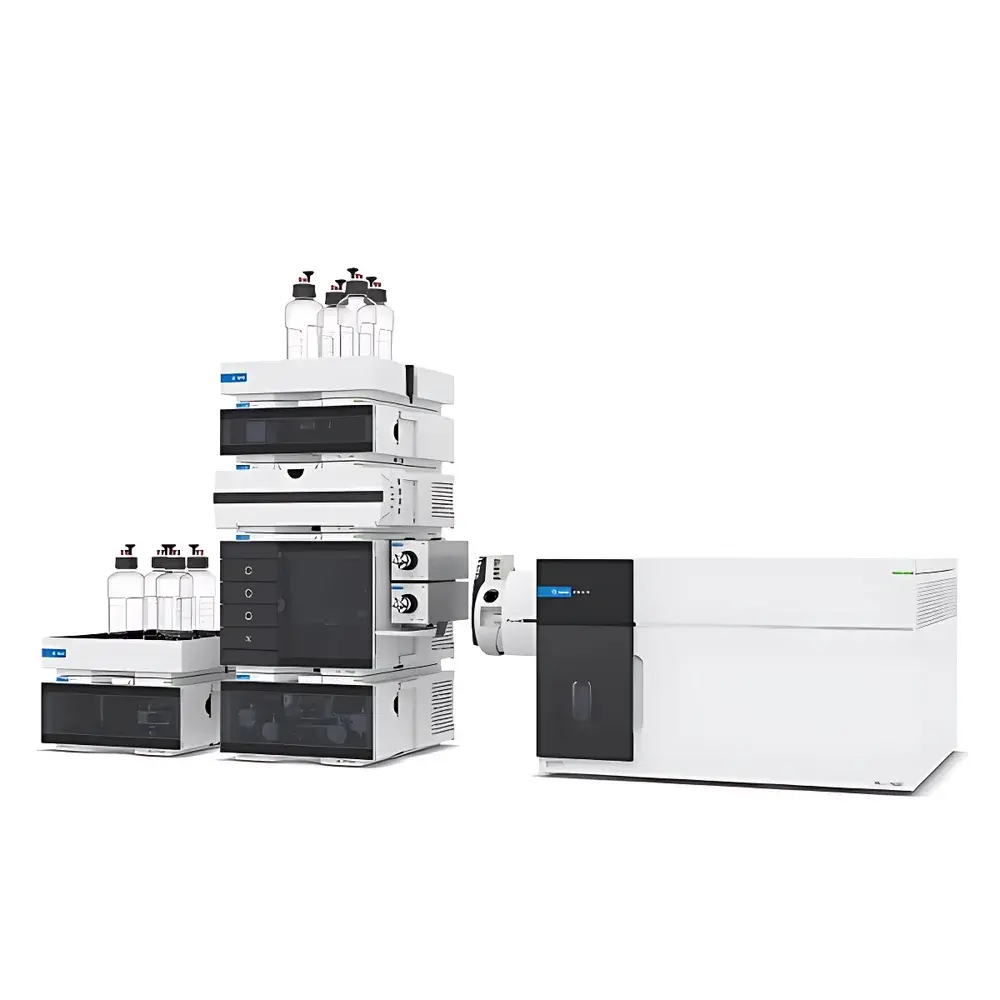
Agilent 1290 Infinity III Online SPE System
| Brand | Agilent Technologies |
|---|---|
| Origin | Germany |
| Manufacturer Type | Original Equipment Manufacturer (OEM) |
| Origin Category | Imported |
| Model | 1290 Infinity III Online SPE |
| Instrument Type | UHPLC–Online Solid-Phase Extraction Coupled System |
| Application Scope | General-Purpose Analytical Platform |
| Maximum Operating Pressure | 1300 bar |
| Temperature Control | Dual-Zone Capability (G7116A/B Modules) |
| Solvent Channels | 4 standard, up to 15 with optional Solvent Selection Valve |
| Column ID Reader | Optional |
| Column Internal Diameter Support | 8 mm max |
| Power Supply | 100–240 VAC |
Overview
The Agilent 1290 Infinity III Online SPE System is a fully integrated, high-pressure liquid chromatography platform engineered for automated, on-line solid-phase extraction (SPE) coupled directly to ultra-high-performance liquid chromatography (UHPLC) and mass spectrometry (MS) detection. It operates on the principle of two-dimensional chromatographic sample introduction: analytes are selectively retained on a reusable SPE cartridge under low-pressure loading conditions, followed by elution and transfer—under high-pressure UHPLC conditions—onto an analytical column for separation. This architecture eliminates manual off-line SPE handling, reduces solvent consumption, minimizes carryover risk, and ensures reproducible sample preparation across thousands of injections. Designed for laboratories requiring regulatory compliance, method robustness, and trace-level quantitation (e.g., environmental water analysis, pharmaceutical impurity profiling, clinical biomarker screening), the system delivers deterministic control over retention, washing, and elution steps via precise gradient programming and valve sequencing.
Key Features
- Agilent Quick-Change Valve Technology: Enables seamless switching between two reusable SPE cartridges or between SPE mode and direct injection mode—without tubing reconfiguration, tooling, or system downtime.
- Dual-Zone Thermal Management (G7116A/B modules): Independently controlled temperature zones optimize SPE cartridge conditioning (e.g., 4–10 °C for cold trapping) and analytical column stability (e.g., 30–60 °C), critical for retention time reproducibility and peak shape fidelity.
- 1300-bar UHPLC Architecture: Supports sub-2-µm particle columns and high-flow-rate loading protocols while maintaining pressure integrity across all fluidic paths—including SPE loop, transfer lines, and analytical flow cell.
- Modular Solvent Delivery: Standard 4-solvent capability; expandable to 15 solvents via optional Solvent Selection Valve—enabling complex multi-step SPE protocols (e.g., conditioning, loading, washing, elution, regeneration) without manual solvent swaps.
- Column ID Reader Integration (optional): Automatically detects and logs column dimensions, packing chemistry, and usage history—supporting audit-ready traceability per FDA 21 CFR Part 11 and GLP/GMP requirements.
Sample Compatibility & Compliance
The system accommodates aqueous, buffered, and partially organic matrices—including drinking water, wastewater, plasma, urine, and tissue homogenates—without pre-filtration when used with appropriate SPE sorbents (e.g., reversed-phase C18, mixed-mode ion exchange, hydrophilic-lipophilic balance). All wetted components comply with USP Class VI biocompatibility standards. The platform supports method validation per ICH Q2(R2), EPA Method 537.1 (PFAS in drinking water), and ISO 17025-accredited workflows. Its software architecture includes electronic signatures, audit trails, and user-access controls aligned with 21 CFR Part 11 and EU Annex 11 requirements.
Software & Data Management
Controlled via OpenLab CDS 2.x or MassHunter Quantitative Analysis software, the system provides end-to-end workflow automation—from SPE method definition (loading volume, wash solvent strength, elution gradient slope) to LC-MS/MS acquisition triggering. Sequence methods store full SPE-LC-MS parameter sets, enabling walkaway operation for unattended overnight runs. Raw data files (.d, .cdf) retain embedded metadata including valve positions, pressure logs, temperature setpoints, and cartridge cycle counts—facilitating retrospective root-cause analysis during QA/QC review or regulatory inspection.
Applications
- Ultra-trace environmental analysis: PFAS, pesticides, pharmaceuticals, and endocrine disruptors in surface and groundwater at sub-pg/L levels.
- Pharmaceutical quality control: Residual solvents, genotoxic impurities, and extractables/leachables in drug substances and containers.
- Clinical toxicology: High-throughput quantitation of opioids, benzodiazepines, and novel psychoactive substances in biological fluids.
- Food safety monitoring: Mycotoxins, veterinary drug residues, and allergen markers in complex food extracts.
- Method development labs: Rapid optimization of SPE sorbent selection, loading pH, and elution strength using built-in method scouting templates.
FAQ
Can the same instrument switch between online SPE and conventional UHPLC analysis without hardware modification?
Yes—the Quick-Change valve allows real-time reconfiguration between SPE and direct injection modes via software command; no manual valve rotation or tubing disconnection is required.
Is column ID reading mandatory for compliance with 21 CFR Part 11?
No, but it is strongly recommended as part of a complete electronic record; the optional reader provides automatic, tamper-evident logging of column identity and usage—reducing manual entry errors and supporting ALCOA+ data integrity principles.
What is the maximum sample volume supported for large-volume injection (LVI) workflows?
With the optional Large-Volume Injection Kit, the system supports programmable loading volumes up to 5 mL—enabling trace enrichment from dilute aqueous matrices while maintaining chromatographic resolution on narrow-bore analytical columns.
Does the dual-zone temperature control support cryogenic SPE trapping?
Yes—G7116A/B modules maintain stable setpoints from 4 °C to 80 °C; sub-ambient operation (e.g., 4–8 °C) is routinely used for cold trapping of volatile analytes prior to thermal desorption and transfer.
How does the system address carryover in high-sensitivity applications?
Carryover mitigation is achieved through three layers: (1) post-elution SPE cartridge rinse with strong solvent, (2) dedicated needle wash station with dual-solvent capability, and (3) flow-path flushing via high-flow purge cycles—each configurable in method parameters and logged in audit trail.




