
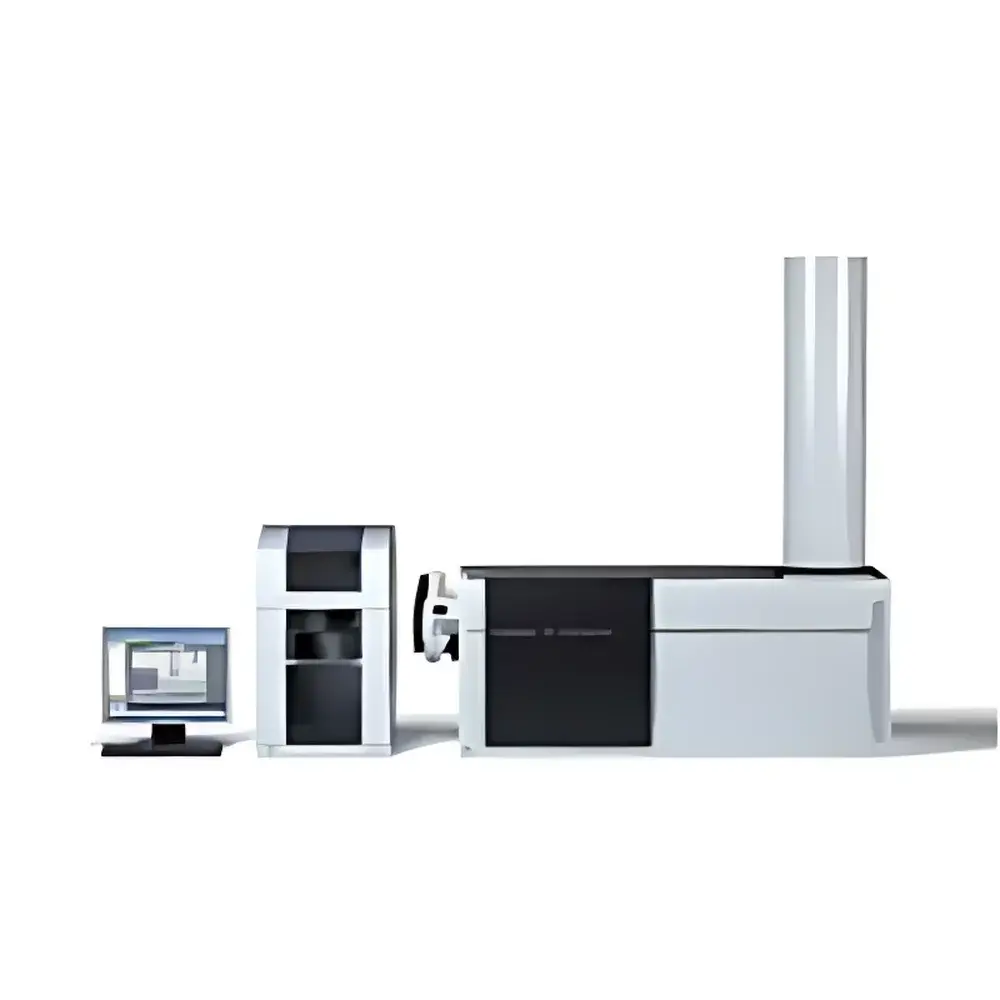
Agilent CE/MS System (7100 Capillary Electrophoresis Coupled with 6000-Series Mass Spectrometers)
| Brand | Agilent Technologies |
|---|---|
| Origin | Germany |
| Manufacturer Type | Original Equipment Manufacturer (OEM) |
| Import Status | Imported |
| Model | CE/MS |
| Instrument Type | Capillary Electrophoresis (CE) System |
| Sample Analysis Scope | Organic Compounds |
| Compatible Mass Spectrometers | Agilent 6100 (Single Quadrupole), 6200 (TOF), 6400 (Triple Quadrupole), 6500 (Q-TOF), ICP-MS, ICP-MS/MS |
| Ionization Sources | ESI (Standard & JetStream), APCI, APP |
| Spray Interface | Grounded-potential, Plug-and-Play Electrospray Interface with Integrated Desolvation |
| Regulatory Compliance | Designed for GLP/GMP environments |
Overview
The Agilent CE/MS System integrates capillary electrophoresis (CE) with mass spectrometry (MS) to deliver high-resolution separation of charged analytes coupled with precise molecular weight determination and structural characterization. Unlike conventional liquid chromatography–mass spectrometry (LC–MS), CE–MS leverages electrokinetic transport in fused-silica capillaries under high-voltage electric fields, enabling rapid, high-efficiency separations of polar, thermally labile, and nonvolatile organic compounds—including peptides, amino acids, nucleotides, small-molecule metabolites, and chiral pharmaceuticals. The Agilent 7100 CE platform is engineered for seamless hyphenation with the Agilent 6000-series mass spectrometers, forming a unified analytical architecture controlled via a single OpenLab CDS workstation. This configuration ensures synchronized method development, real-time signal acquisition, and traceable instrument parameter logging—critical for regulated laboratories operating under ISO/IEC 17025, USP , or FDA 21 CFR Part 11 requirements.
Key Features
- Native compatibility with Agilent’s full portfolio of benchtop MS systems: 6100 (single quadrupole), 6200 (time-of-flight), 6400 (triple quadrupole), and 6500 (quadrupole time-of-flight) mass spectrometers—as well as ICP-MS and ICP-MS/MS platforms for elemental speciation studies.
- Grounded-potential electrospray interface eliminates electrical coupling between CE voltage domains and MS ion optics, preserving optimal CE separation efficiency while maintaining stable MS ion transmission.
- Integrated desolvation system optimized for low-flow CE effluents (typically 10–100 nL/min), delivering enhanced signal-to-noise ratios and sub-picomolar detection limits for organic analytes.
- Plug-and-play spray assembly requires no mechanical alignment; accommodates standard CE running buffers (e.g., phosphate, acetate, or Tris-based electrolytes) without solvent exchange or post-capillary derivatization.
- Multi-source flexibility: Supports electrospray ionization (ESI) with standard or Agilent JetStream technology, atmospheric pressure chemical ionization (APCI), and atmospheric pressure photoionization (APP), enabling broad polarity coverage across diverse compound classes.
- Factory-integrated hardware and firmware ensure synchronized timing control, automatic voltage ramping, and coordinated data acquisition—reducing method transfer complexity and operator-dependent variability.
Sample Compatibility & Compliance
The Agilent CE/MS System is validated for analysis of small organic molecules, biologically active peptides, oligosaccharides, organic acids, and pharmaceutical impurities in complex matrices such as biological fluids (serum, urine), plant extracts, and formulation intermediates. Its robustness supports routine use in quality control (QC) and stability-indicating assays compliant with ICH Q2(R2) guidelines. All CE–MS methods developed on this platform are fully auditable within OpenLab CDS, supporting electronic signatures, audit trails, and user-access controls required under 21 CFR Part 11. The system meets mechanical and electromagnetic compatibility standards per EN 61326-1 and is designed to operate reliably in ISO Class 7 cleanroom environments where applicable.
Software & Data Management
Control and data processing are managed through Agilent OpenLab CDS (ChemStation Data System), which provides unified method setup for both CE and MS modules—including voltage programming, gradient elution (for CE–MS with dynamic pH junction or transient isotachophoresis), and MS scan functions (SIM, MRM, full-scan, or data-dependent acquisition). Raw data files (.D format) are stored with embedded metadata (capillary temperature, injection voltage, sheath liquid flow, source parameters), ensuring full traceability. Quantitative workflows support internal standard calibration, peak area normalization, and integration with LIMS via ASTM E1578-compliant export protocols. Optional MassHunter Qualitative and Quantitative Analysis software enables advanced spectral deconvolution, library searching (NIST, Wiley, METLIN), and multivariate statistical analysis for biomarker discovery applications.
Applications
- Pharmaceutical development: Chiral purity assessment of enantiomeric drugs, counterion profiling in salt forms, and forced degradation product identification.
- Clinical metabolomics: High-throughput profiling of polar metabolites in plasma and cerebrospinal fluid without derivatization.
- Biotherapeutics characterization: Charge variant analysis of monoclonal antibodies and glycoform mapping of therapeutic glycoproteins.
- Environmental analysis: Speciation of halogenated organic pollutants (e.g., perfluoroalkyl substances) and redox-active organometallic complexes.
- Food safety testing: Detection and quantification of mycotoxins, veterinary drug residues, and unauthorized food dyes in regulatory screening programs.
FAQ
Can the Agilent 7100 CE be coupled with non-Agilent mass spectrometers?
Yes—via custom interface development using third-party CE–MS adapters; however, full synchronization, automated method control, and vendor-supported compliance features are only guaranteed with Agilent 6000-series instruments.
What buffer systems are compatible with the grounded-spray interface?
Standard aqueous CE buffers containing volatile electrolytes (e.g., ammonium acetate, formic acid, acetic acid) are fully supported. Non-volatile salts (e.g., phosphate, sulfate) require post-capillary desalting or sheath-liquid dilution to prevent source contamination.
Is method validation support available for regulated environments?
Agilent provides IQ/OQ documentation templates, system suitability test protocols, and technical notes aligned with USP , ICH Q5A–Q5E, and ASTM D7594 for CE–MS method transfer and lifecycle management.
How does CE–MS compare to LC–MS for polar compound analysis?
CE–MS offers superior resolution for highly polar or ionic species that exhibit poor retention or peak tailing in reversed-phase LC, with typical analysis times under 15 minutes and minimal solvent consumption (<1 mL per run).
Does the system support automated sample preparation integration?
Yes—the 7100 CE platform is compatible with Agilent 7696A Sample Prep Workstation for unattended vial-to-capillary injection, including stacking, field-amplified sample injection (FASI), and online preconcentration techniques.




