
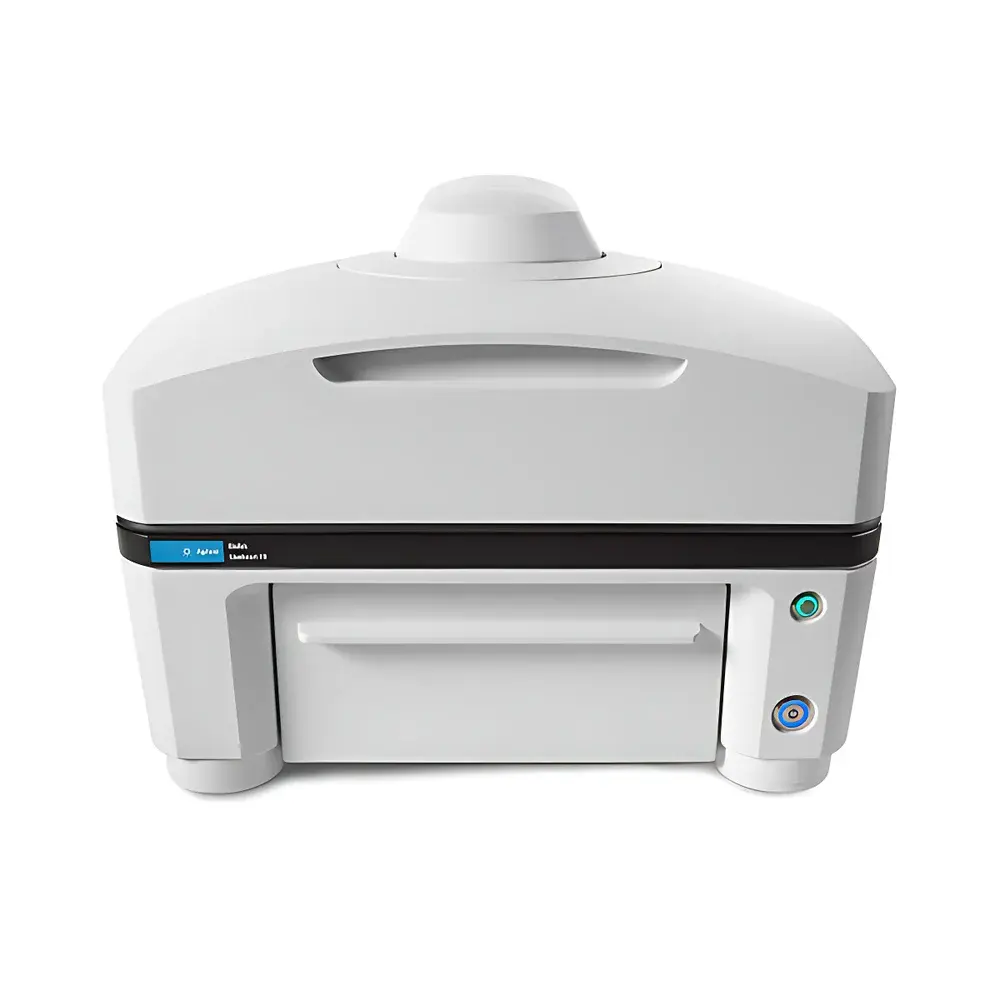
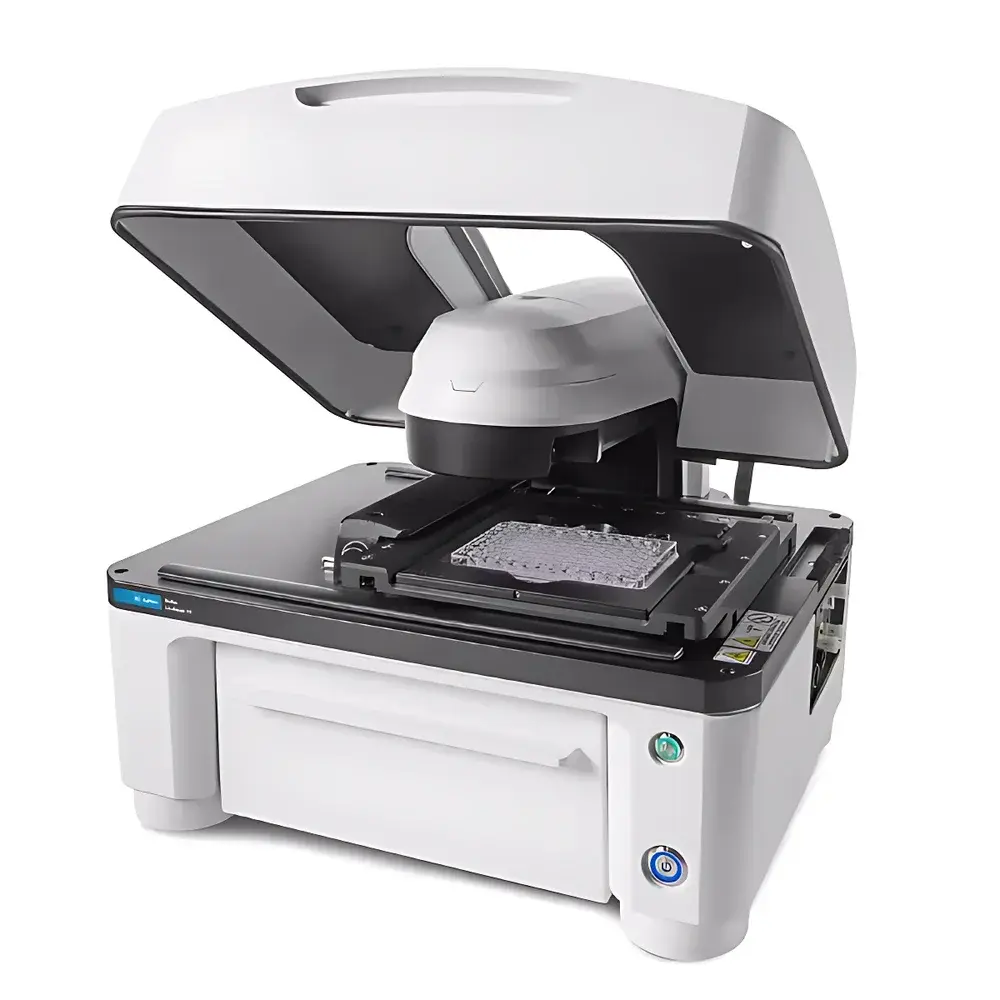
Agilent Lionheart FX Automated Live-Cell Imaging System
| Brand | Agilent Technologies |
|---|---|
| Origin | USA |
| Manufacturer | Agilent Technologies |
| Import Status | Imported |
| Model | Lionheart FX |
| Temperature Control | Up to 40 °C |
| Humidity Control | Integrated Humidity Chamber |
| Imaging Throughput | High-speed Kinetic Acquisition |
Overview
The Agilent Lionheart FX Automated Live-Cell Imaging System is a compact, integrated inverted microscope platform engineered for quantitative, time-resolved imaging of living cells under physiologically relevant conditions. It operates on wide-field optical principles—leveraging high-sensitivity monochrome and color CMOS sensors—and supports multi-modal acquisition including fluorescence, brightfield, high-contrast brightfield, color brightfield, and phase contrast. Unlike conventional fixed-stage microscopes, the Lionheart FX employs an open-stage architecture optimized for compatibility with microfluidic devices, perfusion systems, and non-standard culture vessels. Its core design philosophy centers on reproducible, hands-off operation: automated laser-based and image-based autofocus, programmable environmental control (CO2, O2, humidity, temperature), and seamless integration with microplate-based workflows—from 6-well plates to 1536-well formats—as well as slides, Petri dishes, T-flasks, and chambered coverslips. The system does not require a dedicated darkroom or external computing hardware, enabling deployment directly on standard laboratory benches while maintaining GLP-compliant data integrity.
Key Features
- Inverted optical architecture with motorized nosepiece supporting air objectives (1.25×–60×) and oil immersion objectives (60×–100×), plus dedicated phase contrast optics (4×–40×)
- Dual independent syringe-based reagent dispensers for precise, timed addition during kinetic assays—enabling real-time monitoring of rapid cellular responses post-stimulation
- Integrated environmental control module: temperature regulation up to 40 °C, programmable CO2/O2 gas mixing, and active humidity stabilization via sealed chamber—critical for >24-hour unperturbed live-cell experiments
- Wide-field optical path with large-format sensor enabling rapid acquisition across full microplates or large tissue sections without tiling artifacts
- Two complementary autofocus technologies: (a) image-based autofocus identifying maximal contrast planes within each field—including dynamic samples—and (b) laser-based autofocus using reflected interface detection for sub-micron repeatability and reduced phototoxicity
- Open-stage mechanical design accommodating custom substrates, microfluidic chips, and multi-layer culture platforms
Sample Compatibility & Compliance
The Lionheart FX accepts standard and non-standard biological sample carriers including 6–1536-well microplates, glass slides, Petri dishes (35–100 mm), T25/T75 flasks, hemocytometers, and chambered coverslips. All imaging modalities are validated per ISO/IEC 17025 guidelines for measurement traceability in life science instrumentation. Environmental control subsystems comply with ASTM E2912–22 (Standard Practice for Maintaining Controlled Atmospheres in Cell Culture Systems) and support FDA 21 CFR Part 11–compliant audit trails when used with Gen5 software’s electronic signature and user access controls. The system is routinely deployed in GMP-aligned assay development labs where long-term imaging stability, inter-run reproducibility, and metadata-rich acquisition are mandatory.
Software & Data Management
Controlled exclusively by Agilent’s Gen5 Microplate Reader and Imaging Software (v3.12+), the Lionheart FX enables end-to-end workflow automation—from experimental setup and environmental parameter scheduling to multi-channel image acquisition, batch analysis, and publication-ready reporting. Gen5 implements hierarchical user permissions, encrypted data storage, and full audit trail logging meeting ALCOA+ (Attributable, Legible, Contemporaneous, Original, Accurate, Complete, Consistent, Enduring, Available) principles. Image processing includes background subtraction, flat-field correction, Z-stack deconvolution, object segmentation using machine learning–enhanced algorithms, and kinetic parameter extraction (e.g., translocation kinetics, confluence metrics, mitochondrial fragmentation indices). Export formats include TIFF (OME-TIFF compliant), CSV, PDF, and direct integration with third-party analysis platforms via API.
Applications
- Longitudinal monitoring of cell proliferation, migration, and wound healing under controlled hypoxia or hypercapnia
- Real-time assessment of cytotoxicity, apoptosis, and autophagy using multiplexed fluorescent probes (e.g., Annexin V/PI, LC3-GFP, MitoTracker)
- High-content screening of siRNA/CRISPR libraries in phenotypic assays requiring spatial resolution at single-cell level
- Functional characterization of organoids and spheroids—including size distribution, necrotic core formation, and vascularization dynamics
- Time-lapse imaging of neuronal growth cone dynamics, synaptic vesicle trafficking, and calcium oscillations in primary cultures
- Validation of bioprocess parameters in bioreactor-adapted cell lines via parallel microplate-based mimicry
FAQ
Does the Lionheart FX support oil-immersion imaging at 100× magnification?
Yes—the system accommodates standard 100× oil-immersion objectives with integrated objective heater and refractive index compensation for stable, high-resolution imaging over extended durations.
Can environmental parameters be logged and exported with image metadata?
Yes—temperature, CO2, O2, and humidity values are timestamped and embedded in OME-TIFF headers and Gen5 project files, enabling retrospective correlation with morphological or intensity changes.
Is the dual dispenser module compatible with viscous reagents such as Matrigel or collagen solutions?
The syringe pumps support viscosity ranges up to 200 cP; pre-warmed reagent handling and pulse-free dispensing profiles minimize clogging and ensure uniform delivery across all wells.
How does laser autofocus mitigate photobleaching during prolonged timelapse experiments?
Laser autofocus uses a low-power, near-infrared beam (785 nm) that does not excite common fluorophores—reducing cumulative light dose by >90% compared to iterative image-based focusing schemes.
What regulatory documentation is provided for IQ/OQ/PQ validation?
Agilent supplies a comprehensive validation toolkit including installation qualification (IQ) checklists, operational qualification (OQ) test protocols aligned with ISO 13485, and performance qualification (PQ) templates for routine system verification.
Related Products



