
Agilent Cary 630 FTIR Spectrometer
| Brand | Agilent Technologies |
|---|---|
| Origin | Malaysia |
| Manufacturer Type | Original Equipment Manufacturer (OEM) |
| Origin Category | Imported |
| Model | Cary 630 |
| Instrument Type | Benchtop Fourier Transform Infrared Spectrometer |
| Wavenumber Range | KBr beam splitter: 7,000–350 cm⁻¹ |
| ZnSe beam splitter | 5,100–600 cm⁻¹ |
| Spectral Resolution | 2 cm⁻¹ |
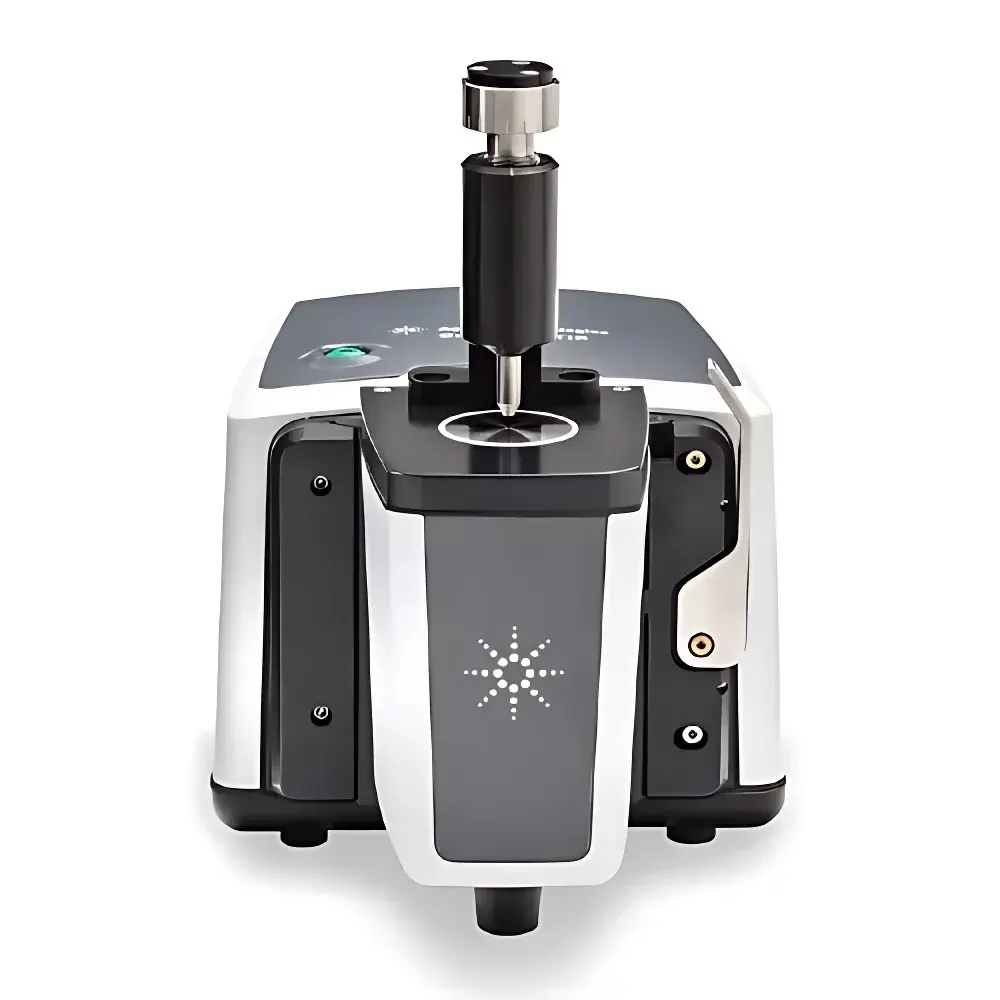
| Dimensions (W × D × H) | 14 × 26 × 16 cm |
| Weight | 3.5 kg |
| Power Requirement | 100–240 VAC, 50/60 Hz |
| Sample Compatibility | Solids, powders, pellets, liquids, gels, pastes, gases |
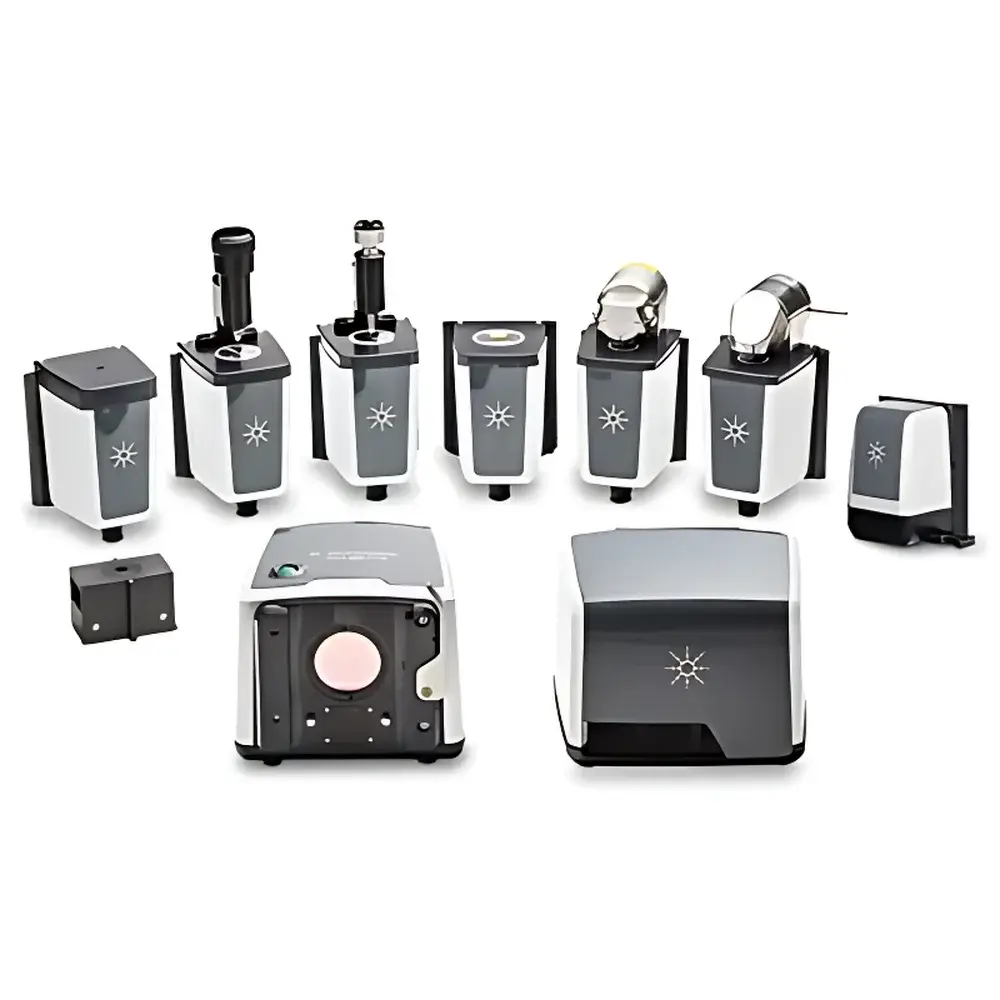
| Sampling Modules | Diamond ATR, Multireflection ZnSe ATR, TumblIR, DialPath, Ge ATR, Mirror Reflection (10° and 45°), Transmission, Diffuse Reflectance, Gas Cell |
| Software | Agilent MicroLab, MicroLab Expert, MicroLab Pharma (optional, 21 CFR Part 11 & EU Annex 11 compliant) |
Overview
The Agilent Cary 630 FTIR Spectrometer is a benchtop Fourier Transform Infrared spectrometer engineered for precision, portability, and operational robustness in regulated and non-regulated laboratory environments. It employs a Michelson interferometer with a stabilized He–Ne laser reference, enabling high-fidelity spectral acquisition across broad wavenumber ranges. The system operates on the principle of interferometric modulation of infrared radiation, followed by Fourier transformation to generate absorbance or transmittance spectra. Its compact optical architecture—integrated into a footprint of just 14 × 26 cm and weighing only 3.5 kg—retains full analytical capability without compromising signal-to-noise ratio or photometric accuracy. Designed for both routine QC/QA workflows and exploratory research, the Cary 630 delivers reproducible quantitative and qualitative data under variable ambient conditions, including elevated temperature and humidity, thanks to its thermally stabilized optics and permanently aligned interferometer.
Key Features
- Modular sampling architecture enabling rapid interchange of application-optimized modules—including Diamond ATR, ZnSe multireflection ATR, TumblIR for rotating liquid films, DialPath for variable-path-length transmission, and dedicated gas cells—without realignment or recalibration.
- Permanently aligned optical train with factory-calibrated interferometer and source, eliminating drift-related recalibration and ensuring long-term measurement stability.
- High-energy throughput design delivering up to 30% greater radiant power at the sample plane compared to conventional benchtop FTIR systems, improving signal fidelity for low-concentration or weakly absorbing analytes.
- Intuitive hardware interface with front-panel status indicators and tool-free module docking, reducing setup time to under 10 seconds per configuration change.
- Thermally managed detector (DTGS or optional MCT) and optimized beam path geometry support consistent performance across ambient temperatures from 15 °C to 35 °C and relative humidity up to 80% non-condensing.
Sample Compatibility & Compliance
The Cary 630 accommodates diverse physical states—solids (including KBr pellets and thin films), powders, pastes, gels, volatile and non-volatile liquids, and gases—through interchangeable sampling interfaces. Each module is mechanically registered and optically matched to the base instrument, maintaining alignment integrity and spectral fidelity across configurations. The system complies with international spectroscopic measurement standards, including ASTM E1421 (Standard Practice for Describing and Measuring Performance of Fourier Transform Mid-Infrared (FT-MIR) Spectrometers) and ISO 18381 (Molecular spectroscopy — Vocabulary for infrared spectroscopy). When equipped with MicroLab Pharma software, it supports audit-trail generation, electronic signatures, role-based user permissions, and secure electronic record storage—fully aligned with FDA 21 CFR Part 11, EU Annex 11, and ICH GCP/GLP requirements for regulated pharmaceutical, biotech, and contract research organizations.
Software & Data Management
Agilent MicroLab software provides a guided, icon-driven workflow environment suitable for both novice and expert users. Each analytical step—from background collection and sample measurement to spectral preprocessing (baseline correction, smoothing, normalization) and library search—is supported by contextual visual cues, annotated screenshots, and color-coded result summaries. MicroLab Expert extends functionality with advanced chemometric tools (PCA, PLS regression), custom method scripting, and automated report generation in PDF or CSV formats. For GxP environments, MicroLab Pharma adds full electronic record lifecycle management: immutable audit trails, configurable retention policies, tamper-evident digital signatures, and export-ready validation documentation packages (IQ/OQ/PQ templates included). All software versions support spectral database integration—including commercial libraries (Sadtler, Aldrich) and user-curated collections—and permit spectral subtraction, overlay, and derivative analysis for peak identification and quantitation.
Applications
- Pharmaceutical raw material identification and assay verification per USP and Ph. Eur. 2.2.24.
- Polymer characterization—including crystallinity assessment, additive identification, and degradation monitoring—using ATR and transmission modes.
- Food authenticity testing (e.g., olive oil adulteration, dairy fat profiling) via fingerprint region analysis (1,800–900 cm⁻¹).
- Chemical reaction monitoring in situ using flow cells or heated ATR accessories.
- Environmental analysis of microplastics in water filtrates using reflectance and transmission sampling.
- Forensic trace evidence analysis (paint chips, fibers, adhesives) with minimal sample preparation.
FAQ
What beam splitters are supported, and how do they affect spectral range?
The Cary 630 accepts KBr and ZnSe beam splitters. KBr enables full mid-IR coverage from 7,000 to 350 cm⁻¹, while ZnSe extends usability to higher-energy regions (5,100–600 cm⁻¹) with enhanced durability for humid or acidic environments.
Is the instrument compatible with GLP-compliant data handling?
Yes—when configured with MicroLab Pharma software, the system meets 21 CFR Part 11 and EU Annex 11 requirements for electronic records and signatures, including audit trails, user access controls, and data integrity safeguards.
Can the Cary 630 perform quantitative analysis without external calibration standards?
It supports both standardless semi-quantitative analysis (e.g., peak height/area ratios) and rigorous quantitative methods using internal standards, calibration curves, or chemometric models—provided appropriate reference materials and validation protocols are applied.
How does the TumblIR module simplify liquid film analysis?
TumblIR rotates the sample cell during acquisition, averaging out thickness variations and minimizing interference fringes—enabling reproducible transmission-mode spectra of viscous or non-uniform liquids without solvent evaporation or cell cleaning between runs.
What maintenance is required to sustain optical performance?
No routine optical alignment is needed due to permanent interferometer calibration. Recommended maintenance includes periodic desiccant replacement (for KBr optics), detector purge gas verification (if used), and module interface cleaning per Agilent’s documented procedures—typically every 6–12 months depending on usage frequency and lab environment.




