
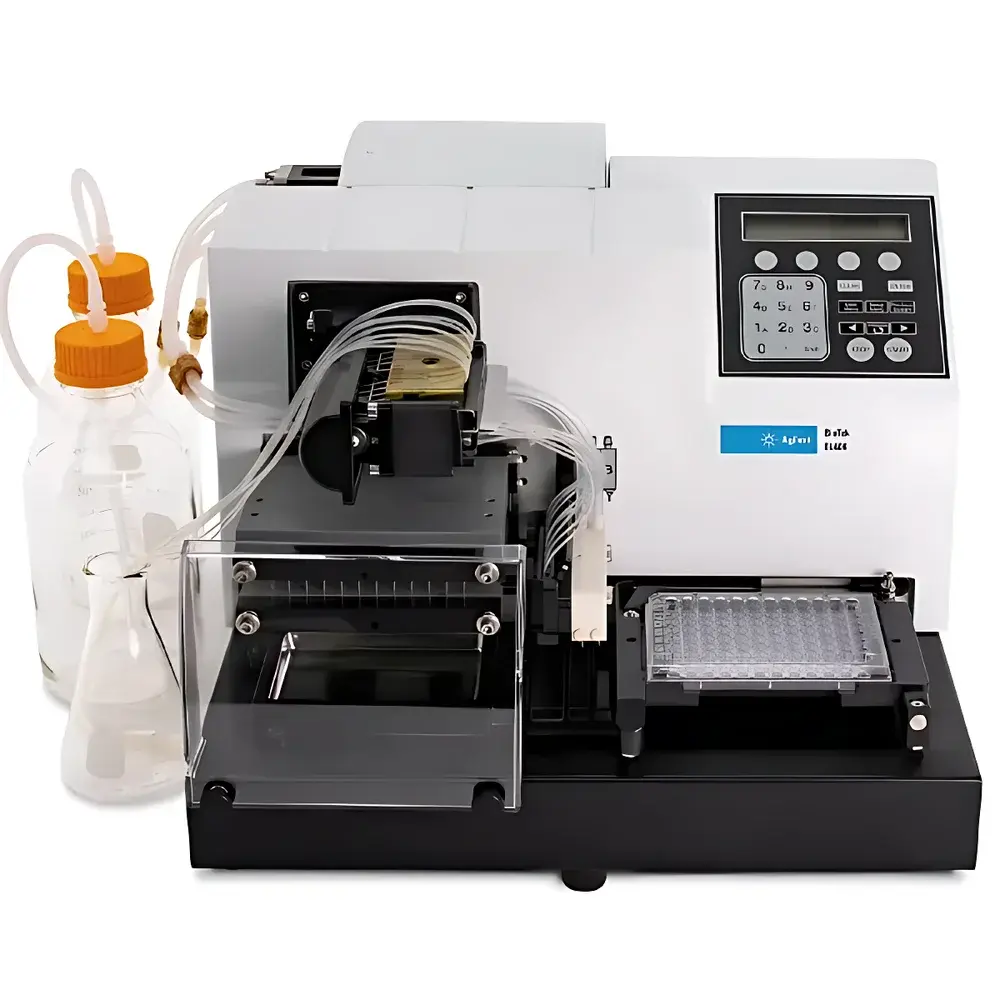
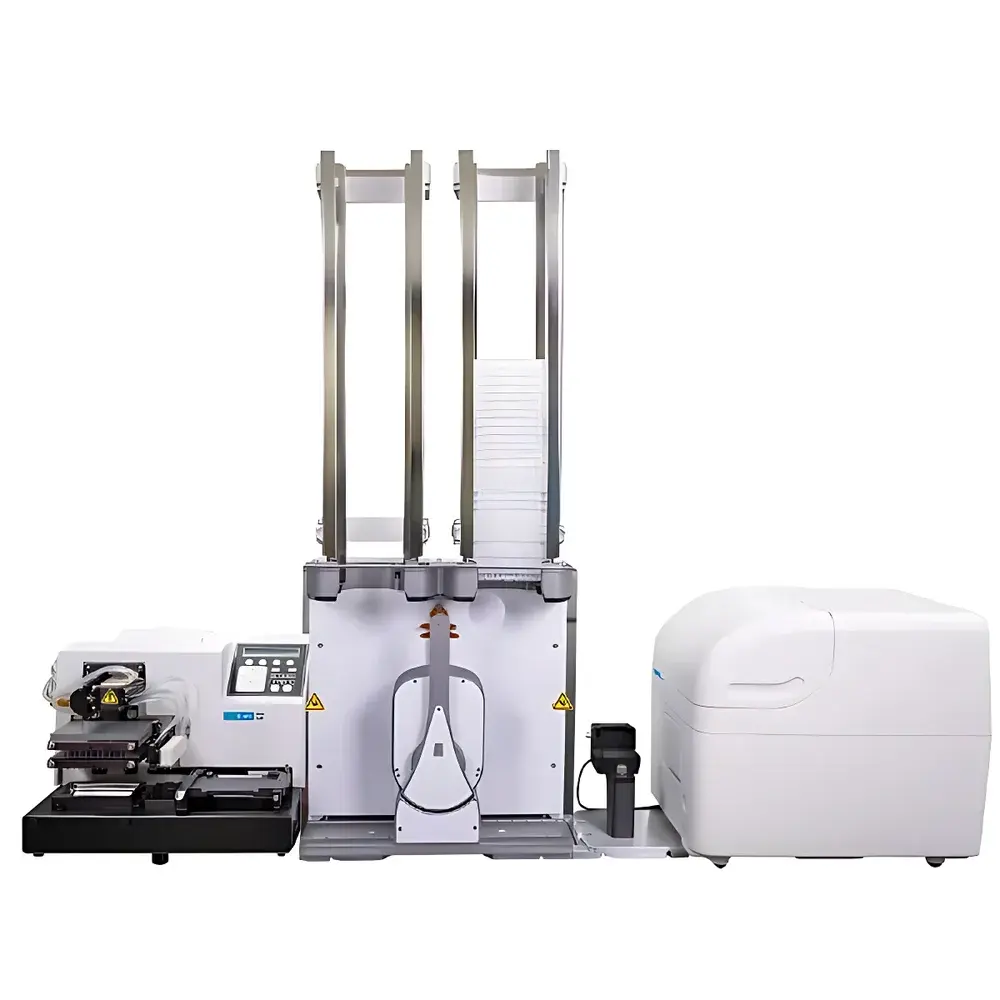
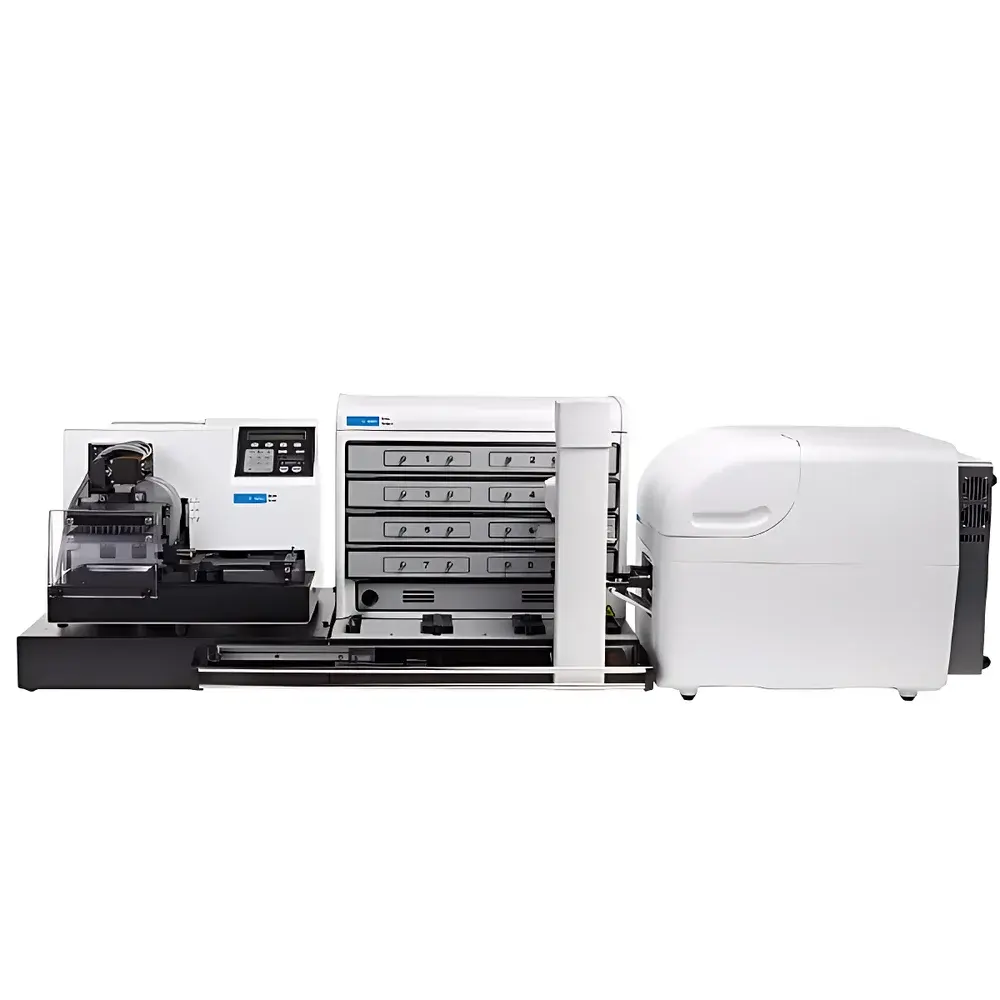
Agilent BioTek EL406 Combination Washer-Dispenser System
| Brand | Agilent Technologies |
|---|---|
| Origin | USA |
| Manufacturer | Agilent Technologies |
| Product Category | Imported Instrument |
| Model | EL406 |
| Pricing | Upon Request |
Overview
The Agilent BioTek EL406 Combination Washer-Dispenser System is an integrated, benchtop microplate processing platform engineered for precision, reproducibility, and workflow scalability in life science laboratories. Based on dual-mode fluid handling architecture—combining positive-displacement syringe pumps and peristaltic pumping—it delivers simultaneous plate washing, multi-reagent dispensing, magnetic bead separation, and vacuum filtration within a single instrument footprint. Its core operational principle relies on programmable aspiration/dispense cycles governed by precise fluid dynamics control, enabling consistent wash efficiency across 96-, 384-, and 1536-well microplates. Designed for high-throughput assay development, EL406 supports cell-based assays requiring gentle handling (e.g., adherent monolayer cultures), immunoassays, nucleic acid purification workflows, and Luminex xMAP®-compatible multiplexed analyses—all without cross-platform transfer or manual intervention.
Key Features
- Modular dual-pump architecture: Independent syringe pump and peristaltic pump modules support parallel dispensing of up to four reagents with adjustable flow rates and programmable dispense patterns.
- Dual-action wash head: Precision-engineered for uniform aspiration across all well geometries; optimized for low-shear removal of loosely adherent cells while maintaining >99.8% residual volume consistency (per ASTM E2750-22 validation protocols).
- Ultrasonic Advantage™ technology: Integrated ultrasonic bath and automated cleaning cycle remove crystallized salts, protein aggregates, and biofilm residues from fluid paths—reducing maintenance downtime and eliminating manual disassembly.
- Three-plate compatibility: Fully validated operation with ANSI/SLAS-standard 96-, 384-, and 1536-well plates; wash times range from 13 seconds (96-well) to 36 seconds (1536-well) under standard protocols.
- X-Y-Z adjustable plate carrier: Motorized stage enables fine-tuned vertical positioning and lateral alignment, critical for minimizing shear stress during cell monolayer washing and ensuring optimal tip immersion depth.
- Vacuum filtration and magnetic separation modules: Onboard vacuum manifold supports rapid filter-bottom plate processing; integrated magnetic field array enables automated bead capture/release for immunoprecipitation, nucleic acid isolation, and assay cleanup.
Sample Compatibility & Compliance
The EL406 accommodates diverse sample formats including polystyrene, polypropylene, and PVDF membrane-bottom microplates, as well as magnetic bead suspensions (Dynabeads®, Sera-Mag™, MagPlex®) and latex microspheres. It meets ISO 13485 design controls for IVD-related instrumentation and supports GLP/GMP-compliant operation through audit-trail-enabled software logging (21 CFR Part 11 compliant when used with Agilent BioStack™ or third-party LIMS integration). All fluid pathways are constructed from chemically inert, USP Class VI-certified materials to prevent leaching or adsorption artifacts during low-volume reagent handling.
Software & Data Management
Controlled via an embedded touchscreen interface running BioTek’s Gen5® Microplate Reader Software (v3.12+), the EL406 supports method-driven protocol creation with real-time monitoring of pressure, flow rate, and wash volume. Protocols include built-in validation routines for carryover assessment, linearity verification, and volumetric accuracy per ISO 8655-6. Data export is compatible with CSV, XML, and SDMX formats; instrument logs record timestamped events including ultrasonic cleaning cycles, pump calibration history, and error diagnostics. Seamless integration with Agilent’s BioSpa™ 8 and BenchCel™ automation platforms enables unattended serial processing across heterogeneous plate types.
Applications
- ELISA, AlphaLISA®, and other immunoassay formats requiring stringent wash stringency and low background.
- Cell-based high-content screening (HCS) where preservation of monolayer integrity is essential prior to fixation or imaging.
- Multiplexed bead-based assays (Luminex xMAP®) including cytokine profiling, genotyping, and phosphoprotein detection.
- Nucleic acid purification workflows involving magnetic bead binding, wash, and elution steps.
- Vacuum-assisted filtration for compound library normalization or desalting prior to mass spectrometry analysis.
- Automated assay development in regulated environments requiring full traceability, version-controlled protocols, and electronic signatures.
FAQ
Does the EL406 support FDA 21 CFR Part 11 compliance?
Yes—when operated with Gen5 software configured for electronic signature enforcement and audit trail activation, the system satisfies requirements for secure user authentication, immutable data logging, and role-based access control.
Can the EL406 perform simultaneous dispensing and washing?
No—the system executes washing and dispensing as sequential, non-overlapping operations to ensure fluid path integrity and prevent cross-contamination; however, parallel reagent dispensing (up to 4 channels) occurs within a single dispense step.
Is calibration required before each run?
Routine volumetric calibration is recommended every 30 days or after maintenance; Gen5 includes automated calibration wizards with gravimetric verification templates aligned with ISO 8655 standards.
What maintenance intervals are recommended for the Ultrasonic Advantage module?
The ultrasonic bath solution should be replaced weekly; full system decontamination using the automated cleaning cycle is advised after every 100 runs or when processing viscous or protein-rich buffers.
How does the EL406 handle edge effects in 1536-well plates?
The dedicated 1536-well wash head employs staggered aspiration nozzles and dynamic Z-axis compensation to maintain consistent tip-to-well distance across all 1536 positions, minimizing corner well variability observed in conventional linear wash heads.
Related Products





