
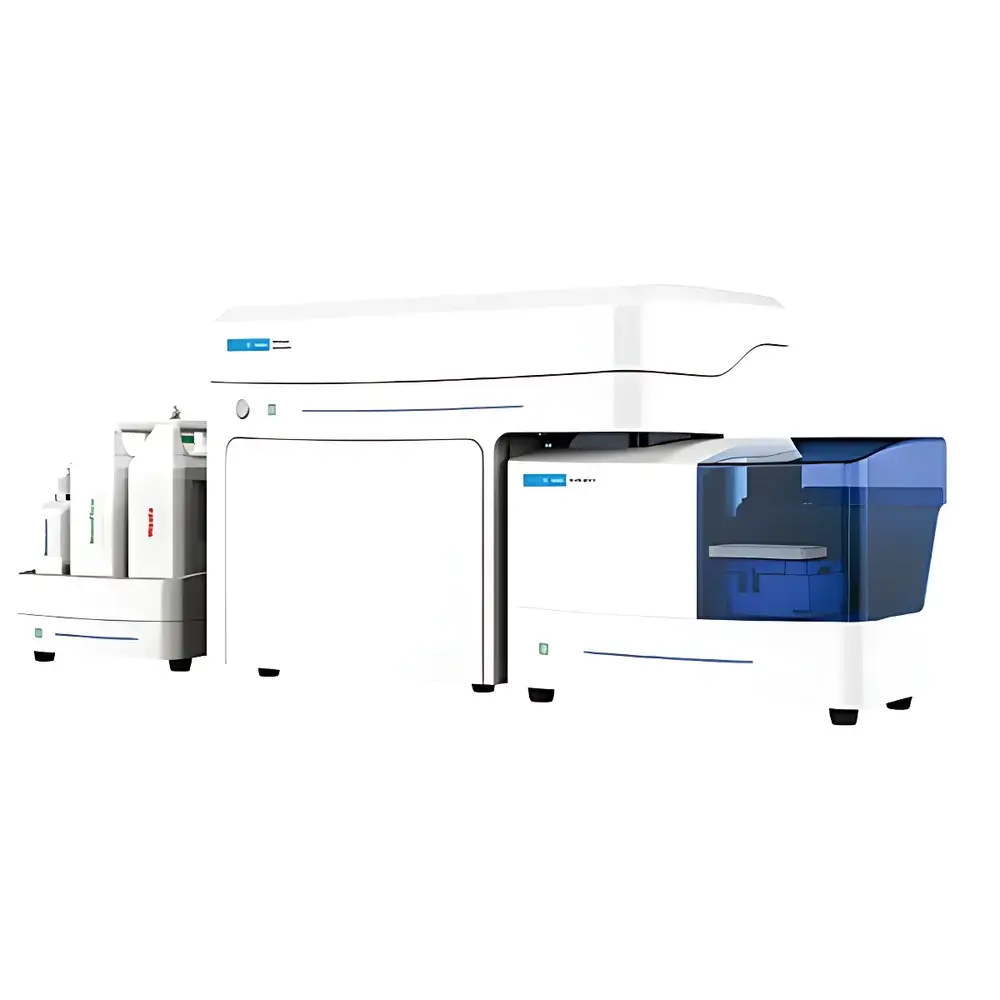
Agilent NovoCyte Advanteon Spectral Flow Cytometer
| Brand | Agilent Technologies |
|---|---|
| Origin | Zhejiang, China |
| Manufacturer Type | Original Equipment Manufacturer (OEM) |
| Regional Classification | Domestic (China-manufactured) |
| Model | NovoCyte Advanteon |
| Pricing | Upon Request |
| Technology Platform | Spectral Flow Cytometry |
| Instrument Type | Flow Cytometry Analyzer |
| Intended Use | Research-Only |
| Detection Channels | 19 (expandable to 21 fluorescence parameters) |
Overview
The Agilent NovoCyte Advanteon Spectral Flow Cytometer represents the third-generation evolution of Agilent’s widely adopted NovoCyte platform—building upon the robust architecture of the NovoCyte and NovoCyte Quanteon systems. Engineered for precision spectral flow cytometry, the Advanteon leverages silicon photomultiplier (SiPM) detector technology to enable high-parameter, high-sensitivity cell analysis without traditional optical filter constraints. Unlike conventional filter-based cytometers, it captures full emission spectra across a broad wavelength range (typically 350–800 nm), then applies computational unmixing algorithms to resolve fluorochrome signatures with minimal spillover. This architecture supports up to 21 fluorescence parameters using 1–3 configurable lasers (e.g., 405 nm, 488 nm, 640 nm), making it suitable for deep immunophenotyping, rare-event detection, and multi-omic panel development in academic, pharmaceutical, and biotechnology research laboratories.
Key Features
- Spectral detection architecture with 21 independent SiPM detectors—each providing photon-counting sensitivity and a dynamic range of 7.2 decades without gain adjustment
- Optimized forward- and side-scatter optics enabling reliable resolution of submicron particles down to 0.1 µm (e.g., platelets, bacteria, extracellular vesicles)
- Real-time fluidic feedback control system ensuring constant sample core stream velocity across variable flow rates (10–100 µL/min), minimizing coefficient of variation (CV) drift
- High-throughput acquisition at up to 100,000 events per second with on-board digital signal processing and zero data loss at maximum rate
- Integrated absolute counting capability via volumetric sampling—no reference beads required for quantitative cell enumeration per unit volume
- Modular laser configuration (1–3 lasers) and scalable detector array allow field-upgradable expansion from 19 to 21 fluorescence channels
- Optional sample recovery mode preserves unanalyzed cells post-acquisition for downstream functional assays or sorting validation
Sample Compatibility & Compliance
The NovoCyte Advanteon accepts standard flow cytometry sample formats including 12×75 mm FACS tubes, as well as 24-, 48-, 96-, and 384-well microplates when coupled with the NovoSampler Q autosampler. Its pressure-driven hydrodynamic focusing system accommodates viscous or particulate-laden samples—including whole blood (with optional lysing reagents), PBMC suspensions, tissue digests, and microbial cultures—without clogging. The instrument complies with IEC 61010-1:2010 for laboratory equipment safety and meets electromagnetic compatibility requirements per CISPR 11. While designed strictly for research use (RUO), its data integrity framework supports GLP-aligned workflows through audit-trail-enabled software logging, user-access controls, and exportable raw FCS 3.1/4.0 files compatible with third-party analysis platforms (e.g., FlowJo, Cytobank, R/Bioconductor).
Software & Data Management
NovoExpress v4.x software delivers an integrated environment for experimental design, real-time acquisition, spectral unmixing, population gating, statistical modeling, and publication-ready reporting. Its intuitive drag-and-drop interface reduces training time while maintaining advanced capabilities—including batch processing, template-driven analysis, and customizable PDF/PowerPoint export. All acquisition parameters, compensation matrices, and gating hierarchies are saved within FCS-compliant files, ensuring full traceability. The software supports 21 CFR Part 11–ready configurations (with optional electronic signature module), including role-based permissions, change logs, and immutable audit trails—facilitating compliance in regulated preclinical research settings.
Applications
- High-dimensional immune profiling (e.g., >15-color T-cell subset characterization in tumor microenvironments)
- Stem cell and progenitor cell phenotyping with low-abundance marker detection
- Extracellular vesicle (EV) analysis by size-resolved scatter + multi-fluorochrome labeling
- Microbial community analysis—including viability assessment and antibiotic resistance screening in mixed cultures
- Cell cycle and apoptosis kinetics using multiparametric DNA/RNA/protein staining
- CRISPR screen validation via surface marker co-expression tracking in pooled libraries
FAQ
Is the NovoCyte Advanteon FDA-cleared for clinical diagnostics?
No. This instrument is designated for research use only (RUO) and is not intended for diagnostic procedures or patient management.
Can existing NovoCyte users upgrade to the Advanteon platform?
Yes—Agilent offers hardware retrofit kits and software migration paths for qualified NovoCyte Quanteon systems, subject to mechanical and firmware compatibility assessments.
Does the system support spectral compensation without reference controls?
Yes. Built-in reference-free unmixing uses pre-characterized fluorochrome emission spectra stored in the instrument library; however, single-stain controls are recommended for optimal accuracy in novel panel development.
What maintenance is required for long-term stability of SiPM detectors?
SiPMs are solid-state devices with no consumable optics or alignment-sensitive components; routine calibration involves daily QC bead runs and annual factory performance verification—no lamp replacement or mirror cleaning required.
How does the Advanteon handle autofluorescence in primary tissue samples?
Its spectral unmixing engine models and subtracts cellular autofluorescence as a distinct component during linear regression, improving signal-to-noise ratio for dim markers in heterogeneous samples such as splenocytes or tumor digests.




