
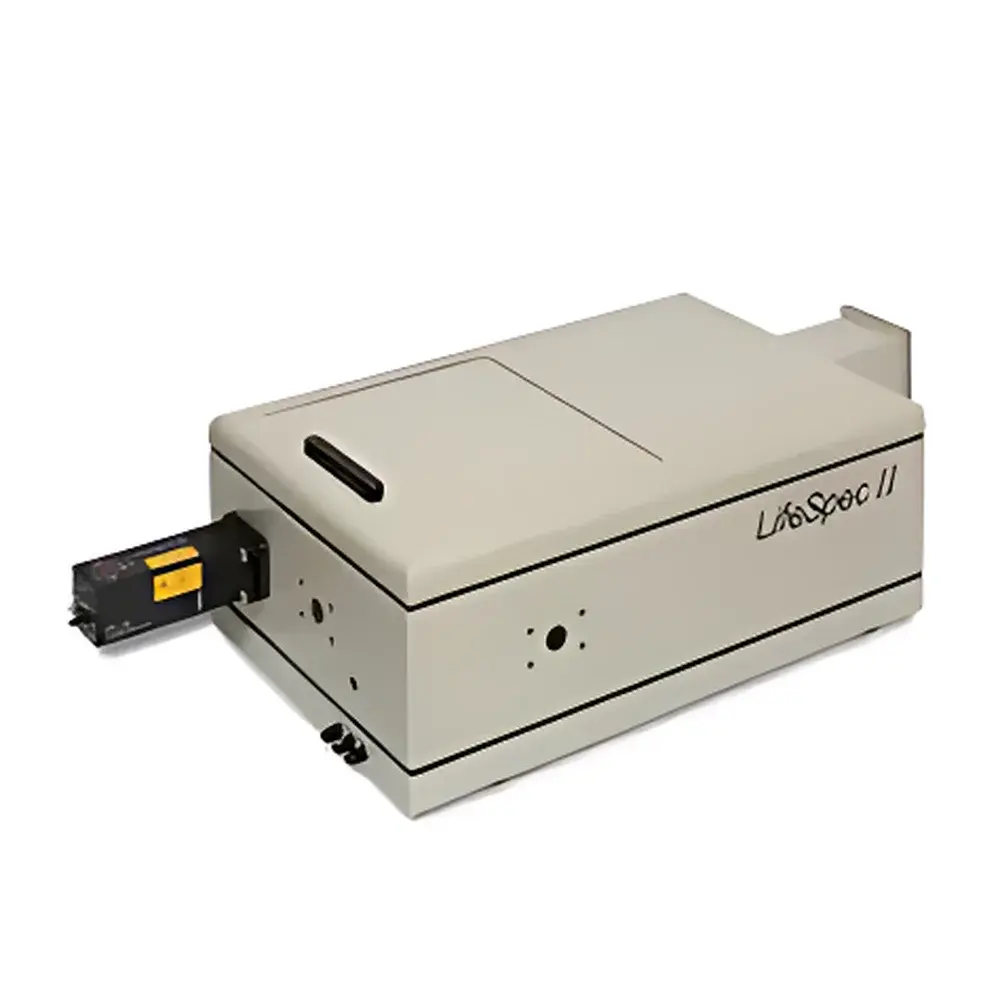
Edinburgh Instruments LifeSpec II Time-Resolved Fluorescence Spectrometer
| Brand | Edinburgh Instruments |
|---|---|
| Origin | United Kingdom |
| Manufacturer Type | Original Equipment Manufacturer (OEM) |
| Product Origin | Imported |
| Model | LifeSpec II |
| Wavelength Dispersion Element | Dual Grating Monochromator |
| Spectral Bandpass (Slit) | 0–60 nm |
| Optical Resolution | 0.01 nm |
| Sensitivity (Signal-to-Noise Ratio) | 6000:1 |
| Wavelength Accuracy | ±0.1 nm |
Overview
The Edinburgh Instruments LifeSpec II is a fully integrated, benchtop time-resolved fluorescence spectrometer engineered for high-precision measurement of fluorescence lifetimes across the ultraviolet–visible–near-infrared (UV–Vis–NIR) spectral range. Based on time-correlated single-photon counting (TCSPC), the system delivers picosecond-level temporal resolution—down to 5 ps—enabling quantitative analysis of ultrafast photophysical processes in molecular systems. Its zero-time-dispersion optical architecture eliminates pulse broadening in the emission path, ensuring fidelity in lifetime deconvolution and minimizing instrumental response function (IRF) distortion. Designed for both academic research laboratories and industrial quality control environments, the LifeSpec II operates as a turnkey solution when coupled with pulsed excitation sources—including femtosecond and picosecond lasers, EPL diode lasers (375–670 nm), EPLED UV LEDs (265–360 nm), and supercontinuum laser systems—providing flexible, application-driven excitation coverage.
Key Features
- Zero-time-dispersion optical design: Eliminates chromatic dispersion in the emission arm, preserving temporal integrity of short-lived decays and enabling accurate multi-exponential lifetime fitting.
- Dual-grating subtractive-mode monochromator: Reduces stray light by >6 orders of magnitude versus conventional additive configurations, critical for high-dynamic-range TCSPC measurements.
- Modular detector compatibility: Supports interchangeable photomultiplier tubes including blue-sensitive PMTs (e.g., Hamamatsu R928P), red-sensitive PMTs (e.g., Hamamatsu R5509), multi-channel plate PMTs (MC-PMTs), and NIR-enhanced PMTs (up to 1700 nm with optional InGaAs detectors).
- Automated wavelength scanning and lifetime acquisition: Integrated motorized monochromators and delay electronics enable synchronized spectral and temporal data collection without manual intervention.
- Scalable excitation platform: Native support for EPL series pulsed laser diodes, EPLED UV LEDs, and external fs/ps laser systems via TTL synchronization and adjustable delay generators.
- High-resolution spectroscopic performance: 0.01 nm optical resolution and ±0.1 nm wavelength accuracy meet ISO 17025 traceability requirements for calibration-critical applications.
Sample Compatibility & Compliance
The LifeSpec II accommodates liquid, solid, and thin-film samples using standard cuvette holders, fiber-optic probes, or custom sample stages. It supports temperature-controlled measurements (via optional cryostat or Peltier stage integration) and is compatible with vacuum- and inert-atmosphere gloveboxes. The instrument complies with IEC 61010-1 for electrical safety and meets CE marking requirements. Data acquisition workflows support audit-trail-enabled operation under GLP and GMP frameworks; raw TCSPC histogram files (.sdt) retain full metadata (excitation wavelength, detector bias, grating position, timing calibration) required for 21 CFR Part 11–compliant validation. Optional software modules provide automated ASTM E2847–aligned lifetime reporting and ISO 11146–referenced beam profiling integration.
Software & Data Management
F900 software provides a unified interface for instrument control, real-time histogram visualization, global lifetime analysis (including iterative reconvolution, decay-associated spectra, and component amplitude mapping), and export to industry-standard formats (CSV, ASCII, HDF5). All acquired datasets are timestamped and digitally signed to ensure data provenance. Batch processing supports multi-sample lifetime comparison with statistical confidence intervals (χ² minimization, F-test evaluation). Raw histogram files preserve full photon arrival time stamps, enabling post-acquisition IRF deconvolution and advanced modeling (e.g., Förster resonance energy transfer (FRET) distance distribution analysis using MEM or Bayesian inference tools).
Applications
- Photophysics of organic semiconductors and perovskite thin films
- Time-resolved fluorescence anisotropy for rotational diffusion studies
- Protein folding/unfolding kinetics monitored via tryptophan lifetime shifts
- Quantum yield and triplet-state dynamics in photocatalysts
- Microenvironment sensing using environment-sensitive fluorophores (e.g., Nile Red, PRODAN)
- Validation of luminescent standards per CIE Publication 177:2006
- Pharmaceutical polymorph characterization via crystallinity-dependent lifetime signatures
FAQ
What is the minimum measurable fluorescence lifetime with the LifeSpec II?
The system achieves an instrument response function (IRF) width of <15 ps (FWHM) when configured with a fast blue-sensitive PMT and EPL-375 laser, enabling reliable resolution of monoexponential decays down to ~5 ps.
Can the LifeSpec II be upgraded for near-infrared detection beyond 900 nm?
Yes—optional NIR PMT modules (e.g., Hamamatsu R10699) extend spectral coverage to 1700 nm; fiber-coupled InGaAs detectors are supported for gated detection modes.
Is the software compliant with FDA 21 CFR Part 11 requirements?
F900 v4.2+ includes electronic signature capability, audit trail logging, and role-based access control—fully configurable for Part 11 compliance during system qualification.
Does the system support polarization-resolved lifetime measurements?
Yes—motorized polarizers and dual-detector configurations are available as factory-installed options for time-resolved anisotropy (r(t)) and depolarization ratio analysis.
How is wavelength calibration performed and verified?
Calibration uses NIST-traceable Hg/Ar emission lines; automated routine verification is included in the F900 maintenance protocol, generating calibration certificates aligned with ISO/IEC 17025 documentation standards.




